
Restoration Agriculture Review

This post may contain affiliate links. Read my full disclosure here.
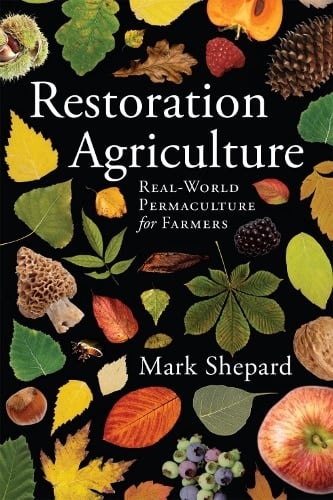
Restoration Agriculture: Real World Permaculture for Farmers is a long overdue call to revolutionize farming as we know it. Mark Shephard shares a vision of renewed soils, diverse ecosystems and healthy watersheds – filled with an abundance of nutrient rich food crops. He begins with some background information on agriculture as we know it, and then progresses to the new reality of permaculture farming – restoration agriculture.
Would you like to save this?
The Rise of Industrial Agriculture
Since WWII, our food crops have been increasingly bathed in a cocktail of herbicides, pesticides and chemical fertilizers. The industrial complex that won the war turned its’ collective might to fighting the insects and diseases that damaged crops. Farmers were told to “get big or get out”. The “Green Revolution” promised to “feed the world” with crops that produced higher yields per acre and genetically modified crops promised pest free fields free of weeds. Industrial agriculture companies such as Monsanto, Cargill and Del Monte vowed to bend nature to the will of man.
The Fall of Industrial Agriculture
The thing is, Momma Nature had other ideas. The megalithic proportioned machines that allow the planting and harvesting of huge monoculture fields compact the soil, forming a dense hardpan under the topsoil that prevents crops from accessing deeper nutrients. The huge fields that stretch for miles and miles through the heartland are ripe for erosion. Indeed, there is very little topsoil left in most of our prime agricultural regions. What soil is left is often dead and lifeless, killed by the herbicides and pesticides. Crops survive only through the application of large amounts of chemical fertilizers, often watered by rapidly depleting aquifers.
The Green Revolution and genetically modified crops were found to only give higher yield with the application of the industrial chemicals, and the seeds from these crops could not be saved from year to year like the heirloom and open-pollinated crops farmers had grown before. Around the world, farmers who had formerly been self-sufficient were now deeply in debt. Suicide rates among farmers have skyrocketed. Read “Monsanto’s GMO Seeds Contributing to Farmer Suicides Every 30 Minutes“.
A New Paradigm – Permaculture and Restoration Agriculture
The time has come to, as Mark put it, “stop trying to grow things that don’t want to grow and killing things that do want to grow”. Permaculture focuses on working with nature instead of against it. There are many variations on this theme, but all work to restore ground cover, protect (and rebuild) topsoil, conserve and clean water, and create a healthy, balanced ecosystem. The majority of crops in the system are perennial, not annual, so they are planted once to produce for many years. The permaculture food production plot is not static. The amount of food and variety of food produced evolves as the plants grow and change.
Animals also have a place in the restoration agriculture system, to help manage diseases and control plant growth, as well as to produce a valuable crop in their own right. Honey and mushrooms represent yet another facet of this amazingly productive polyculture. Instead of growing one crop, such as corn or wheat, from a plot of soil, the farmer can now grow many.
When I first started reading Restoration Agriculture, my initial reaction was, “That is so cool!”, quickly followed by, “Can you really make it work?”. The short answer is, “Yes.” mark has written this book largely based on his own successful experience at New Forest Farm, a 106-acrea commercial scale perennial agriculture ecosystem that was converted from a row-crop grain farm.
The photos of New Forest Farm towards the end of the book are rich and verdant. There is a quiet beauty to the variety of colors (mostly shades of green) and textures. It is much more visually interesting than the unending rows of grains and legumes that cover so much of our countryside. The land speaks to me. It reminds me of my own backyard on a much grander, more productive scale. (For those who aren’t familiar with my garden, you can view photos on the Gardening page.)
If you’d like to hear more in Mark’s own words, you can watch his presentation to a group of organic farmers. It touches on many of the topics included in the book.
I hope you’re as intrigued as I am about diversifying our food sources, healing the soil and providing everyone with healthy food.
I did not receive any money for reviewing this book, only a copy of the book itself.
vital to my lifestyle, trying to learn and live a regenerative lifestyle.
For the life of me, I can never successfully grow radishes. I have tried growing them in raised beds, straight in the garden, part sun/shade, full sun, composted soil, and so many other situations. I thought they were supposed to be one of the easiest to grow. Any suggestions?
Eat something else? 😉
They like cooler temps and plenty of moisture, not too rich soil or they get leaves but small roots.
Working to aquire 18 acres and move toward off grid and self-sufficient. Would love anything you choose to write about that will move is in this direction!!
Very interested in learning all I can about permaculture and implementing the principles on our property.
I’m excited to get my hands on this boom!
We want to incorporate “pigerators” into our system. Also want to expand our orchard. Looking for more information.
I would like to learn more about many thins — gardening herbs, nutrition, and “recycling” back to the earth
My winter project is to set up a small aquaponics system in my kitchen for growing cook herbs and such.
I will be retiring this Jan. I can’t wait to start working on my own permagarden!
I’ve just gotten into gardening the last 2 years, I am working on raising some plants indoors this winter. Would love to win.
Hey
Hey! I’d love to have that book!
Looks like a great book! I would love to hear more discussion on the changing weather patterns and how we can adapt our growing gardenns/farms to them.
I’ll bet this book is totally awesome .. we are interested in raised beds, heirloom seed saving and goats .. the next thing we need to be more self-sufficient is a source of water to access without electricity .. working on that …
I would like to know how to grow soursop plants. Could you please give me some ideas on how to start them from seed (indoors) and what sized pots, type of soil, how deep the soil, and the care of the plant. Thanks!
I love that there is a growing awareness that farming needs to change for the better. I have a big organic garden and I am hoping to get all my neighbors involved in having a neighborhood homesteading movement by each of us doing something like rabbits, chickens, gardening, etc.
I’ve done some research on Monsanto and the practice of using genetically engineered seed for crops. It truly is a win for Monsanto et al, and a definite lose for everyone else. The use of “Round-Up Ready” seed just means that in a year we’ll have an evolution of natural pests that become impervious to the built-in pesticide in ge crops… leading to yet more lethal and dangerous chemical development to poison the earth.
We can’t continue to sustain this trend. As more and more people present with allergies and gut issues from foods produced by genetic engineering, the answer is not to invest in processed foods but to return to the old ways, nature’s ways.
This won’t happen unless and until we all take a united stand against genetic engineering in seeds, and unless and until we all boycott all foods not certified to be non-ge.
I am interested in learning about Permaculture — i.e., returning waste back into the system to recycle.
this is so timely and interesting, we are trying to cope with many of the problems mentioned on our 5 acre farm.
I was just telling my kids that next year I want an enormous garden and do some canning too! So between now and then I want to learn all I can because I have ot had a garden in about 12 years or canned in that long as well. I want to try and get a years worth of food put away before next winter! I can’t hardily wait.