
Restoration Agriculture Review

This post may contain affiliate links. Read my full disclosure here.
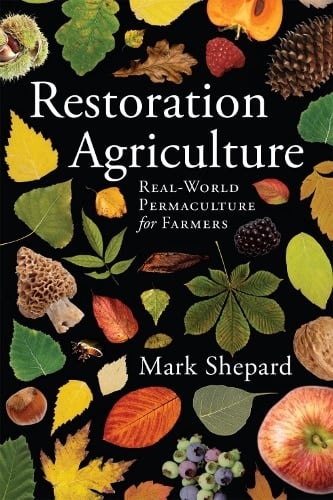
Restoration Agriculture: Real World Permaculture for Farmers is a long overdue call to revolutionize farming as we know it. Mark Shephard shares a vision of renewed soils, diverse ecosystems and healthy watersheds – filled with an abundance of nutrient rich food crops. He begins with some background information on agriculture as we know it, and then progresses to the new reality of permaculture farming – restoration agriculture.
Would you like to save this?
The Rise of Industrial Agriculture
Since WWII, our food crops have been increasingly bathed in a cocktail of herbicides, pesticides and chemical fertilizers. The industrial complex that won the war turned its’ collective might to fighting the insects and diseases that damaged crops. Farmers were told to “get big or get out”. The “Green Revolution” promised to “feed the world” with crops that produced higher yields per acre and genetically modified crops promised pest free fields free of weeds. Industrial agriculture companies such as Monsanto, Cargill and Del Monte vowed to bend nature to the will of man.
The Fall of Industrial Agriculture
The thing is, Momma Nature had other ideas. The megalithic proportioned machines that allow the planting and harvesting of huge monoculture fields compact the soil, forming a dense hardpan under the topsoil that prevents crops from accessing deeper nutrients. The huge fields that stretch for miles and miles through the heartland are ripe for erosion. Indeed, there is very little topsoil left in most of our prime agricultural regions. What soil is left is often dead and lifeless, killed by the herbicides and pesticides. Crops survive only through the application of large amounts of chemical fertilizers, often watered by rapidly depleting aquifers.
The Green Revolution and genetically modified crops were found to only give higher yield with the application of the industrial chemicals, and the seeds from these crops could not be saved from year to year like the heirloom and open-pollinated crops farmers had grown before. Around the world, farmers who had formerly been self-sufficient were now deeply in debt. Suicide rates among farmers have skyrocketed. Read “Monsanto’s GMO Seeds Contributing to Farmer Suicides Every 30 Minutes“.
A New Paradigm – Permaculture and Restoration Agriculture
The time has come to, as Mark put it, “stop trying to grow things that don’t want to grow and killing things that do want to grow”. Permaculture focuses on working with nature instead of against it. There are many variations on this theme, but all work to restore ground cover, protect (and rebuild) topsoil, conserve and clean water, and create a healthy, balanced ecosystem. The majority of crops in the system are perennial, not annual, so they are planted once to produce for many years. The permaculture food production plot is not static. The amount of food and variety of food produced evolves as the plants grow and change.
Animals also have a place in the restoration agriculture system, to help manage diseases and control plant growth, as well as to produce a valuable crop in their own right. Honey and mushrooms represent yet another facet of this amazingly productive polyculture. Instead of growing one crop, such as corn or wheat, from a plot of soil, the farmer can now grow many.
When I first started reading Restoration Agriculture, my initial reaction was, “That is so cool!”, quickly followed by, “Can you really make it work?”. The short answer is, “Yes.” mark has written this book largely based on his own successful experience at New Forest Farm, a 106-acrea commercial scale perennial agriculture ecosystem that was converted from a row-crop grain farm.
The photos of New Forest Farm towards the end of the book are rich and verdant. There is a quiet beauty to the variety of colors (mostly shades of green) and textures. It is much more visually interesting than the unending rows of grains and legumes that cover so much of our countryside. The land speaks to me. It reminds me of my own backyard on a much grander, more productive scale. (For those who aren’t familiar with my garden, you can view photos on the Gardening page.)
If you’d like to hear more in Mark’s own words, you can watch his presentation to a group of organic farmers. It touches on many of the topics included in the book.
I hope you’re as intrigued as I am about diversifying our food sources, healing the soil and providing everyone with healthy food.
I did not receive any money for reviewing this book, only a copy of the book itself.
Some of the best ways to restore our agriculture is to grow our own food as much as possible, buy as much as we can from local farmers whose practices we know, and not to buy processed food (which only supports Big Ag). Our dollars are the best way to change things!
I would love to know if this kind of thing can work in a suburban garden–and if so, how?
Hi Adrienne – check out this video clip from Geoff Lawton. He’s the founder of the Permaculture Research Institute in Australia. Small scale suburban permaculture in a tiny backyard — 80 medicinal plants, 30 fruit trees, 70 kilos of vegetables, vertical wall growing, 161 kilos of fruit, 22 varieties of berries on 640 SQUARE FEET.
http://www.youtube.com/watch?v=XrSlnKFLkFY
I love my garden and love reading on anything permaculture. Want to learn more about the ins and outs of beekeeping in the future. Maybe also growing fruit trees.
Can this form of agriculture be adapted to a backyard garden?
My husband and I are working toward finding a house for sale with enough land for a good size family farm. My biggest question is really just how to get started once we find a place. What are the most important factors to consider when starting out?
This book sounds like it’s exactly the information I have been looking for!
The more I learn, and the more I garden in my own yard the more important this becomes to me. Yes, people need to be fed but not at the cost of poisoning them over the long haul!
I don’t have a suggestion this is exactly what I’ve been interested in learning about. Thank you for the opportunity to win this great prize. Good luck everyone.
Sounds like an interesting read. We just moved and are in the process of building another garden.
I am interested in planting a perennial fruit garden using permaculture methods this coming year. What are some good ways to effectively keep weeds at bay?
Jenn, one way I like to keep weeds at bay is to plant some other kind of ‘weed’ there that will overpower them, like dandelion, mint, or some other beneficial herb that is a strong grower. It depends on what kind of weeds you’re trying to control, but there are great resources on all the ‘edible weeds’ for your region that are extremely hearty. Or cover crop (green manure) plants like clover. These naturally fix nitrogen directly into the soil to fertilize your other plants.
It makes for a little bit messier of a garden, but it can increase the biodiversity, production, and output of your available planting area.
I have gotten a lot of useful info from your blog. I have a small farm with chickens and goats and a large garden, all raised organically. This book would be such a great tool to help me enrich my farm. Thank you for offering this chance to win one.
I have heavy, clay soil and every fall I add leaves and other organic materials to my garden plot. I feel like I have been doing this for years now and my soil is still very heavy. How much organics do I need to add to my soil to get it more loamy? Is there anything specific I could add to lighted it up? Thanks for your help with this.
Kathleen – i’m not sure from your comment how much land you’re managing, but you may want to try a completely different approach with a section of it. The “Back to Eden” method has worked in similar situations with challenging soil from too much clay, or too much stone that was just impossible to remove.
http://vimeo.com/28055108
You could also try a hugelkultur bed – the methods are linked at the bottom of this article:
http://highlyuncivilized.com/2012/01/15/why-you-should-help-paul-wheaton/
My husband really wants to produce our own strawberries. As a family of 8 we go through over 120 half-pint jars of strawberry jam a year, not to mention the fresh ones we eat. Commercial growers plant new plants every year. Is this necessary for the home grower? And how much land would it take to produce enough strawberries for us?
Are there ways to keep grubs/root worms from being in the soil? Naturally? Thank you for the chance to win this
This book looks really interesting to me. I just began gardening and because my land is mostly sand and rock I “built” my raised beds soil from a recipe I found on a sustainable organic farmers website. In my ignorance I learned something very cool. I have kale and Swiss chard plants that are four years old. Each fall I dig them up, put them in pots and store them in a sunny window in my garage where the temp never gets below ~45 degrees. They keep producing very well for me. I could not just rip them out because they were still producing and did not want to leave them in the ground as I am from Michigan and we have some pretty tuff winters. Turns out we have a symbiotic relationship. 😉
I am interested in gardening with chickens – what healthy plants can we put in the chicken run to make the chickens happy and pretty it up. At some points, our run looks like mudville. Gross!
Very nice! thanks for the opportunity!
Driving through Nebraska on a road trip a couple of years ago, my hubby and i saw the miles of corn fields. It almost broke my heart, it was so unnatural and even eerie. No towns, no houses. Just corn, as far as the eye could see. There’s got to be a better way – thank you for promoting this book. It sounds fascinating.
Sounds like a good book, hope I win
Truly you have great giveaways! 🙂 Thank-you for all that you do~!~