
Old-Fashioned Potato Bread Recipe with Real Mashed Potatoes

This post may contain affiliate links. Read my full disclosure here.
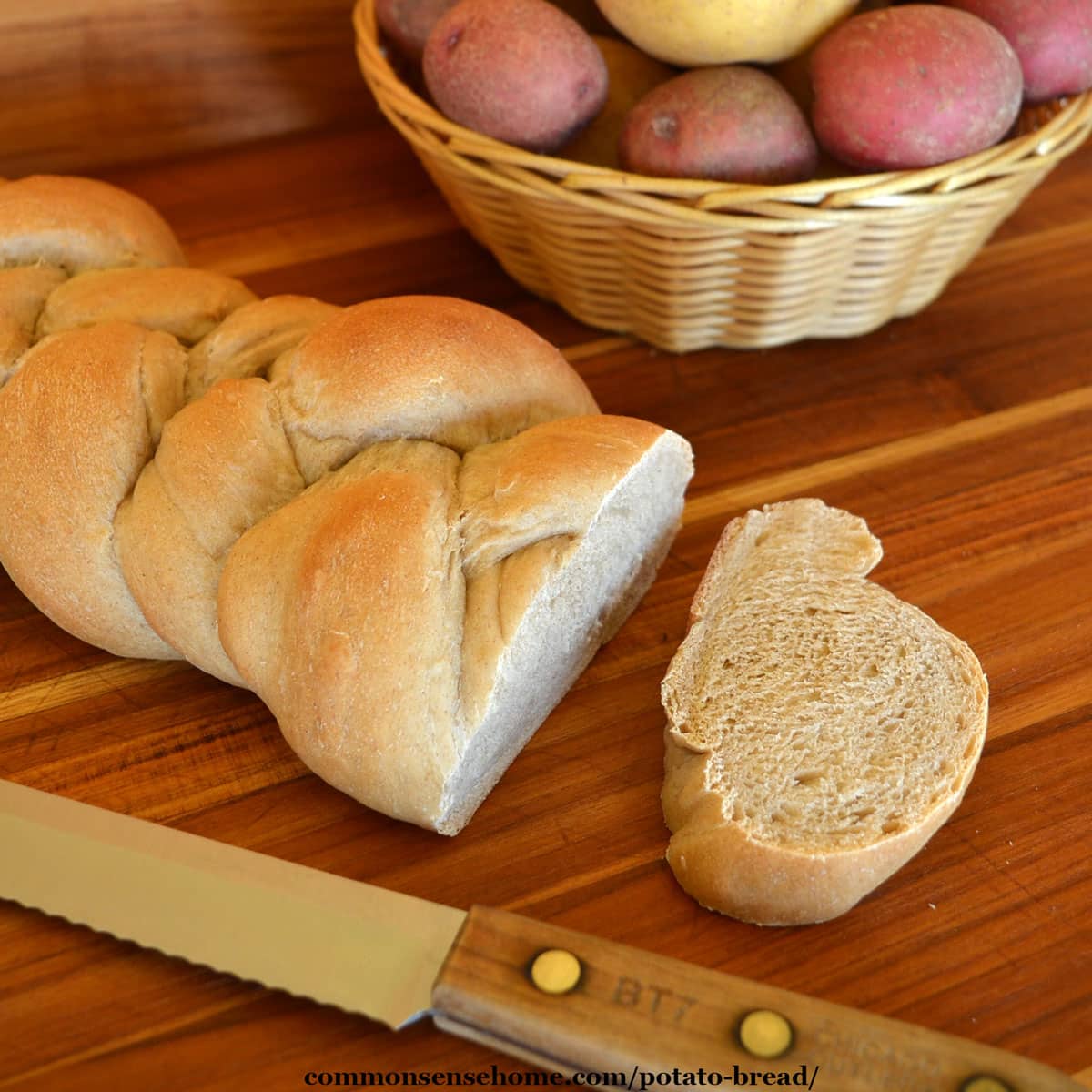
This old-fashioned potato bread recipe is made with real mashed potatoes for soft, flavorful loaves that stay fresh for days. When we were first married, my husband liked store-bought potato bread — the kind that’s almost fluffy like cotton candy. Once we tried making this version with real potatoes, we never looked back.
All you need to do is combine mashed potatoes, warm water, butter, sugar, salt, flour, and yeast, then knead until smooth and elastic. Let rise, shape into loaves, and bake at 350°F until golden brown. The result is tender homemade bread that’s perfect for sandwiches, toast, or dinner rolls.
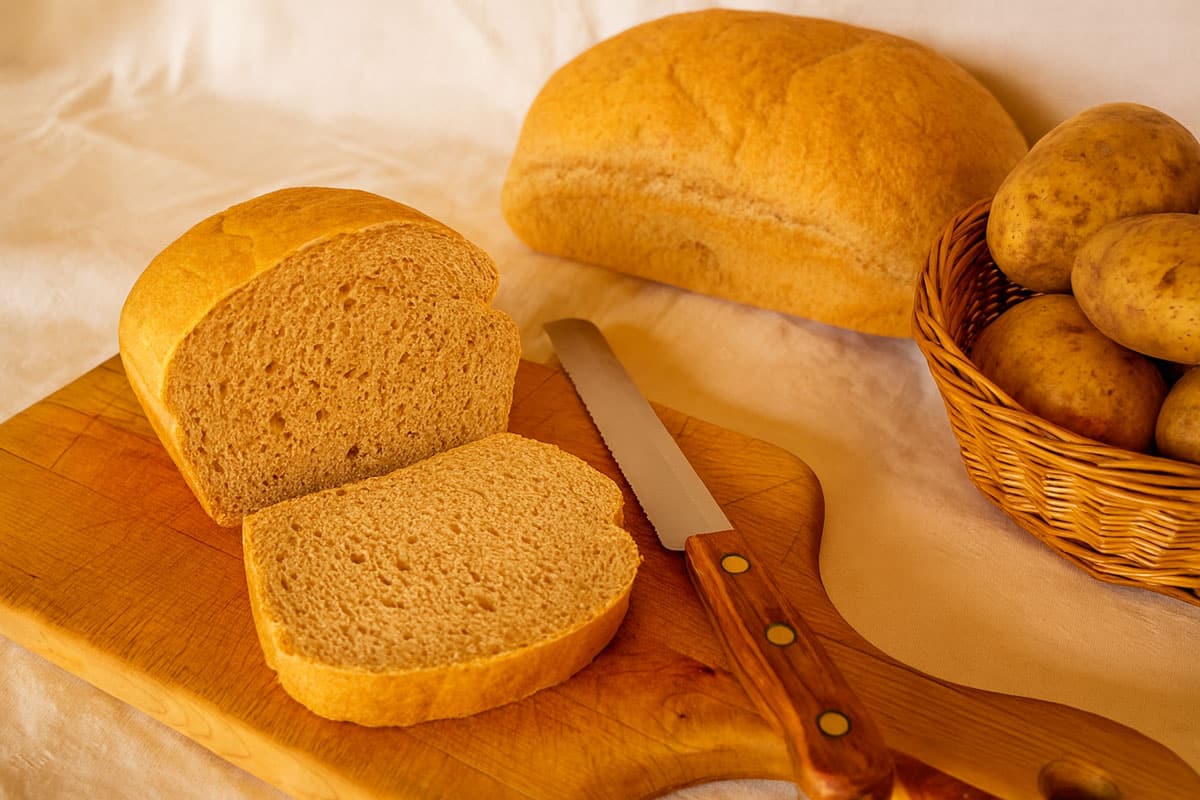
Table of Contents
How to Make Potato Bread
Skip the boxed flakes — this recipe uses real mashed potatoes for a soft crumb and rich, buttery flavor. The natural starch in the potatoes helps the bread stay moist, so it keeps well on the counter for several days or freezes beautifully for later.
Ingredients
- 7 ounces cooked potato (you can use leftover mashed potatoes, or cook up a small potato and mash it)
- Warm water, enough to equal 1 3/4 cup when combined with the potato.
- 2 tablespoons softened butter
- 2 1/2 tablespoons sugar
- 1 teaspoon sea salt
- 3 1/2 cups bread flour (I usually use a mix of fresh ground and pre-milled flour)
- 1 1/2 teaspoons SAF-instant yeast or bread machine yeast
Tip: If I’m using leftover mashed potatoes, they go right into the bread with butter, milk, salt and pepper. It all blends nicely into the dough.
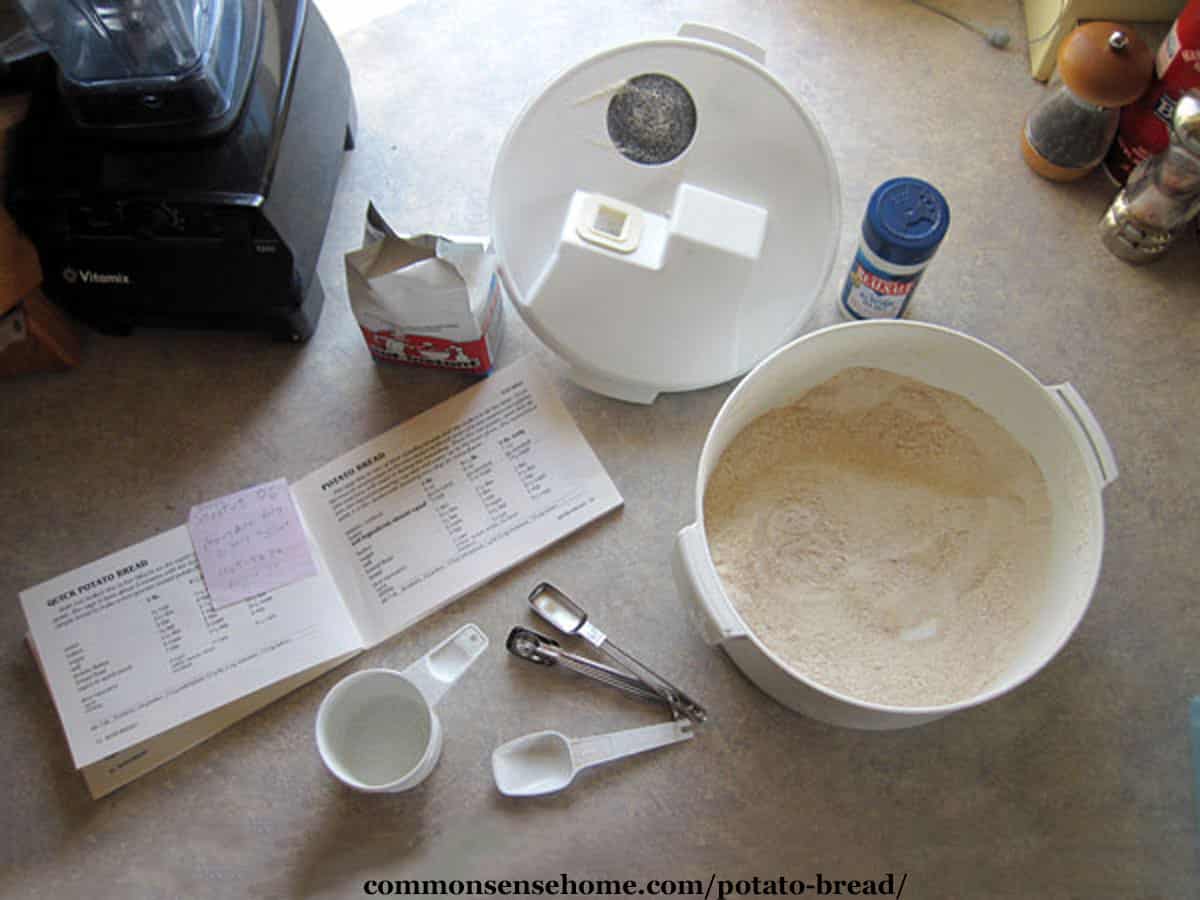
1. Mix the Dough
Mash or measure your potatoes, then add enough warm water to reach 1 ¾ cups total. Combine with butter, sugar, salt, flour, and yeast.
If using a stand mixer or Bosch Universal Plus Mixer. knead with a dough hook for 6–8 minutes, adding flour gradually until the dough is smooth and elastic.
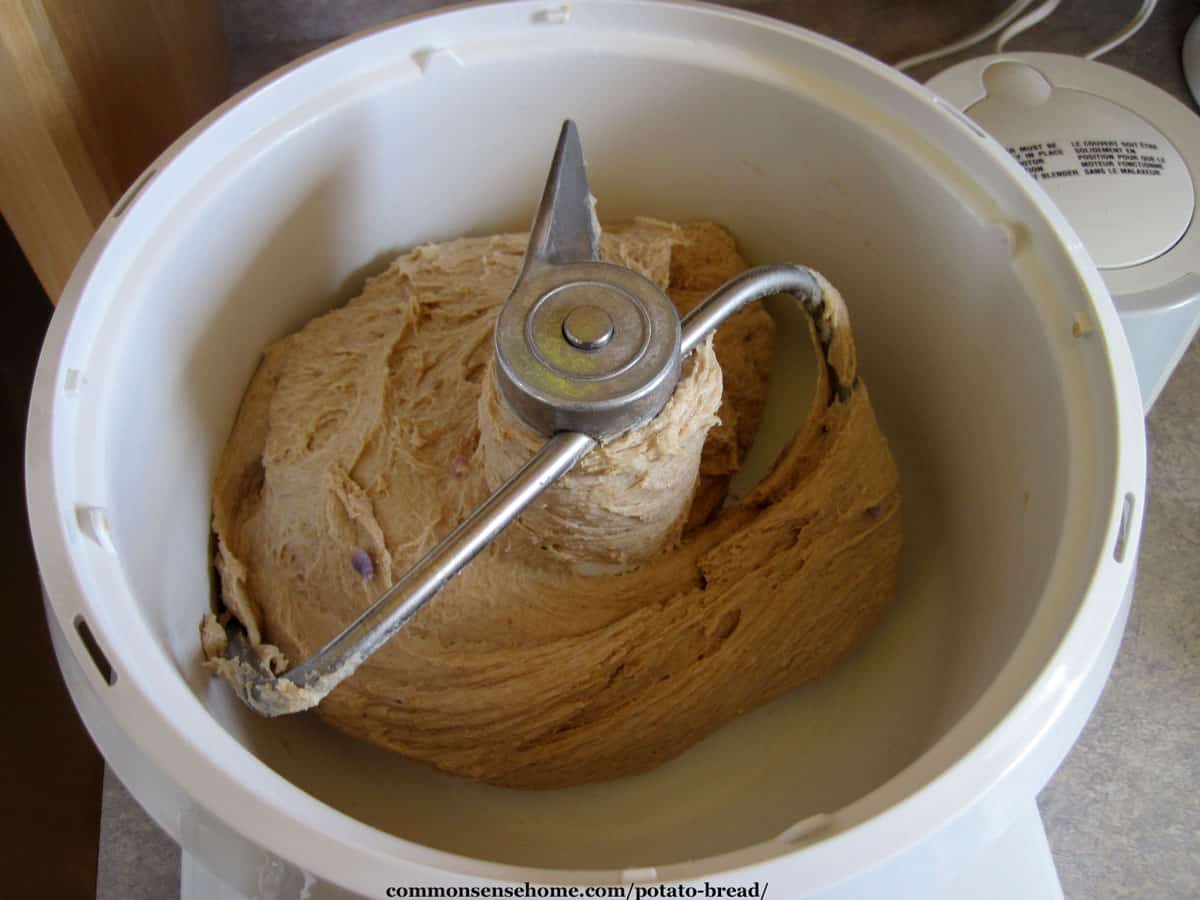
If kneading by hand, mix the wet ingredients with yeast in a large bowl. Then stir in flour until you have a soft, slightly sticky dough. The dough should feel tacky but not wet — over-flouring makes bread dry and dense.
This dough will be a little bit more sticky than many bread doughs. This is normal. If you look closely, you can see little bits of brightly colored blue potato.
(I finally bought a Bosch after killing three different bread machines. It’s more expensive, but can handle double batches of whole wheat bread without a fuss, unlike lighter machines.)
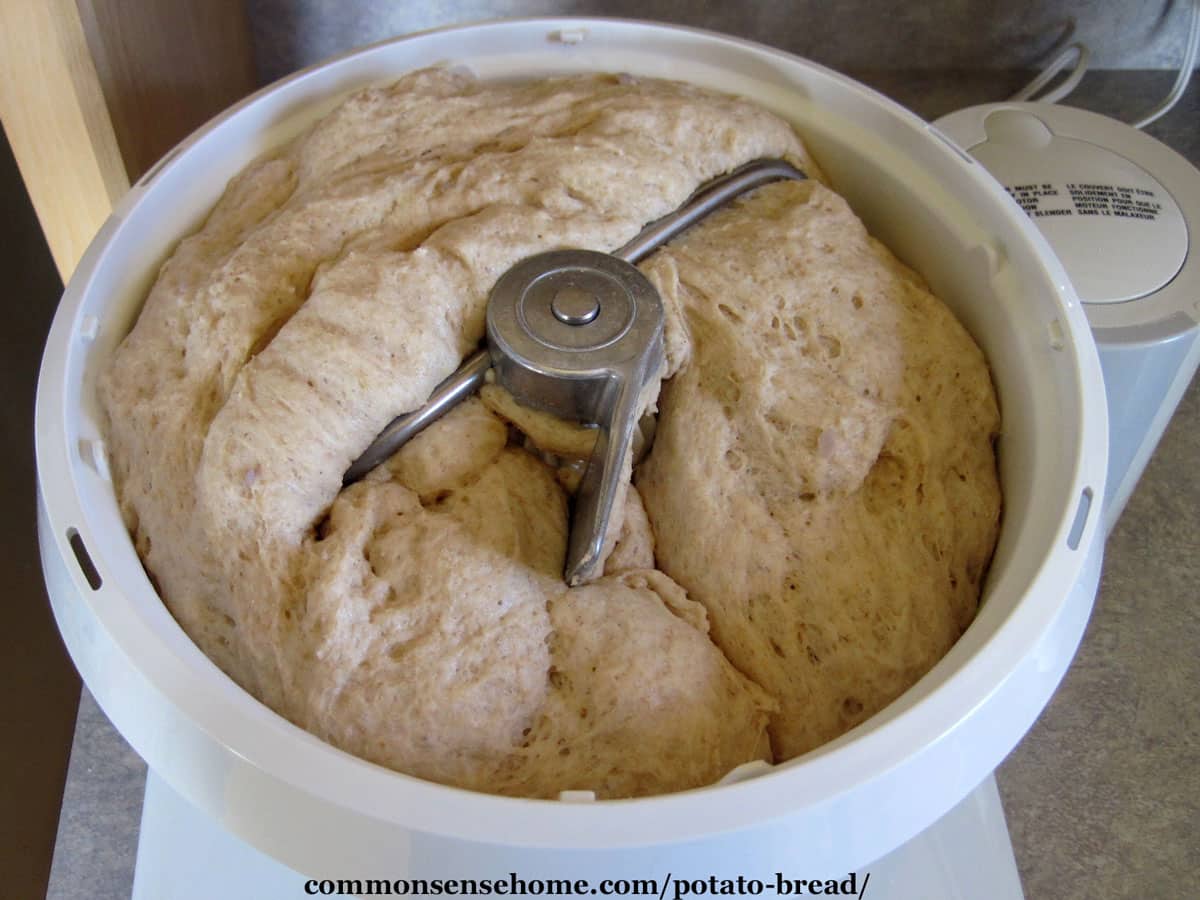
2. Let it Rise
Cover and let rise about 20 minutes, then punch down and let rise again until doubled.
This two-step rise develops the gluten and deepens the flavor.
3. Shaping and Baking
Form into loaves and place in greased pans.
- One recipe makes one large (9×5) or two smaller loaves.
- For a double batch, divide into three 9×5 pans.
My favorite bread pans are the Pampered Chef Stoneware loaf pans. They are naturally somewhat non-stick, but not entirely. I do grease them a little, but bread tends to stick much more frequently in the glass pan than the stoneware.
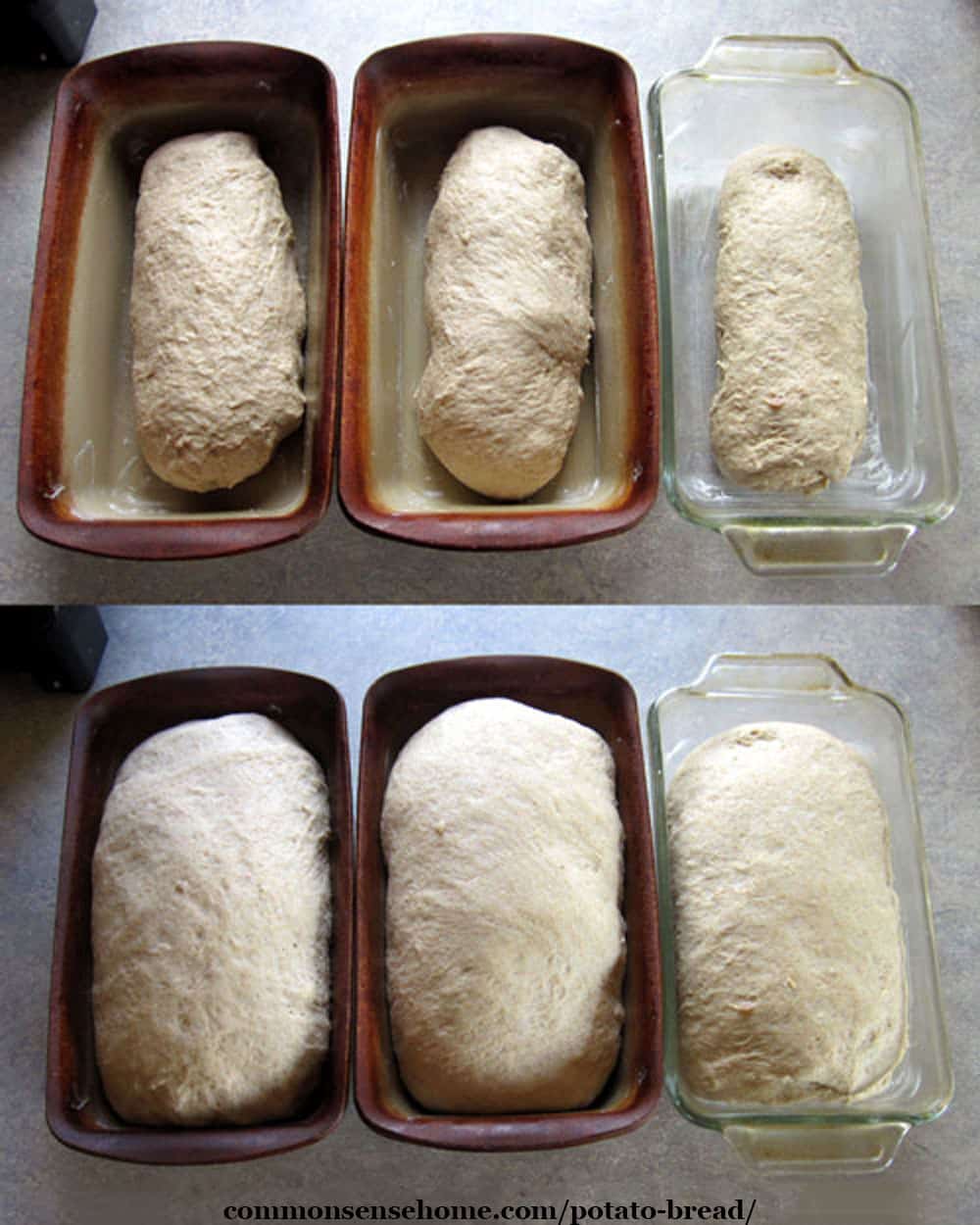
Let the dough rise until nearly double in size. Preheat the oven to 350°F and bake 25–30 minutes, until golden brown. Remove from pans and cool on wire racks before slicing.
Cutting too soon releases steam and can dry the loaf. If your family devours the entire loaf hot from the oven, it doesn’t really matter.
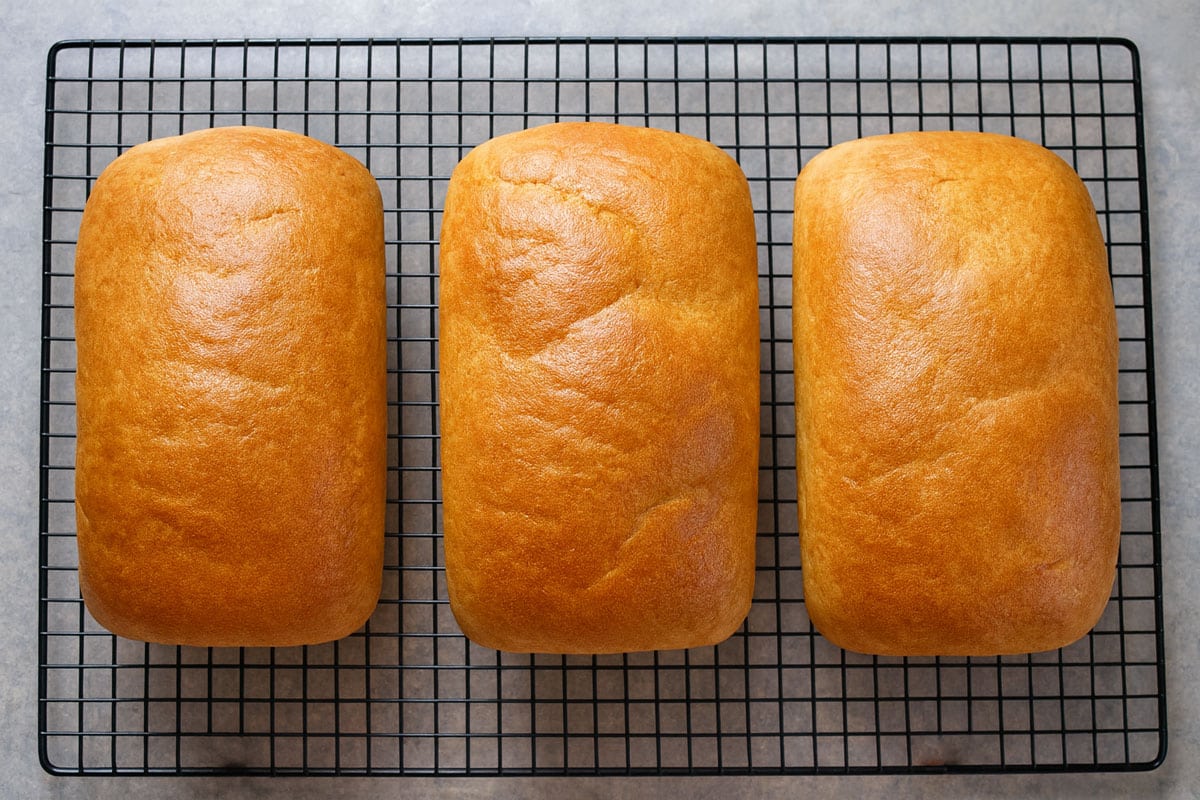
Remember, bread will rise a bit in the oven, so bake before it is overflowing the pans. (And don’t get involved in another project and forget about your bread…)
Storage and Freezing
Potato bread keeps well at room temperature for 4–5 days in a bread box or paper bag. For longer storage, freeze cooled loaves or rolls in airtight bags for up to 3 months. To serve, thaw at room temperature or warm briefly in the oven.
Would you like to save this?
Variations
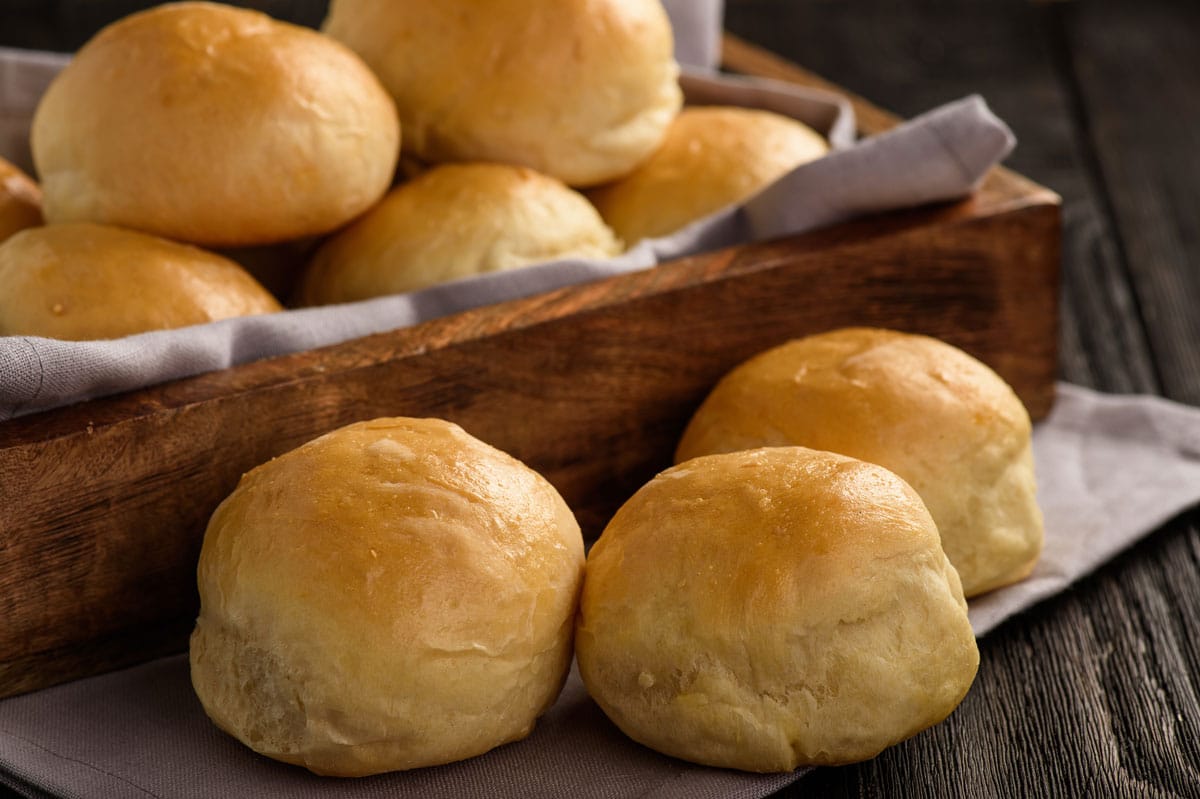
Potato Bread Rolls
Divide the dough into roll-sized portions and place on a greased or parchment-lined baking sheet. Set close together for soft sides or farther apart for individual rolls. Let rise until doubled, then bake at 375°F for 12–15 minutes until golden.
Bread Machine Directions
Add ingredients in the order your machine recommends. Select the wheat, sweet, or white bread cycle. Do not use a delayed bake timer — the potatoes can spoil if they sit too long.
Using Active Dry Yeast
Substitute 2 teaspoons active dry yeast for instant yeast. Proof in one cup of warm water before mixing with the rest of the ingredients.
Recommended Bread Baking Supplies
Some of my recommended bread making supplies and equipment:
- King Arthur Organic Bread Flour – gives reliable structure and flavor
- Nutrimill Grain Mill – for home milling of fresh grain
- Bosch Universal Plus Kitchen Machine – a real workhorse in the kitchen
- Pampered Chef Stoneware loaf pans – bake evenly and release cleanly
- Nordic Ware Large Cooling Racks – sturdy and easy to clean
More Homemade Bread Recipes
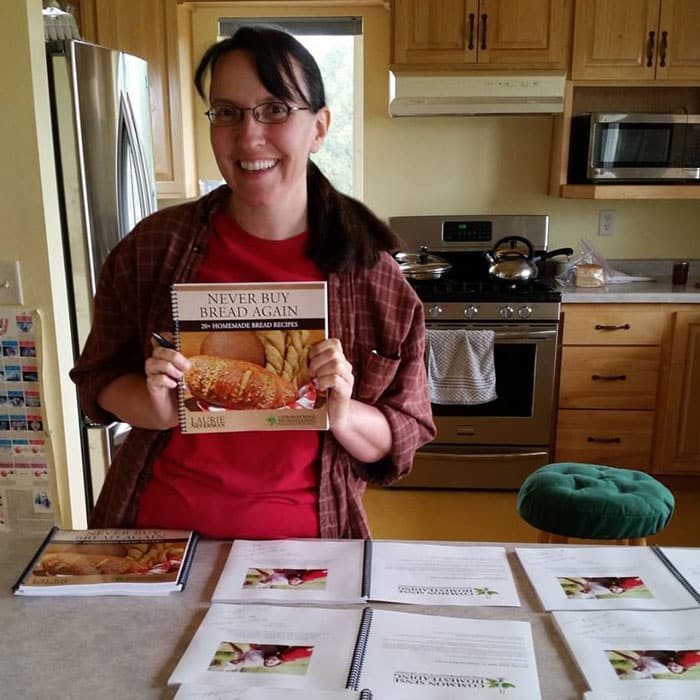
If you enjoy this old-fashioned potato bread recipe, you’ll love my book, Never Buy Bread Again: 20+ Homemade Bread Recipes!
Learn more and order your copy here.
Inside you’ll find:
- Everyday sandwich and crusty breads
- Sourdough and quick breads
- Gluten-free options
- Storage and freezing tips
- Fun extras like flavored butters and fondue recipes
The book includes full color photos, and stories from our family about the recipes and baking traditions. It has a spiral binding so that it lays flat on the kitchen counter for easy reading while cooking. My sons started baking bread when they were about ten — if they can do it, you can too!
PrintPotato Bread Made with Mashed Potatoes
A tender bread made with real mashed potatoes. Great for sandwiches.
- Prep Time: 1 hour
- Cook Time: 25 minutes
- Total Time: 1 hour 25 minutes
- Yield: 2 loaves 1x
- Category: Bread
- Method: Baking
Ingredients
- 7 ounces cooked potato
- Warm water, enough to equal 1 3/4 cup when combined with the potato (Put the mashed potato into a 2 cup measuring cup. Add water to bring the level up to 1 3/4 cup)
- 2 tablespoons softened butter
- 2 1/2 tablespoons sugar
- 1 teaspoon sea salt
- 3 1/2 cups bread flour
- 1 1/2 teaspoons SAF-INSTANT yeast or bread machine yeast
Instructions
If mixing by machine:
-
Add everything into the machine and mix for 6-8 minutes, adding additional flour if needed. Make sure add the last of flour slowly – you want the dough to be smooth and elastic. Too much flour will give you hard dough and dry bread.
If kneading by hand:
- Mix wet ingredients with yeast until thoroughly blended, then add dry ingredients, adjusting flour as needed to give a soft, elastic dough. This dough will be a little bit more sticky than many bread doughs. This is normal.
After mixing the dough:
- Let bread rest and rise for around 20 minutes, then punch down and allow to rise again.
- Once doubled in size, form dough into loaves and place in greased bread pans. A single recipe makes one large loaf or two smaller loaves. I usually divide the dough into two 9×5 pans, or make a double batch and divide it into three regular loaves.
- Preheat oven to 350F. Bake for 25-30 minutes, until golden brown. Remove from pans and cool on wire racks.
- Store in sealed container and use within a few days or freeze for longer storage.
Notes
You can use leftover mashed potatoes, or cook up a small potato and mash it.
If baking in a bread machine, select “wheat”, “sweet”, or “white bread” setting. Do not use a delay timer.
You may substitute 2 teaspoons active dry yeast (for SAF-INSTANT yeast) and proof in one cup of the warm water prior to mixing the dough.
What goes better with homemade bread than homemade soup?
We have dozens of made from scratch recipes on the site, including:
- Chicken and Gnocchi Soup (Olive Garden Style)
- Cheesy Broccoli Soup with a Surprise Ingredient
- Cheese Soup with Homemade Bread Bowls
We hope you enjoy this potato bread as much as we do!

This article is written by Laurie Neverman. Laurie grew up in the kitchen, learning baking and home cooking from her momma. At age 15, she and her mom and two sisters created Irene’s Custom Cakes & Catering. This was her summer job through most of high school and college.
Originally posted in 2011, updated in 2019.
great recipe good use of leftover potatoes
Hi! I was wondering if the 7 ounces of potato is by weight or by volume. I’m looking forward to trying this!
I opt for volume, since my measuring cups are easier to access than my kitchen scale.
Great, thanks!!
You’re welcome. Enjoy the bread.
I live alone and bake my own bread. This recipe is wonderful! I have made it 3 or 4 times now. I have a question. Can I make this single recipe and make 3 small loaves out of it? And what would the cooking time be reduced to? 3 loaves will let me freeze 2 loaves and keep one for right away. I don’t eat the two loaves fast enough and I thought to break it down to 3 might cut down on waste. Thanks for a great recipe!
There’s no reason you can’t divide the dough any way you like, even making buns out of it. I haven’t made loaves that small, but I think around 15-20 minutes of bake time should do the trick.
Hi Laurie, Thanks for this recipe! I was looking for a bread that used up mashed potatoes, and here it is. One question — I’ve just made my dough and let it sit for 20 minutes, and I’m not seeing any rise at all. My kitchen isn’t particularly cold. Should I have warmed my water and/or proofed the yeast first? And if the answer is “yes,” is there any way to salvage it now?
Thanks!
If you used instant yeast, proofing isn’t necessary. I do try to use warm ingredients to encourage rising. (I will add that to the post. I always warm my liquids for bread baking, so I didn’t think to mention it.) The yeast should kick in if you put it in a warmer area. You could set your bread bowl in a sink of warm water, or turn your stove on love and set the bread bowl somewhere on or near it.
I had to add a 1/2c warm milk to the recipe because I live in a dry climate and the dough was way too dry. It worked. But I am baking it in the oven but NO temp for the oven and NO time to bake. I like that you use real mashed potatoes and not instant flakes
Yes, sometimes recipes need to be adjusted based on local conditions. I hope it works well for you. BTW, the URL entry to leave a comment is for those who have websites and want to leave a link to them.
I don’t have a bread maker, can i still make this?
Sure, just mix by hand as you would any other bread dough.
Thank you for sharing such a great recipe! Made it yesterday and everybody in my family loved it.
I did not have leftover mashed potato so instead I baked 2 small potatoes in the microwave and mashed them. When recipe calls to add water to 1 3/4 cup I mixed it with milk to bring it closer to the taste of mashed potatoes. Put everything in the bread machine, baked on Sweet option with Medium crust and we got a delicious loaf of perfect potato bread.
Thanks for sharing your experience!
Made this tonight with leftover mashed potatoes from Christmas. It was absolutely delicious. I didn’t change anything. Mixed in breadmaker, then baked in oven.
Yeah! Glad it worked out well.
Made this yesterday – what a lovely loaf! No need to change a thing; this one’s a keeper!
Hi, I want to try this potato bread. It has been YEARS since I made bread. We do not eat a lot of store bought bread (I have Crohn’s so I try to avoid it…But I love warm bread with butter and I miss it). My question is: do you let the dough rise twice. Once after punching down and then again when it is shaped and put in the loaf pans?? I wasn’t quite clear on that part. Thank You for sharing
Yes, the dough does rise twice, once after being punched down and once after being shaped in the pans. This helps to create a light and tender crumb.
Oh my goodness.. this is so good.. wow!! It’s a winner here 🙂 I’m wanting to look at the all potato bread too, as I’m trying to get farther away from so many grains, but wow.. I did do some tweaking though 🙂 Here’s what I did.. I didn’t use butter, but coconut oil, so no dairy here. Then I used one cup (out of the 3 1/2) of ground millet. The rest I used organic wheat. And because I used to make bread all the time.. but have gotten out of the habit of it, I thought about making one of our favorites.. herb. So, I added some black pepper, oregano, thyme, and a little caraway seed too. To add a little bit of a nutty flavor and just to see how it would taste (I like to play in the kitchen) I used some nutritional yeast also.. everything else you had on the list, I did the same. I used my hand mixer with dough hooks, which went really fast.. (awesome.. really) and then did the one rise, punch down and put it in one large pan because.. I had a feeling it would not last long haha.. The bread rose wonderfully and smells and tastes fantastic. 🙂 I have another idea I’m going to try, I’ll let you know when I do. I’m going to try sweet potato (the white flesh kind which is sweeter) and swirl some cinnamon in it and add about 1/2 cup of raisins. Not sure yet, but thinking about adding a few nuts too. I’m hoping it comes out as a sweet bread with that wonderful cinnamon too.. we eat a lot of sweet potatoes, so that would be easy. Thank you!!! 🙂
Ooooo…yummy! Thanks for sharing, that sounds great!
I made this using almost a cup of potatoes and then adding milk to make 1 1/4 cup. Then I added the water to make it to 1 3/4 cup. The rest I left the same and put it all in the bread machine. It was awesome and I made another loaf right away because I couldn’t stop eating it!
Sounds great!
Thanks for this! I accidentally let a bunch of raw potatoes freeze and am hoping I can save them from the trash by turning them into bread. I’ve got three loaves of this in my oven right now and it smells wonderful!
Hmmm…they might be a little sweet, but hopefully it will work.
It did work. I’m amazed. They are delicious!! http://www.simplifylivelove.com/2013/01/whole-wheat-potato-bread.html
Woot! The potatoes do a great job of keeping the bred moist. 🙂
nom! I do love a good potato gnocchi too. Have you ever made potato candy? It’s really nothing more than potatoes, peanut butter, and sugar, so you know… super healthy… but it’s an option for your leftover spuds too.
mmmm…gnocchi. Now that it’s cooled off, I’ll have to make some chicken and gnocchi soup again soon – https://commonsensehome.com/chicken-and-gnocchi-soup-olive-garden-style/
I’ve had potato candy before, but what I had was not my favorite. I rather eat the bread. 🙂
This is the best bread ever!!!!!!! I mixed the ingredients in my bread machine and put it on the dough cycle, then I took the dough out and let it rest for 20 minutes. Then I put the dough into 2 loaf pans and let rise until doubled and baked them in the oven. The bread was soft and it stayed soft. This is the only bread recipe that I will use. I did freeze one loaf and when I thawed it out it tasted like I just made it 🙂 YUM! YUM!
Glad you enjoyed it. It is one of my favorites for staying moist, and freezes well for me, too.
Well, I got real excited when I saw the title til I got to the ingredients. I cannot do any type of wheat or gluten.Do you have any suggestions for substitutes to make this bread?
Sherry – I haven’t tried this GF, but here’s a recipe for gf potato bread that doens’t have some of the weird ingredients of others – http://www.cookingbread.com/recipes/gluten_free_bread/gluten_free_potato_bread_recipe.html
Potato Gluten Free Bread Recipe: Makes 1 loaf
Ingredients
1 large boiled potato
2 eggs
1 1/4 cups water
1/4 cup melted butter
1 teaspoon vinegar
2 tablespoons sugar
2 cups rice flour
1/2 cup tapioca flour
1 cup potato flour
1 1/2 teaspoons salt
2 teaspoons powdered gelatine
1 tablespoon xanthum gum
1 1/2 tablespoons active dry yeast
Method
Boil a potato till cooked. Drain and cool in cold water. Peel the potato and mash. You want to make sure there are no lumps in the potato. Whisk together the eggs and the water together and add to the breadmaker. Add in the melted butter, vinegar, sugar and mashed potato. In a bowl mix the flours, salt, gelatine and the xanthum gum together and stir. Add the flour mixture to the breadmaker. Sprinkle the yeast on top. Set the breadmaker to basic, 2 lb. After the bread is cooked allow to cool in the breadmaker for 10 minutes before removing. Cool on a rack.
You should be fine, as most bread machine cookbooks I've seen specify 3-4 cups of flour. I just like to bake mine in two smaller loaves and then freeze one.
I just added everything to the machine. BUt just realized that it is not clear if this is for two loaves or one. Please advise. I have a large bread machine and it should be fine, but am concerned that it may overflow?
I did my undergraduate studies at UW-Superior – that's where I met my husband. 🙂
I've been cutting back on grains, but like you, I still keep family memories (and recipes) alive in the kitchen.
This looks really good! I just found your blog today. My husband grew up in Superior, so I know that neck of the woods. I love your thoughts. I grew up on a farm and had grandparents born around the same time as the depression too. Everything growing up was from scratch at their house, even after they moved to town. I miss those days, but try to keep the memories alive by doing as much as I can by scratch at home.
Ladies – if you try the recipe, please consider leaving me a note to let me know how it worked out for you, and if you'd suggest and "tweaks" to the recipe.
Hello Laurie, I’m going to give this recipe a try today. However, I was just curious on why you don’t just let the bread cook in the bread machine vs cooking it in the oven? Will it come it any different or won’t cook right?
I usually make a double batch at once now that I have the Bosch, so I can bake less frequently. Also, in the years that I used a bread machine, I was never as happy with the crust from a bread machine versus the crust when it’s oven baked. If you wanted to do a single batch on your standard baking cycle, it should work just fine.
Thank you for the recipe. I will give it a go!
This recipe sounds good, my hubby also is a fan of potato bread, I will have to give this a try. Thanks~April
Brigid – I would have thought you'd have a potato doughnut recipe, or maybe you'd make up some potato cakes with extra BACON. 😉
Mary – It's the best recipe I've found for this type of bread, so I hope it works out well for you, too.
Heidi – sounds like a winner!
Wow. This is a recipe I can hardly wait to try. My hubby loves mashed potatoes and potato bread. I love whole wheat so we can both be happy. Thanks.
I am super happy to see this post. I used to adore potato bread. I love that you made it with whole wheat too! Can't wait to try this.
That looks wonderful. Now, something other than lefse to make out of potatoes!