
Deer Fly Repellents – Natural Ways to Get Rid of Deer Flies

This post may contain affiliate links. Read my full disclosure here.
Deer flies are aggressive, painful biters that can turn a peaceful walk or day in the garden into an itchy nightmare. In this article, we’ll explore effective repellents and practical solutions for how to get rid of deer flies around your home and garden—using natural methods whenever possible.
Would you like to save this?
Table of Contents
What Attracts Deer Flies?
Like mosquitoes, deer flies are attracted to carbon dioxide from breathing. They’re also attracted to dark colors, warmth, and motion. They tend to go after the tallest moving object – which we can use in our favor.
Start by wearing light colored clothing and hanging out with taller people. (Mostly joking on the tall people part.) Protect your head, and limit exposed skin with long sleeve shirts. If you’re on a patio, set up a fan to help blow them away.
Best Deer Fly Repellents
Results are mixed on whether DEET based insect repellents actually repel these pests. Some people swear by applying real vanilla extract (not imitation) to exposed skin as a natural deterrent. Another option is essential oil based repellents.
Some essential oils commonly used as insect repellents include:
- Eucalyptus
- Catnip
- Lavender
- Pepperment
- Lemongrass
- Citronella
- Rosemary
- Thyme
- Tea tree
Homemade Deer Fly Repellent
To create a homemade deer fly repellent:
- Fill an 8 ounce glass spray bottle ¾ with alcohol or witch hazel.
- Add 10 drops essential oil, and enough distilled water to fill.
- Shake before use.
- Avoid using eucalyptus, peppermint, or lemongrass with children under 10.
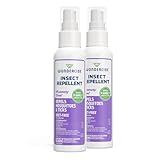
You can also buy ready made repellent sprays.

How to Get Rid of Deer Flies
Controlling these pests can be challenging, especially if want to avoid toxic chemicals.
The larvae start their life cycle in the mud of wet areas, such as ponds, streams, or wetlands. Eliminating standing water around the yard reduces breeding areas. Mowing tall grass and weedy areas also reduces habitat.
We have a LOT of bug eating wildlife in our yard, so they are part of our control strategy.
Natural predators of deer flies include:
- frogs
- toads
- spiders
- wasps and hornets
- dragonflies
- birds, such as killdeer and cowbirds
We have ponds and semi-wild areas, so it works better for us to encourage deer fly predators. Since I originally wrote this article in 2012, the natural predators have significantly reduced our deer fly problems. My youngest was able to stop wearing his feathered cap.
Deer Fly Traps
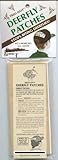
There are several different types of deerfly traps. Deerfly patches stick onto your hat to trap the little buggers. The patches might also work on a pant leg or wrist if the flies are really bad.
Use larger sticky traps for biting flies near your barn, stable or campsite. Hanging blue cups coated in Tangle-Trap or similar sticky substance has been shown to attract and trap deer flies. Blue mimics animal movement, and the stickiness keeps them from flying away.
Using Height to Get Rid of Deer Flies
My youngest complained about deer flies every time he mowed the yard. They dive bombed his eyes and circled his head.
Years ago, my husband told me a story about when he was a Boy Scout. They were traveling through a swampy area in Canada, being plagued by deer flies.
Their guide plucked a muddy fern and set it on top of his hat. The flies started circling the fern instead of his head. The rest of the troops followed suit, and they were one their way without flies in their faces.
We’re short on ferns around here, but do have peacock feathers. I took my son’s hat, and taped on feathers to create his personal deer fly distraction. Sure enough, the feather kept the flies away from his head.

If you’re short on feathers, even wearing a hat will help. Our menfolk favor boonie hats.
Tom B. shared another handy option on our Facebook page for those who drive tractors:
“My uncle has a cattle ranch in Canada. The land is completely flat, and he’s plagued with deer flies when he’s out on his tractor.
His trick is tying a red rag to a tall plastic pipe strapped to his tractor. It always works. They go after the tallest thing around.”
Where do Deer Flies Live?
The females lay their eggs in mud, so swamps and wet lands are some of the most likely spots to get bit.
That said, they also make themselves at home around livestock, campgrounds, and open fields. They like anywhere there’s a meal nearby and somewhere to lay their eggs not too far away.
Deer fly season peaks in June/July in most of their range. They are common throughout most of the United States and Canada.
Do all Deer Flies Bite?
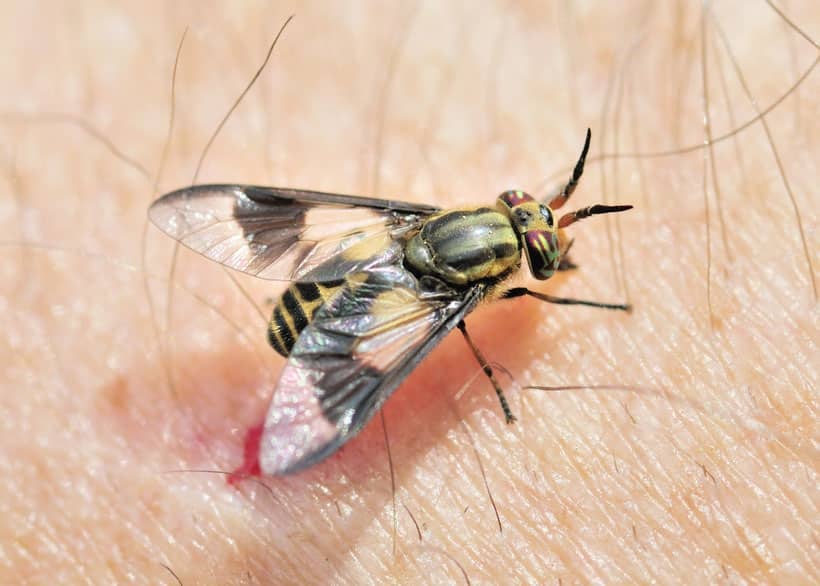
The females are the guilty parties. They’re after your blood, and their bites really itch. The males feed on pollen and nectar from plants.
Deer flies tend to go for the head and upper body, whereas horse flies like to go for the legs. They are about 1/4″ to 1/3″ (6 -8 mm) long. Horse flies are about 2-3 times the size.
Deer fly saliva contains an anti-coagulant, which means the bites keep bleeding for a while. They can cause an allergic reaction for those who react to anticoagulants. The bites will swell and itch, so it’s important to keep kids from scratching to prevent secondary infections.
Check out “Deer Fly Bites – Why They Hurt, Avoidance and Natural Relief” for treatment tips.
More Natural Pest Control Tips
- Natural Tick Repellents and Easy Tick Control Tips
- How to Get Rid of Ants Naturally
- Natural Spider Repellents – 8 Ways to Get Rid of Spiders
- Natural Mosquito Repellents – Recommendations & Recipes
- How to Get Rid of Mosquitoes – Effective Natural Solutions

This article was written by Laurie Neverman. Laurie lives with her husband and sons on 35 acres in northeast Wisconsin. They turned an abandoned pasture into a permaculture oasis, with two ponds, food forests, annual gardens, and more. She enjoys wildcrafting, ducks, and good books.
Originally posted in 2012, last updated in 2025.
This is all great information. I am heading back into deer fly country tomorrow. I will be bringing peacock feathers, sticky tape and my hat…lavender possibly. What I want to build on is the plantain suggestion-Excellent stuff! There is wide leaf and narrow (I prefer wide) where I am going. And the year before last I got a literal hole in my leg from broken sticks while climbing through downed trees…I used plantain constantly and soaked the wound with warm/hot linseed once a day. It filled in and only a pink mark where an ugly scar would have been had I not used plantain….
I’m curious what methods you use to “encourage deer fly predators.” We have plenty of frogs, dragonflies and birds here on the Rideau in Eastern Ontario, but also tons of deer flies now in early July (more than in the past five years.). How do you encourage the predators?
At our place, we have plenty of semi-wild areas for nesting birds, and don’t spray so the aquatic life that eats the flies can flourish. We’ve put up an assortment of birds houses for swallows, bluebirds, and wrens.
Fly populations will ebb and flow over the years as conditions change. If there’s a surplus of flies, eventually the predators should catch up, but it may take a while.
I’ve noticed that this year at our place, while the deer fly population is still controlled by predators, other fly populations (those the breed in manure) have boomed. We’ve had barely any rain for over two months now, so the manure isn’t getting spread and breaking down like it should from all the free range poultry. This is the worst they’ve ever been, in spite of the wide range of birds. I know the predators will catch up and the rains will eventually come, but meanwhile, way too many flies.
I am in Delaware and the deer flies are back. Do not go outside. Where do I get things can put on my clothes. I had a friend who worked for Mosqueto Contol and he built a black box that seems to work. Will have to call that Dept. to see if I can get info. They do not come into our screened in porch.
Hi Barbara.
I had my son add some more links to the article for the stick on patches and fly traps to make them easier to find. Sorry you are overrun by biting flies. We’ve had a cool start to the season, so ours aren’t out yet.
wear a blue helmet coated with tanglefoot, will keep them from biting,when back of helmet is full of flys just flip it around.To clean use acetone and recoat .Can also hang blue items coated with tanglefoot along edges of wetlands or woods.
Hi all. I get bitten on my ankles & elbows so the feather doesn’t help me. I’m highly allergic so I have learned over the last couple years to pull the toxin out with a gadget. The original intent is supposed to be used to remove black heads (which I don’t have) It’s like a magic wand. Carry it with you & as soon as your bitten suction the bite ASAP. most times it won’t itch but if it does then I use Benadryl topical. I I don’t use my little friend I blowup like a balloon ?. The 1 I use is MIO Spa Science sold for under $30.
Don’t feel obligated to post this. It’s just my experience & what I use.
That’s interesting. I would not have thought of that.
Some good comments and info here. I live just southeast of Boston about 3 miles from the ocean. We have both deer flies and horse flies in our neighborhood (I have wetlands that are actually pretty dry about 90% of the time behind our house). Deer flies seem to be active here through early August while the horse flies hang on a while longer. Never been bit by a deer fly but was bit by a horse fly on my foot about 2 years ago. Developed cellulitis on that leg and it swelled up by like a sausage. Antibiotics took care of that. Deer flies seem to be most active in the direct sunlight in our backyard but don’t seem to venture up into the front yard or deck area. They also seem to most active between 9am and 5 pm. They also seem to be less active on cloudy or breezy days. We try to limit our backyard work to early evenings. Ticks are the main problem around here and seem to be active even in the winter. Mosquitoes are a health problem around here with EEE but overall aren’t too bad in our area. Thankfully we also don’t live too close to any salt marsh…the closest being about 3 miles from here or else we would be dealing with the 3rd member of the Moe, Larry and Curly family of flies….the dreaded Greenhead.
Thanks for sharing your experience, Keith.