
Home Freeze Drying – What to Know Before You Buy

This post may contain affiliate links. Read my full disclosure here.

Home freeze drying lets you preserve fruits, vegetables, meats, and even complete meals without refrigeration. The finished food is lightweight, stores well, and often tastes remarkably close to fresh when rehydrated.
But is a home freeze dryer worth the investment?
I’ve been using a Harvest Right freeze dryer since 2016, preserving everything from garden strawberries to homemade fajita filling. I love the convenience of having ready-to-use foods in the pantry, but freeze drying isn’t the best choice for every food—or every household.
Let’s look at how freeze drying works, what foods you can safely preserve, how much work is involved, and how the major home freeze dryer brands compare.
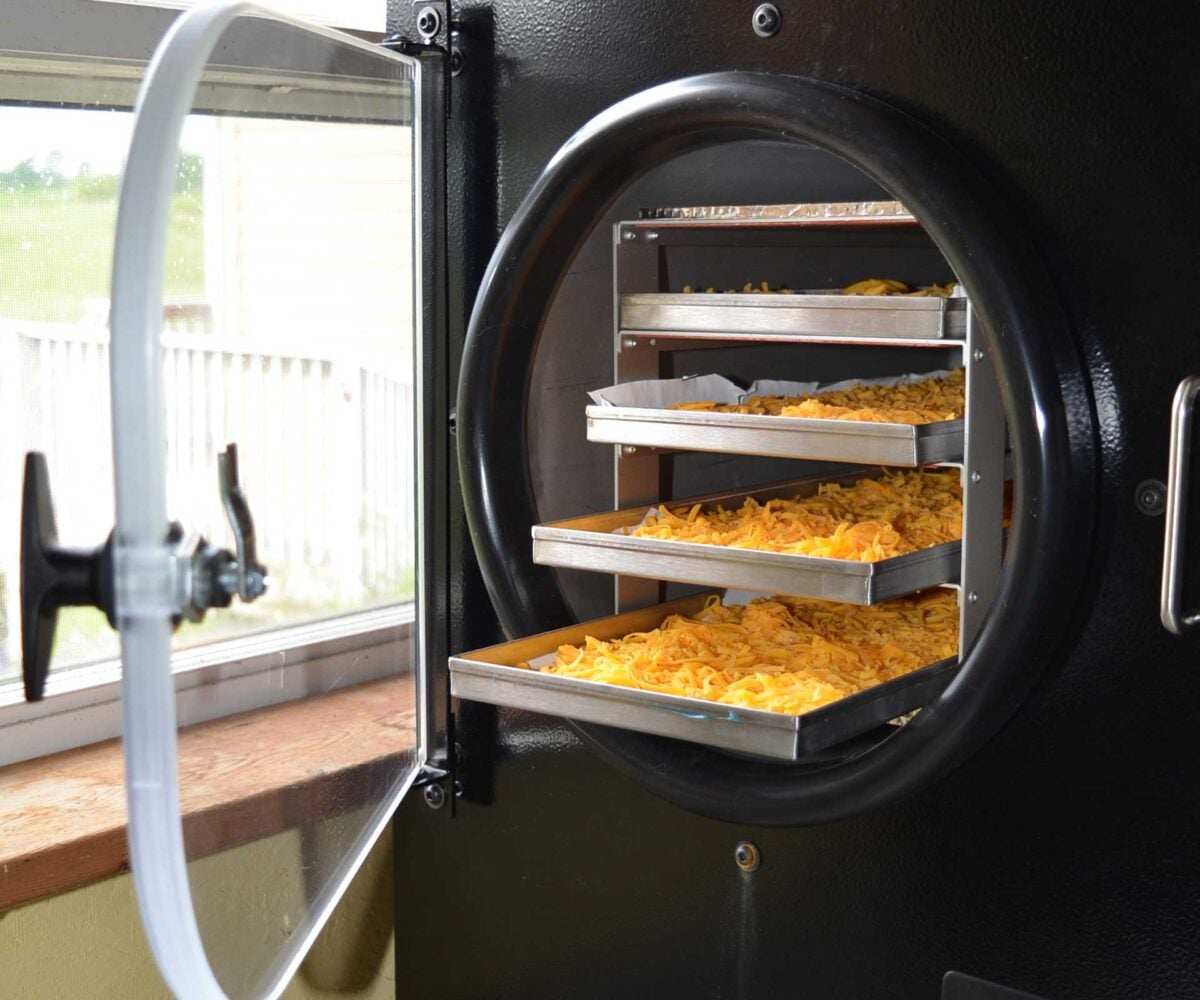
Table of Contents
What Is Home Freeze Drying?
Freeze drying is a food preservation method that removes moisture from food while it’s frozen.
Unlike ordinary dehydrating, which uses warm air to evaporate water, freeze drying uses extremely cold temperatures and a powerful vacuum to turn frozen water directly into vapor. This process is called sublimation.
The result is food that’s extremely dry, lightweight, and often retains much of its original shape, flavor, and color.
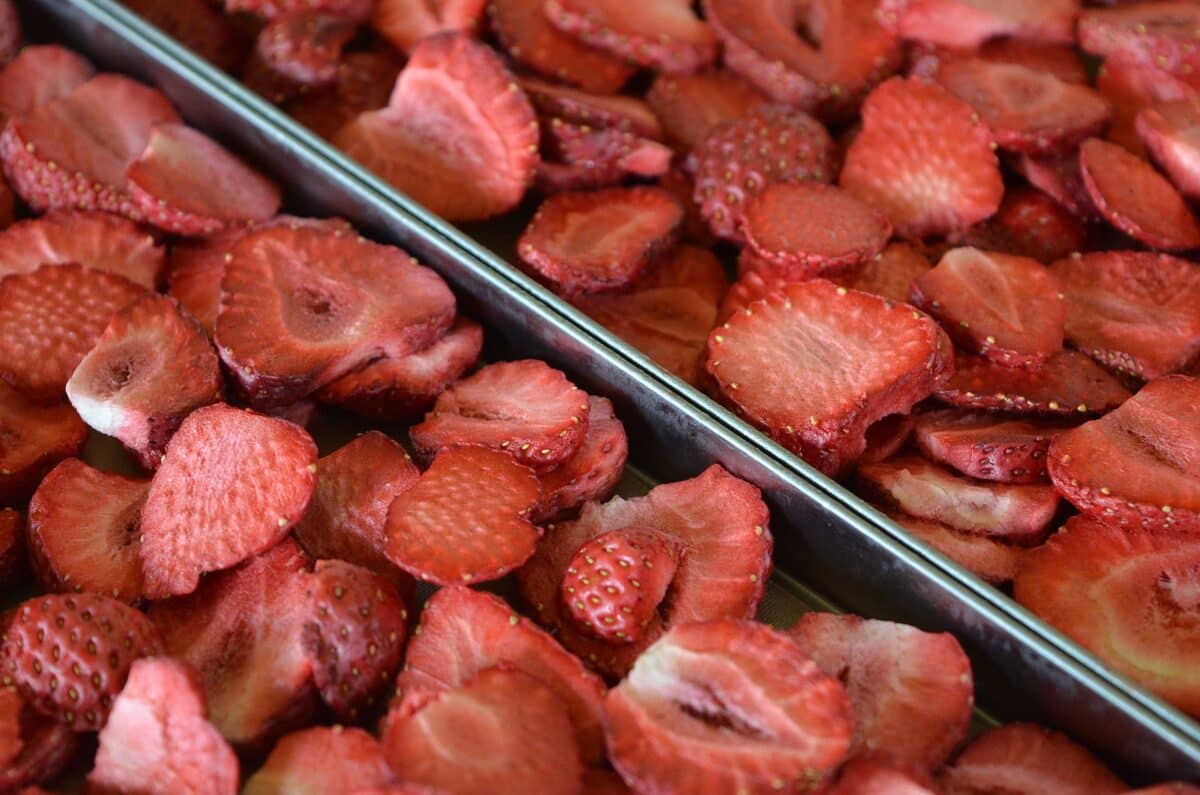
Freeze dried strawberries, blueberries, and apple slices make delicious crunchy snacks. Cooked meats, vegetables, and meals can be rehydrated with water for quick meals.
Can You Freeze Dry Food Without a Freeze Dryer?
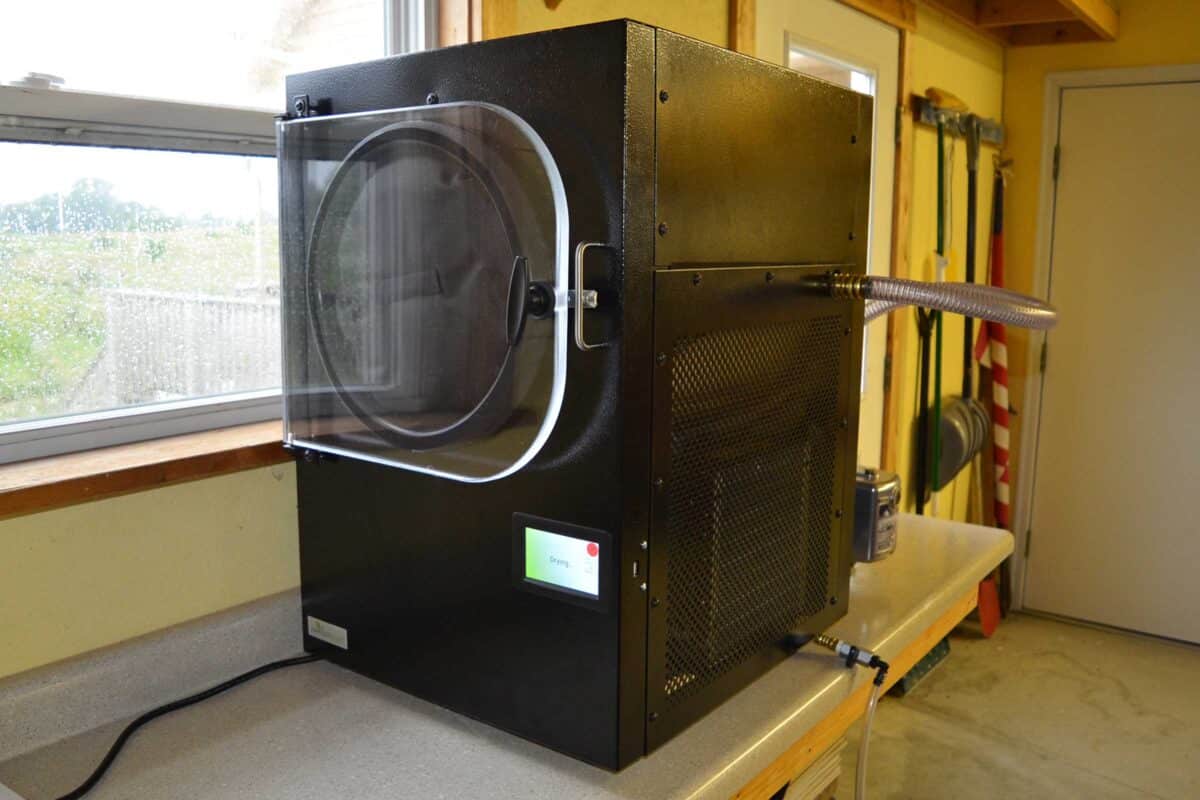
No—not reliably. This is a common misunderstanding. Some people assume that freezing food and then putting it in a dehydrator will produce freeze dried food. It won’t.
A home freeze dryer combines three important functions:
- Freezing: The machine freezes food to extremely low temperatures.
- Vacuum drying: A powerful vacuum pump reduces the pressure inside the chamber, allowing ice to change directly into vapor.
- Controlled heating: The machine gently warms the food during drying to help remove the remaining moisture.
A regular freezer and food dehydrator cannot duplicate this process. You can sometimes observe natural freeze drying outdoors in extremely cold, dry conditions, but that’s not a reliable method for producing safely preserved food.
For more information, see Dehydrator Versus Freeze Dryer – What’s the Difference?
How to Freeze Dry Food at Home
Modern home freeze dryers automate most of the process, but preparing the food properly makes a big difference.
- Prepare the food. Wash produce, trim away unwanted portions, and cut food into small, uniform pieces. Blanch vegetables when appropriate, just as you would before freezing.
- Fill the trays. Spread food evenly without overloading. Pre-freezing food on the trays can shorten the processing time.
- Start the freeze drying cycle. Follow your machine’s instructions. It will freeze the food, create a vacuum, and gradually remove moisture.
- Check for dryness. Break open several of the thickest pieces from different trays. There should be no ice, damp spots, or moisture remaining in the centers. Add drying time if needed.
- Package promptly. Freeze dried foods absorb moisture from the air quickly. Transfer them to appropriate moisture-proof containers as soon as they’re finished.
Most batches take many hours, often a full day or longer. Drying time varies with the food, thickness, moisture content, machine, and room temperature.
What Foods Can You Freeze Dry?
One of the biggest advantages of home freeze drying is the variety of foods you can preserve.
Good candidates include:
- Fruits: Strawberries, blueberries, apples, peaches, bananas, and other fruits.
- Vegetables: Peas, corn, carrots, green beans, broccoli, and many garden vegetables.
- Lean meats: Cooked chicken, ground beef, turkey, and other lean meats.
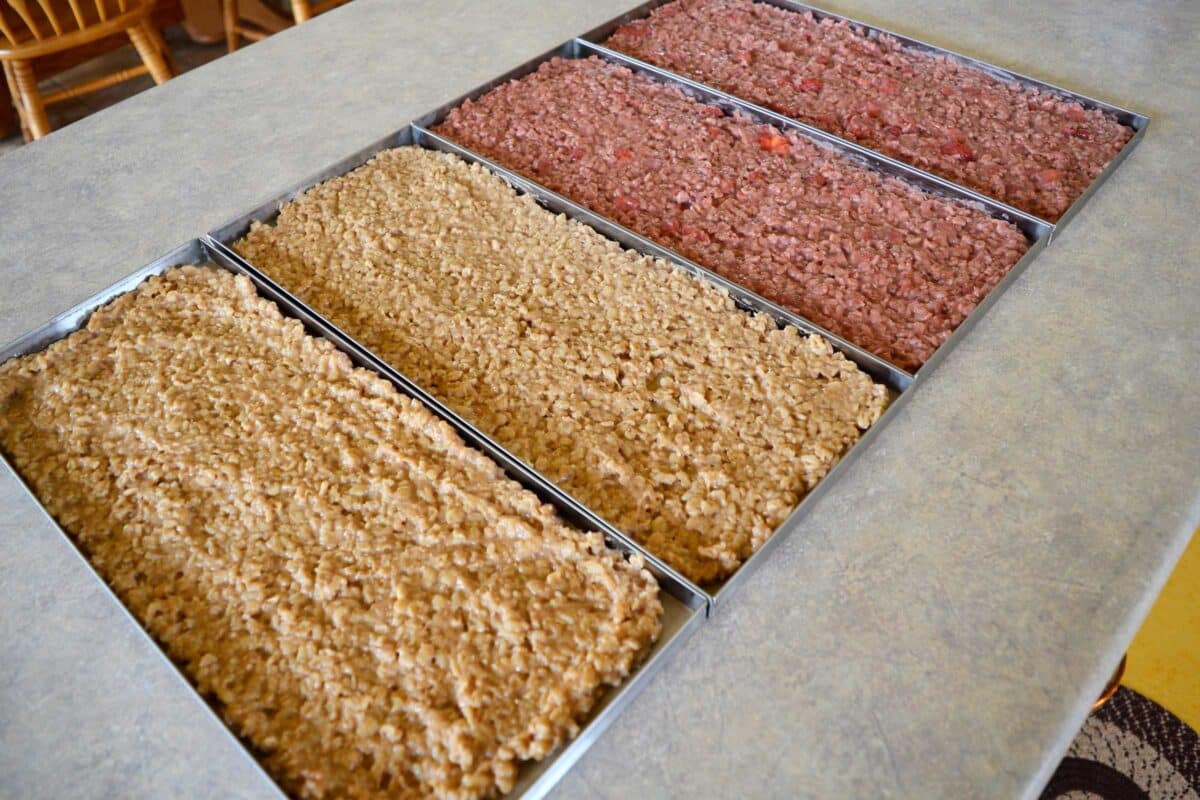
- Prepared meals: Soups, casseroles, pasta dishes, and rice-based meals.
- Dairy foods: Yogurt, cottage cheese, and some other dairy products.
We especially enjoy freeze dried fruit. The flavor becomes concentrated, and the light, crunchy texture makes it an appealing snack. My sons also enjoyed freeze dried fajita meat strips, which they nicknamed “Meatos.”
You can grind freeze dried fruits and vegetables into colorful powders for smoothies, baked goods, or natural food coloring.
What Foods Shouldn’t You Freeze Dry?
Not everything belongs in a freeze dryer.
High-fat foods are poor candidates because fat doesn’t freeze dry. Butter, cooking oils, peanut butter, and very fatty meats may spoil or become rancid during storage.
I learned this the messy way when I tried freeze drying precooked pork sausage patties. The fat melted and coated the inside of the machine.
High-sugar foods can also be troublesome. Honey, syrup, and many jams remain sticky because sugar interferes with moisture removal.
Other foods, including some baked goods and dense, thick portions of food, may dry unevenly.
Freeze drying also doesn’t sterilize food. Bacteria and other microorganisms can survive the process and become active again when moisture returns.
For food safety, use good sanitation practices, cook foods that require cooking, and make sure everything is completely dry before packaging. Treat rehydrated raw foods as raw foods.
For more guidance, see Utah State University Extension’s guide to safe freeze drying.
How Long Does Freeze Dried Food Last?
Commercially freeze dried foods sometimes advertise a shelf life of up to 25 years. However, that doesn’t mean everything you freeze dry at home will remain in good condition for decades.
Proper drying, packaging, and storage conditions all affect shelf life. High-fat foods are especially prone to rancidity, and even well-preserved foods can gradually lose flavor, color, and nutritional value.
Our Experience Storing Freeze Dried Food
We’ve had mixed results with long-term storage.
Some of the freeze dried foods we packaged in Mylar bags and stored in our basement storage area have picked up moisture over time. That’s disappointing, especially considering the work involved in processing them.
In contrast, the foods we vacuum sealed in glass jars have remained dry. However, we’ve noticed that their colors have faded over time, even though the lights in our storage area are only on occasionally.
Based on our experience, I recommend:
- For long-term storage: Use quality, high-barrier Mylar bags with appropriate oxygen absorbers, then place the sealed bags inside airtight containers, such as five-gallon buckets with gasketed lids.
- For foods you’ll use regularly: Vacuum-sealed glass jars are convenient because you can see the contents and easily inspect their condition. Keep them protected from light.
- For all freeze dried foods: Store in a cool, dark, dry location. Lower, stable temperatures help preserve quality.
The bucket provides an extra layer of protection, but it won’t make up for a poor seal or packaging that allows moisture through.
Rotate Your Freeze Dried Foods
One of the biggest mistakes people make with long-term food storage is putting food away and forgetting about it.
A friend recently told me about people who purchased a freeze dryer, filled their pantry with freeze dried food, and then stopped using the machine and largely ignored their stored food. I worry about what they’ll find when they finally open those packages.
We recommend rotating freeze dried foods just like canned goods, frozen foods, and other pantry staples.
Use the oldest packages first, inspect your storage periodically, and replace foods as you use them. Try rehydrating some of your stored foods occasionally, too, so you know how they taste and how to prepare them.
The goal isn’t simply to store food for 25 years. It’s to have good food available when you need it. (Just because it’s safe to eat old food doesn’t mean that it’s optimal to eat old food.)
If you discover moisture, mold, unusual odors, or other signs of spoilage, discard the food rather than tasting it to see whether it’s still good.
Comparing Home Freeze Dryers: Harvest Right, Blue Alpine, and StayFresh
When I purchased my first freeze dryer in 2016, Harvest Right was one of the few practical choices for home users.
Today, there are several manufacturers worth considering.
| Brand | Main advantages | Things to consider |
|---|---|---|
| Harvest Right | Wide selection of machine sizes from small countertop to commercial, established home-user community, oil-free pump options. | Compare pump upgrades, accessories, and electrical requirements. Some quality control and customer service issues as the brand has expanded. |
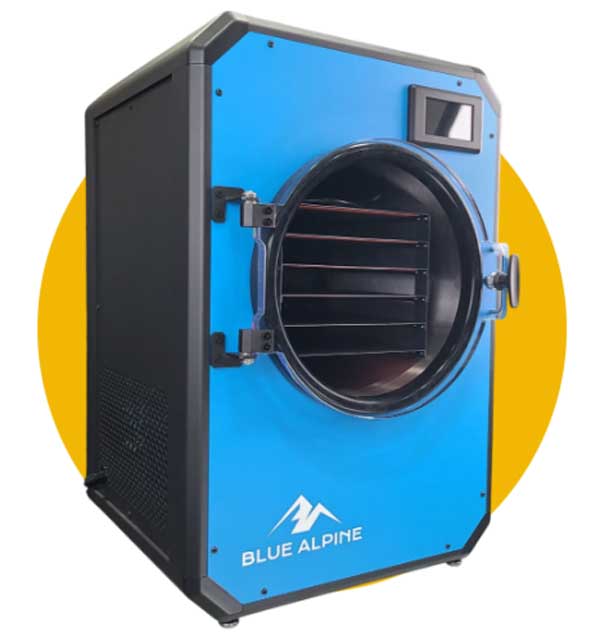
| Blue Alpine | U.S.-assembled machines, generous tray space, standard baking-sheet-style trays on certain models. Right to Repair – it’s easy to order replacement parts, if needed. | Fewer household size choices; check pump and circuit requirements. Well rated customer service. |
| StayFresh | Multiple machine sizes from small countertop to Mega, generous drying capacity, different pump packages. Lifetime free technical support. | Compare overall dimensions, service options, and warranty coverage. Discounts available for military, first responders, and teachers. |
All three brands offer machines capable of preserving substantial quantities of food. Both Harvest Right and StayFresh now have small countertop units available for order at a lower price point.
The best choice depends on how much food you want to process, how much room you have, and how frequently you’ll use the machine.
Before purchasing, compare:
- Batch capacity: How many pounds of fresh food fit in one load?
- Electrical requirements: Does the machine need a dedicated 15- or 20-amp circuit?*
- Vacuum pump: Does it require oil changes, and what maintenance is involved?
- Dimensions: Is there room for the machine, pump, drainage, and ventilation?
- Warranty and service: What parts are covered, and how are repairs handled?
Prices and model specifications change, so check the manufacturers’ current information before ordering.
*We ended up adding a dedicated 20 amp circuit in our garage for our freeze drier after my husband tripped the breaker by using the garage door opener while the freeze dryer was running.
Disclosure: The links below are referral links. If you purchase a freeze dryer through one of these links, I may earn a commission at no additional cost to you. Your purchases help support Common Sense Home and allow me to continue sharing practical food preservation information. Thank you for your support!
Shop Blue Alpine Freeze Dryers
Check out Harvest Right Freeze Dryers
Is a Home Freeze Dryer Worth the Money?
Home freeze dryers cost thousands of dollars, plus electricity, packaging supplies, and occasional maintenance. They also require substantial space and make noticeable noise while operating.
For occasional food preservation, canning, freezing, or dehydrating may be more economical.
But a freeze dryer may be a worthwhile investment if you regularly preserve large harvests, want lightweight meals for camping or travel, or prefer to store homemade foods without refrigeration.
One of my favorite benefits is having quick meals available when life gets busy. We’ve freeze dried homemade fajita filling, casseroles, soups, pulled beef, taco meat, and other family favorites. For a quick meal, we can add water, heat, and serve.
Home freeze drying also gives you control over ingredients. This is especially helpful for families managing food allergies or sensitivities. Also, most pre-made freeze dried meals are light on protein. You can dry meat separately to add to other foods, or bump up the protein ratio in prepared meals.
If you want a freeze drying cookbook, Freeze-Drying the Harvest by Carolyn Thomas looks like a safe bet. Carolyn’s been a part of the online homesteading community for years. As a mother of 11, she spends a lot of time in the kitchen.
For a closer look at operating expenses, see Harvest Right Freeze Dryer – Cost Analysis and Optimizing Load Size.
Freeze Dryer Maintenance and Placement
A freeze dryer is more complicated than a typical kitchen appliance. Most models include a refrigeration system, stainless steel drying chamber or trays, vacuum pump, and drainage system.
Choose a location with adequate ventilation, a suitable electrical circuit, and enough room to access the equipment. We keep ours in the garage, where the noise is less noticeable.
Ambient temperature matters, too. Extremely hot conditions increase processing time, while freezing temperatures can damage components if water remains in the system.
Oil-based vacuum pumps require maintenance, including oil changes or filtering. Oil-free pumps generally cost more but reduce routine oil handling. Follow the manufacturer’s maintenance schedule rather than assuming all pumps require the same care.
For more information, see Harvest Right Freeze Dryer Oil Change and Filtering.

Is Freeze Drying Right for Your Household?
I appreciate freeze drying because it adds another option to our food preservation toolbox. It doesn’t replace canning, dehydrating, root cellaring, or freezing. Each method has advantages.
For example, I still prefer canned foods for many everyday meals, dehydrating for certain herbs and snacks, and root cellaring for crops that store naturally.
Freeze drying shines when we want lightweight foods, quick meal ingredients, or long-term storage without relying on electricity after processing.
If you’re considering a machine, think about what you actually eat and how often you’ll use it. A freeze dryer that sits idle isn’t much of an investment.
If you’re just getting started with food preservation, see Home Food Preservation – 10 Ways to Preserve Food at Home. And for more ideas on building a practical pantry, explore our food storage and preparedness resources.
About the Author

Laurie Neverman is the creator of Common Sense Home and author of Common Sense Preparedness. Raised on a Wisconsin dairy farm, she has decades of hands-on experience with gardening, cooking, and food preservation. She’s been using a home freeze dryer since 2016 and shares practical ways to build a more resilient and abundant household.
Originally published in 2016, last updated in 2026.
Hi,
Would you say that the electricity generated by running a small HR machine is a significant expense? Curious if that is a factor that stands out for this product.
Thank you
It depends on your electric rates. We have an article – Harvest Right Cost Analysis – where one of our readers broke down the energy use from his unit. At his normal electric rate running large loads, it was costing him around $2/load to freeze dry. He tested a medium unit. If you click through the link it breaks down how to optimize load size and full testing information.
Hi, I would like to use the harvest right freeze dryer for cut up apples and black currants are these fruits recommended?
Apple slices dry well, though different types of apples have different textures when dry. Some are softer, while some stay more crisp.
Black currants will be difficult to dry because of the thick skins. You probably need to slice them or at the very least puncture the skins to get them to dry. Slicing would work better.
My family loves sliced apples freeze dried especially when they’re sprinkled with a little cinnamon before going in the freezer.
How much will it cost to buy the medium size freeze dryer ship to Manila Philippines
You would need to contact Harvest Right directly to get a shipping estimate.
Their hours are:
Mon-Fri 8am-6pm (MST)
Sat 9am-2pm (MST)
Phone: 801.386.8960
I love my freeze dryer except for one thing: I haven’t found a yogurt (other than the store bought garbage) that will freeze dry intact! I’ve tried several different kinds of yogurt and I have tons of starter now but I REALLY want a shelf stable yogurt for my snacking father who struggles to eat regular meals.
All the milk based products I’ve dried get powdery to some extent (some more, some less). Maybe using gelatin in your homemade yogurt as a binder would help?
I added about a tablespoon of dry baby oatmeal to a large container of Yoplait Yogurt. Then I used a pastry bag with the star tip on it. They came out perfect!!!
I’d like someone to address the high ~32% rate of dissatisfied customers for this product. Most of the complaints consist of vacuum malfunction, pump problems, long delays for parts and customer service. I ordered mine two months ago so it should ship soon. Hope I get one of the good ones.
I think it’s safe to say that the people who have a properly functioning machine often don’t take time to leave reviews, because they are busy using their machines. (Check out the online freeze drying groups for all the stuff that people are busy happily drying with their fully functional machines for proof.)
If they truly had such a high failure rate, they couldn’t stay in business. We still have the same unit we got over six years ago and have had only minor maintenance issues. Stuff wears out over time.
It is a complicated piece of equipment, so I suspect at times there may be some user error involved, too. I think they’re also having a lot more troubles with shipping in recent years. The unit leaves Harvest Right in good shape, then ends up completely banged up before it reaches the customer. I’ve seen a lot more postings about that type of thing happening. Even when there’s not visible damage, the unit still may have been dropped or mishandled during shipping. We ended up with a lemon riding lawnmower like that. The guy who sold it to us must have known, but not told us about the problem. We took it to another repair shop, and said the frame was cracked, like it had been dropped off a truck while unloading. We couldn’t see the damage, we just noticed it had a strange vibration.
I know they are also struggling with supply chain issues like so many other business, so they probably can’t get the needed parts quickly, so they can’t send them out quickly. You’ll find similar issues for other not so mass produced products, like apple presses and pressure canners. I just went to the Lehman’s website, and apple presses are still out of stock. When my husband ordered one, it took a year to be delivered – not joking. I checked the All-American Canner website, too, and every single model is out of stock. They’re hoping they might have some in by the end of the year.
Small to medium sized businesses often get their orders bumped to the end of the line behind bigger businesses.
I don’t think most people have a true understanding of how years of continuous disruptions and increasing costs are impacting businesses. It’s hitting even harder in Europe, with many forced to close their doors due to heating and electricity costs.
Frankly, I’m surprised at how well Harvest Right is holding up given everything that’s going on. They are not a huge company – less than 100 employees – and I can imagine the volume of calls and emails they receive daily. I do think they try and make things right, but that’s not always easy to do.
I will take a minute to add my 2 cents. I purchased my freeze dryer April 2018, and returned it June 2019. They agreed to give me a refund, less a substantial restocking fee. Bottom line, I am not really an early adopter. I expected it to work more like a dehydrator, i.e. put the food in, set the timer, take the finished product out and put the next batch in. For some reason, I expected the unit to be able to measure when the food was fully dry, and was frustrated there is not good way to know. I ruined a few batches of precious food I had grown in my garden. I didn’t like all the messing around with changing the oil in the compressor, and all the ‘babysitting’ I felt it needed. There were some maintenance issues, and their tech support gave me some incorrect information, and I got frustrated. Obviously all this would be resolved with patience and experience.
I think it is an awesome concept, and sometimes I wish I had given it more of a chance. Someone who understands how it works, is willing to use it properly, and willing to tolerate some inconvenience with technical support, will be very happy with it.
thank you for putting so much information out on your experience with freeze drying. i admire your writing style and hope to obtain a freeze dryer shortly; more to play with and learn about long term storage as any other reason, i hope the reports of intense fruit and berry flavors are accurate; as i get older nothing seems to taste as good as when i was a kid.
The better the quality of the product you start with, the better the quality of the finished product, or course, but the freeze drying process does concentrate flavors. It’s bad for dill pickles (so salty!), but great for fruit.
Too much of the store produce is bred for durability instead of flavor, and picked green.
I love my HR! I’ve freeze dried milk from my goats and cow, scrambled eggs, precooked meats and meals. I never got into the Candy that some people are obsessed with. However, I have one of the original machines. They said I can’t update firmware. And I have a messy pump. So, from that stand point, I wish I had waited to purchase. It looks like they got a lot of stuff sorted.
Yes, the units have improved significantly since the early years.
i am very interested in the harvest right freeze drier but quite honestly scared to buy one given all the bad reviews on the Better Business Bureau’s web site. I did my usual final search for issues prior to going ahead with the purchase and was surprised bu the number of complaints. There are issues right up to May 2022 so these are not old issues.
can some people that ACTUALLY have a unit post and let us all know how their experiences.
I actually own a unit. I also invite you to look through the comments, which include many comments from readers who actually own a unit. You can also go online to youtube, and watch hundreds (probably thousands) of videos from people who actually own a unit, or go to Facebook and search on freeze dryer groups, and find thousands of people who actually own a unit.
Yes, there are still occasional problems, and yes, on the BBB site you will generally not find comments from happy customers. Harvest Right has shipped tens of thousands of units. These are fairly complex pieces of equipment. Sometimes things go wrong. It happens. It’s impossible to operate a business and have every product/every job turn out absolutely perfect, and the happy customers tend to be busy using their products and not telling the whole world about it. (Unless they have a youtube channel or Facebook group, etc.)
You know it’s funny Laurie, I am new to freeze-drying, but getting to choose the amount of salt in a particualr bag is important to me as I don’t want to die of a heart attack, or sodium poisoning! I checked the ingredients in some of the freeze-dried producers’ products, I was shocked at the sodium content, in some cases, it was greater than 30% of the food.
Hi Laurie,
Wow! I stumbled across your blog looking for more freeze dried store bought options for my 4 y/o son. He is autistic and will eat only freeze dried fruit. I’m almost certain if I bought a freeze dryer he would eat more variety of foods. He was a normal eater until he got sick then he just stopped eating normally. I have spent more money trying to find foods he will eat and with store supply issues I can’t guarantee he will have his favorites and his favorites are all he eats. I just wanted to stop by and thank you!
Hi Catherine. thank you for your kindness.
Home freeze drying does give you a lot more options, and we personally much prefer the flavor of our home freeze dried products to pretty much everything we’ve purchased. If your son deals with any allergy issues, processing your own food is safer, too. I hope you can find a way to help him to get back to eating more normally. I have friends who’ve used the GAPS diet to improve gut health and also had an improvement in autism symptoms, but I know it can be challenging for those on the spectrum to adjust their eating habits.
I’m so very sorry to hear about your son! Since C-19 I deeply researched vaccines and am 100% convinced our health institutes make us sick and dependant on big pharma THROUGH VACCINES! You can find all ingredients in vaccines on the CDC’s ‘vaccine excipient chart, appendix B’. Everyone should be appalled! Never get another shot! I was a vaccine whore until I researched the REAL STORY OF VACCINES. The drs will adamantly tell you that’s not true but they get$$$ for vaccinating!!
I’m so sorry for your family!! May God Bless you and your family! Dr Brian Ardis is a very good start to research! With God’s love , jeani
With dehydrators, shelves may need rotating because the airflow doesn’t reach certain shelves as well as others. Does the freeze dryer have similar issues?
Experiment idea: For blueberries, the options mentioned are piercing each berry or freezing & pulsing in a food processor. What about using a meat tenderizer like at the link below – modify it so it can only puncture the berries & not go all the way through? (frozen berries would probably work best)
The freeze dryer dries pretty uniformly, as long as the trays are loaded evenly. Given that you would need to interrupt the vacuum process during drying, rotating trays would be difficult.
The meat tenderizer might work, and be a little faster than attempting to puncture individual berries, if you can get the berries to stay in one place. Frozen round balls tend to want to spin and roll away/
Jay Winthorp is clearly a coping poorfag who’s desperately trying to justify his decision to always do the cheapest thing possible. Some people can actually afford to buy things based on criteria other than just being a poorfag you know Jay.
Hello,
My question is how you would know if the food was safe to eat in terms of botulism and time stored? Would you see that the food is spoiled after 5 years for some items that contain milk oil and fat? Or would it be unknown since you can’t see, taste or smell botulism. I worry that i would spend all this time and money doing this instead of buying freeze dried foods from a big company and in a disaster 10 years down the road might indaventently poison myself.
Also, not sure if you know the answer, but i have heard you cant use oxygen absorbers for things like baking soda and baking powder because it could explode. Also absorbers should not be used for salt, sugar and spices? Is this true?
Thanks very much for taking the time to answer!
Botulism spores require very moist conditions to thrive. Properly freeze dried food cannot grow botulism spores.
To thrive, the bacteria need:
Temperatures between 40-120°F/ 5-49°C
Anaerobic conditions (Oxygen below 2%)
Neutral pH
Moist conditions (Water activity level greater than 0.85)
To compare, normal water activity levels for common foods are as follows:
Food Typical aw
Fresh meat 0.98
Cheese 0.97
Preserves 0.88
Salami 0.83
Dried fruit 0.76
Honey 0.75
Pasta 0.50
So if you’re storing in normal room conditions with an oxygen absorber, the temp, O2, and pH may be right, but dry food will not grow the spores. If you’re drier than salami, the spores won’t grow.
(Read more about in the article, “Botulism – Causes, Symptoms, Treatment, Tips for Safe Home Canning“.
Odds are if your food is not dried enough, or there was too much fat, or some other issue, you’ll clearly be able to identify that something is not right, because the food will have softened in storage, or the fat will smell rancid, or there will be some other obvious indicator. We had some issues with this early on when we were first learning. I put meat in a jar without vacuum sealing or O2 absorbers, and it got stale. Another time, I though my pumpkin puree was dry enough, but checked the package months later and it was slightly soft. We used it sooner than later, and it was fine, but I wouldn’t count on soft food for longer storage.
If you’re drying cooked foods, you’ve killed the microbes. If you’re drying most fruit, it’s too acidic to grow botulism spores.
O2 absorbers
You don’t need them for sugar and salt. They keep “as is”. I do like to add moisture absorbers to keep them from turnings into bricks.
I try to rotate my spices annually, but would use O2 absorbers for longer storage.
Leavening agents are chemically reactive, as are the O2 absorbers. I could see where they would possibly react with each other and cause a blowout.
Can a person freeze dry Italian Ice or would it just turn into powder? Italian Ice has mostly water, ice, and flavoring with sugar added.
I have not tried it, but given that it is mostly water/ice, I don’t see how you could end up with anything other than powder, except perhaps sticky powder that won’t finish drying properly because of the high sugar content.
I am torn between the medium and the large unit. Is the large unit too large? What are your thoughts?
How many people are you feeding, and how much stocking up do you want to do?
With continued supply chain disruptions, I highly encourage people to stock up now if possible. Our freeze dryer allows us to stock up with food that will last for years and requires no refrigeration or freeze space.
We got this in email from Valley Food Storage last week:
“We just spoke with our protein supplier and found out that the prices of beef, chicken, sausage, and eggs have TRIPLED since our last big order. From farm to table, the supply chains are facing crushing delays, livestock shortages, increased labor costs, and staffing issues. All of this compounds into the most ludicrous price hike I’ve ever seen in my career.”
The medium unit can hold 7-10 pounds per batch, the large can hold 12-16 pounds.
Hi Laurie,
Thank you so much for your detailed reply! I really appreciate it – it helped clarifies a lot of things. Will take notes on all the information given. Some follow-up questions regarding pre-freeze.
1) How long do you recommend to pre-freeze the food?
2) How much time does it cut down on freeze drying if the food are pre-frozen?
3) How do we know the actual time it takes for freeze-drying in order to plan our production time?
And lastly, do you know if Harvest Right deliver the machine specifically to Malaysia? If yes, does it include installation + guidance on how to use the equipment by their trained technician?
Thank you in advance Laurie! Looking forward to your reply!
Regards,
Lim
1 – It depends on the food, but 8 hours/overnight is typical.
2 – This depends on the food, and ambient conditions. The factory default freezing time in 9 hours. When you want to freeze dry food that is already frozen, you turn on the unit and run it for a half hour to chill it, then load in the food. The unit chills it more, then starts the drying process. Since you’ve brought down the temperature of the food, the 9 hour freezing time will be reduced, but not eliminated completely, because the freeze dryer takes the temperature below zero.
3 – The only way to know for sure what your dry times will be in your conditions with your specific food is to test it. Drying times vary based on the food itself (what it is and how much is loaded) and ambient conditions (temperature and humidity). If you search around on the internet, there are probably people who have posted freeze drying times for certain amounts of certain foods in their location.
You’d need to contact Harvest Right to see about shipping to Malaysia. Their phone # is 1-800-700-5508.
They don’t have installers, as the units are pretty easy to hook up, but there is an owner’s manual included.
Dear Laurie,
Greetings! My name is Lim, I am from Malaysia. Thank you for the great content! I must say, it was a great review with in-depth information! I am tempted to purchase this machine using your code but I have several questions before I make my decision. It will be great if you can assist me in these and clarify the questions to the best of your knowledge. My plans are not for home usage, but actually to start a small business selling protein packs. It will be cooked chickens and beef. I do have plans to include fibre and fruits pack in the future (combination of fruits and vegetable). I am actually from the health and fitness industry hence producing healthy food for my clients is my goal, but not sure if this machine is suitable for the direction of my business. Below are the question.
1) Is this machine suitable for businesses? Do any of your reader purchase this equipment for business other than home usage?
2) Is cooked chicken breast suitable for freeze drying? If yes, must it be in a small cube size or can we freeze dry the whole chicken breast by itself?
3) Is cooked beef suitable for freeze drying?
4) Can we freeze dry different types of fruits together?
5) Can we freeze dry different types of vegetables together?
6) Is this machine suitable for heavy duty? Meaning it will be constantly running all the time. As small business but trying to produce volume, I think it will be running almost all the time.
7) How user friendly is this machine? And will we be able to do our own maintenance with guidance? As I am in Malaysia, don’t think Harvest Right have reps over here.
8) You’ve listed all the advantages of this machine in your review, however would you be able to share with me some of the disadvantages of this machine?
That’s all from me. I have yet to contact Harvest Right, as I’m thinking it will be better if I can hear it from you – unbiased review regarding this machine. I really appreciate it if you can help me out on this. Thank you so much in advance, appreciate it! Looking forward to hear from you.
Regards,
Matt Lim
Malaysia
Hi Lim. I’ll do my best to answer your questions.
1 – Some people do/have used their freeze dryers for business/heavy use. If you want to do this, I’d suggest an extra set of trays (or something of a similar size) so you can pre-freeze one load while another load is in the dryer. Pre-freezing also cuts down time in the dryer. I’d opt for the premium pump (not the oil free or standard), as it uses less electricity than the oil free pump, does not require oil changes after every use, and tolerates higher temps better.
2 – I would not attempt whole chicken breasts, as I would be concerned about moisture retained in the center of the cut. That said, I’m sure some people do it. If you wanted to attempt it, I would pound the meat flat, or opt for strips.
3. Yes, we’ve freeze dried cooked beef as ground beef, strips, slices, and chopped meat.
4 & 5. Yes, you can mix different fruits and vegetables, but I always aim to group products that have similar drying times if possible. For instance, I wouldn’t mix mushrooms and tomatoes, because the mushrooms dry quickly, and the tomatoes are quite wet and take a long time to dry. I would mix pears and pineapple, as both are very sweet and very moist.
6. From reading online forums, I do know that some users keep theirs running almost constantly.
7. Our machine has required very minimal maintenance over the past five years, and we have done all of it ourselves. Even here in the U.S., most people are not familiar with home freeze dryers.
8. You can’t dry fatty foods (like bacon) or some extremely sugary foods. (Most candies will work, but not jam or jelly.) If you have a fruit or vegetable with a well sealed skin (like blueberries) the skin needs to be pierced for them to dry. The freeze drying process takes longer than canning or freezing. The machine is a sizeable investment. It is noisy while operating, so I wouldn’t like to have it in the room that I am in.
Bought mine in 2015. Looks nothing like the one pictured. I asked about having it refurbished, Harvest Right indicated my only option was to buy a new one. They don’t even want to help with any problems with it. I’ve only used it perhaps 50 times. It was a waste of money.
I bought mine in early 2016, so I would think yours would look similar. Mine is the one in the video, and the black one loaded with berries in the still photo.
Given the shipping costs to send it to HR and back you, and that they are dealing with a backlog of orders, I would imagine that it would not be cost effective to refurbish it. It’s also past the three year warranty period.
You never mentioned or not if it was working? They may be able to get you a software update that you could install yourself to improve performance. That would be more cost effective. My 2016 unit is still chugging along. We just dried a batch of duck eggs last weekend.
I specifically note in the post:
“These units are a big investment. If you know you’re only going to use it a couple times per year (or not at all), spend the money on something else you know that you will use.”
Hi,
I was wondering if you would know if there would be any reason to buy the stainless steel model, besides looks? Do the other ones rust out eventually?
I have not seen any indication of advantages to the stainless steel other than cosmetic preferences. The inner drying chamber (the part that actually gets wet) is the same with stainless or other exterior finishes.
What other companies offer freeze-dryers for home use besides Harvest Right?
To the best of my knowledge, there are no other manufacturers of home freeze dryers at this time.
just got my freeze dryer! I am so glad i found your site. How do you make the freeze dried berry yogurt snacks? I looked through your recipes but couldn’t find it. thanks!!
Hi Elizabeth.
They’re just a layer of pureed berries and a layer of yogurt, frozen in a mold, and then removed from the mold and freeze dried.