
How to Get Rid of Mice and Keep Them Out!

This post may contain affiliate links. Read my full disclosure here.

If you build it, mice will come. Sooner or later, you’ll probably need to get rid of mice or rats. Fall is prime time for an increase in mice in your house, as they look for winter protection, but mice and rats can move in at any time. We share how to spot signs of mice, removing them, keeping them out, mouse repellents, and cleaning up the mess safely.
Would you like to save this?
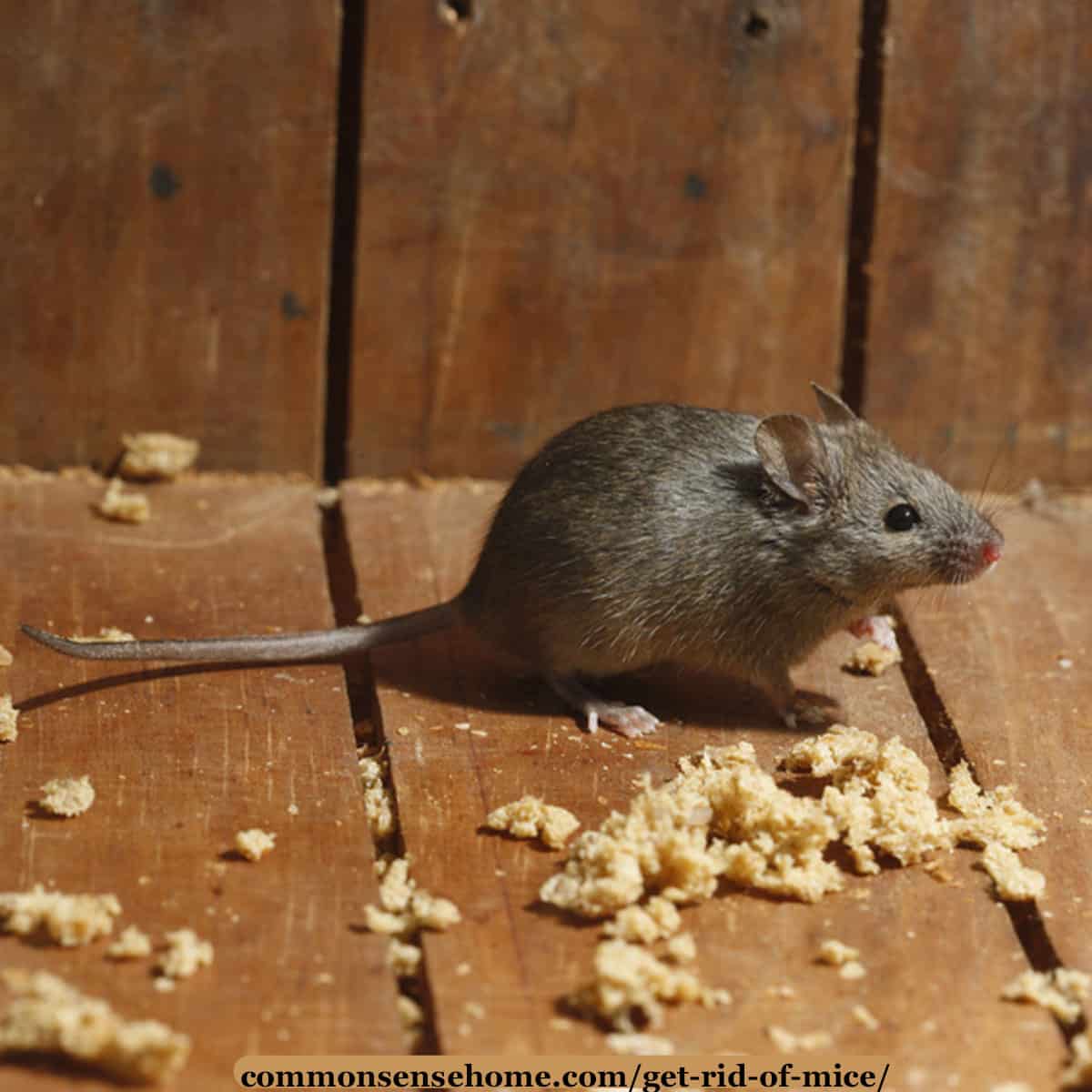
While small, mice and rats can cause big problems. They chew on everything, causing property damage and potential fire risks when they gnaw on electrical wiring and build tinder dry nests in dark corners.
Rodents can spread disease, on their own, through the parasites they carry (their fleas carried the Black Plague) or through their droppings (such as hantavirus).
Table of contents
Best Ways to Get Rid of Mice that Are Already in Your Home
Your four main options to eliminate mice infestations are cats, traps, poison or professional control services.
I’ve come to love my kitties, but it’s not practical for everyone to have a cat or cats in the house, and not all cats are good mousers. (I’ve had friends tell me about their cats who watch the mice run right past them.)
Traps
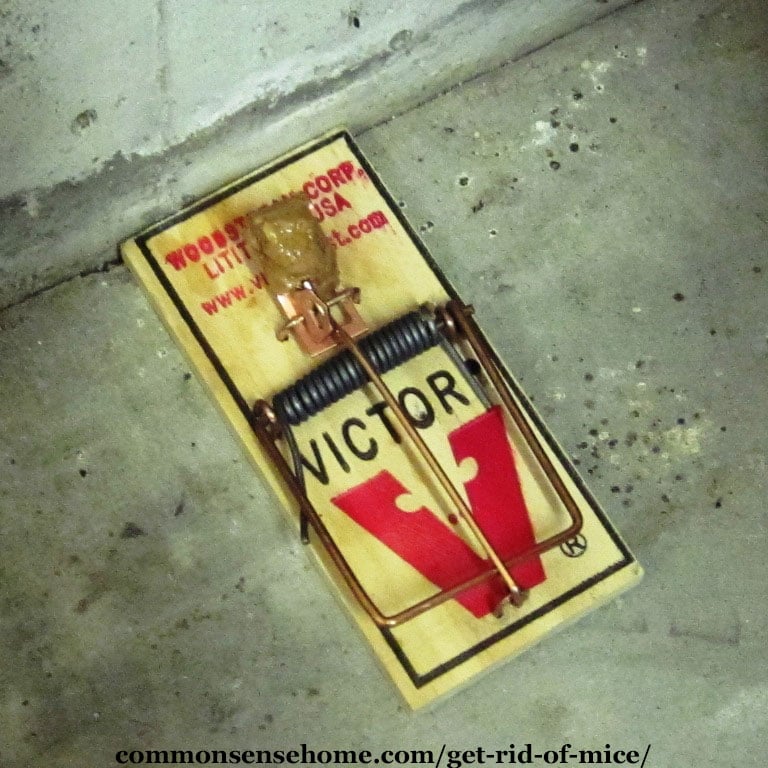
Basic wooden mouse traps are cheap and readily available, but don’t always work. A friend of mine was complaining recently that her mice kept stealing the bait but not getting caught in the trap.
I like Kness SNAP-E Mousetraps. These snap traps are much easier to set than the standard wooden traps, and work well for house mouse and deer mouse infestations.
I used them to clear out the mice that moved into the garage last winter to go after the poultry feed. We tried a couple other brands, but the SNAP-Es worked the best to get rid of mice.
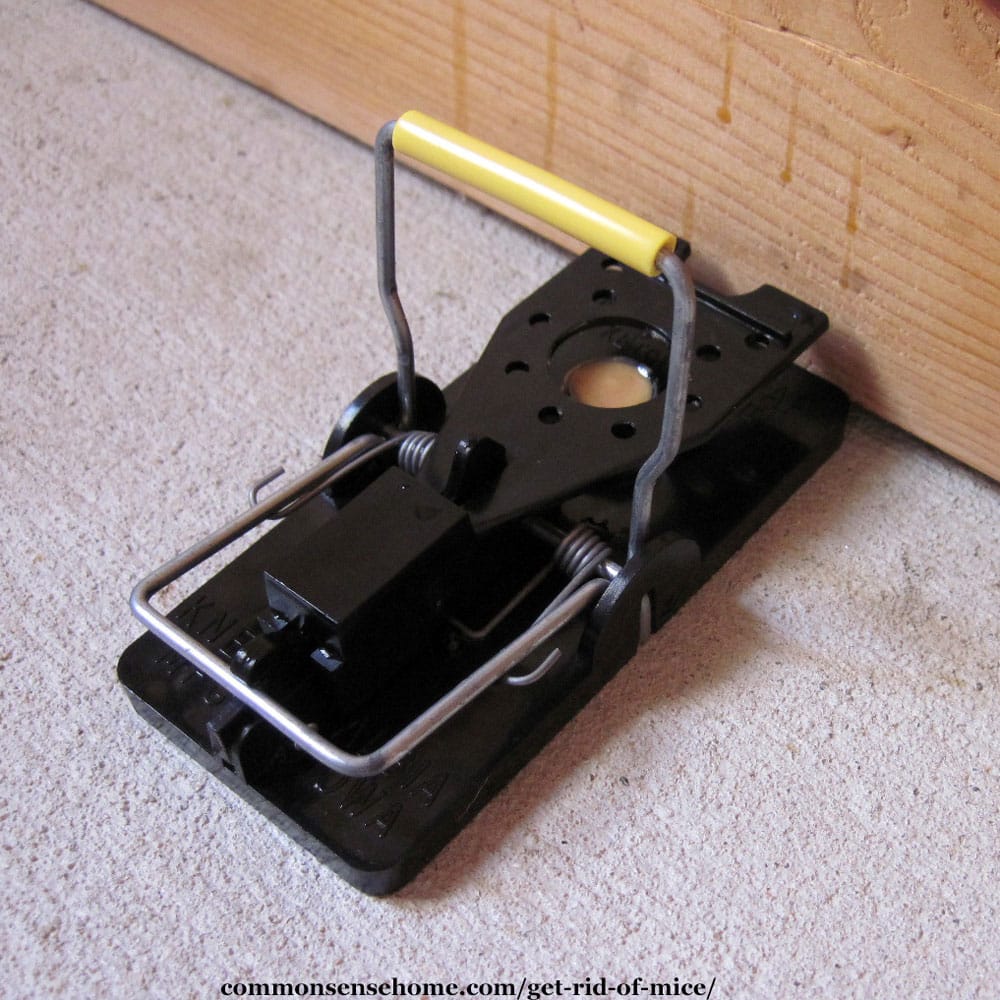
My mom’s favorite bait was peanut butter, which they can’t grab and carry off. Others suggest tootsie rolls as another “stick tight” option. When you’re placing traps, try to put them along walls where you believe mice are moving. Block their path with a buffet of your choosing instead of letting them into your cupboards.
Two traps side by side are better than one, as they will have a tougher time escaping both (remember – mini rodent ninjas). Set the traps perpendicular to the wall (see photo above).
Glue traps/glue boards may work better for small mice such as the eastern deer mouse or white-footed mouse. They tend to set off the snap traps but avoid getting caught.
Humane traps are also available, but one site states that you need to take your mouse at least two miles away to make sure it will not return. I am not a mouse chauffeur, and I don’t think it’s right to share my mice with my neighbors.
Check traps daily, especially if you have a bad infestation. Empty and reset the traps as needed.
Bucket Mouse Trap
Another option that our readers brought to our attention is the rolling mouse trap. It uses a bar, a bucket and peanut butter. The advantage is that it resets itself. The rolling trap can catch multiple mice per night.
This can be a live trap or filled partly with water to kill the mice. One option is the PAWMATE Rolling Mouse Trap which has a wheel in the center for the peanut butter.
Poisons – Why I Don’t Recommend Them
Poisons do kill mice, but not immediately. The mice will crawl off and die somewhere and potentially smell really nasty, plus who wants mummified mice sitting around their house?
Poisons can also be a danger to children, pets, and wildlife that eat rodents. By using poison in an attempt to get rid of mice, you may make the problem worse. I don’t recommend them.
How to Tell if You Have Mice in Your House
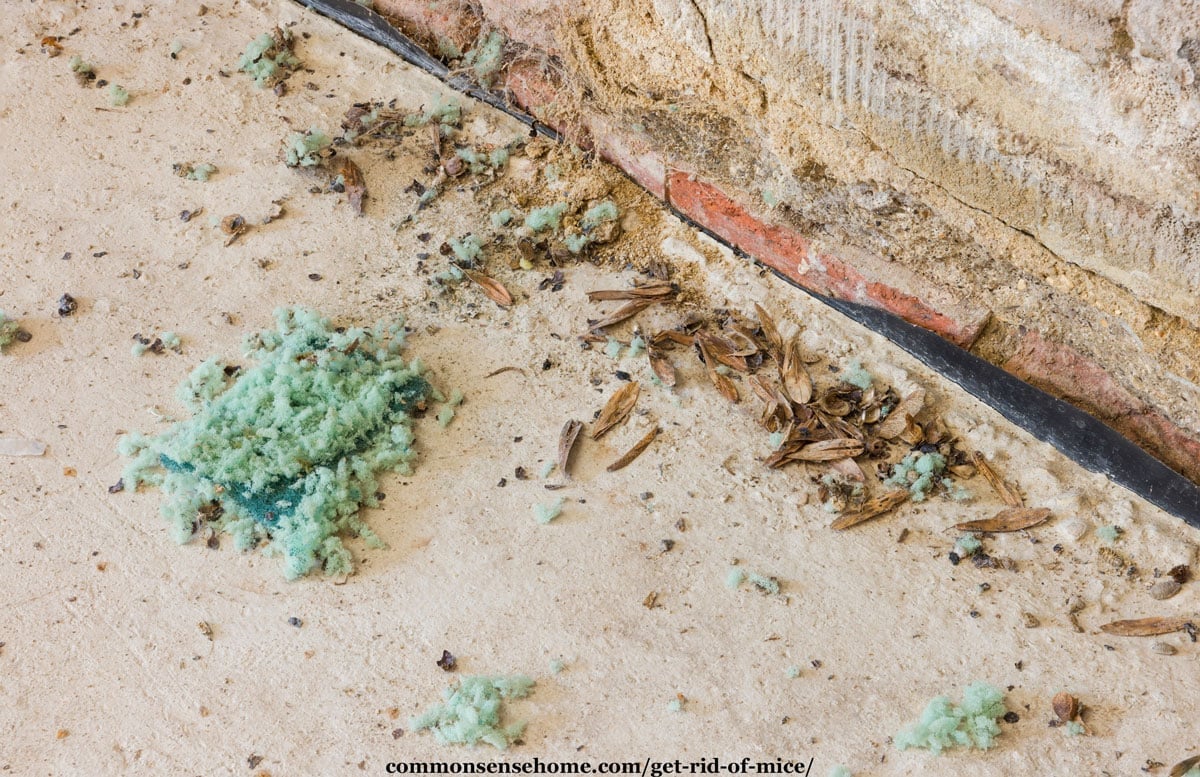
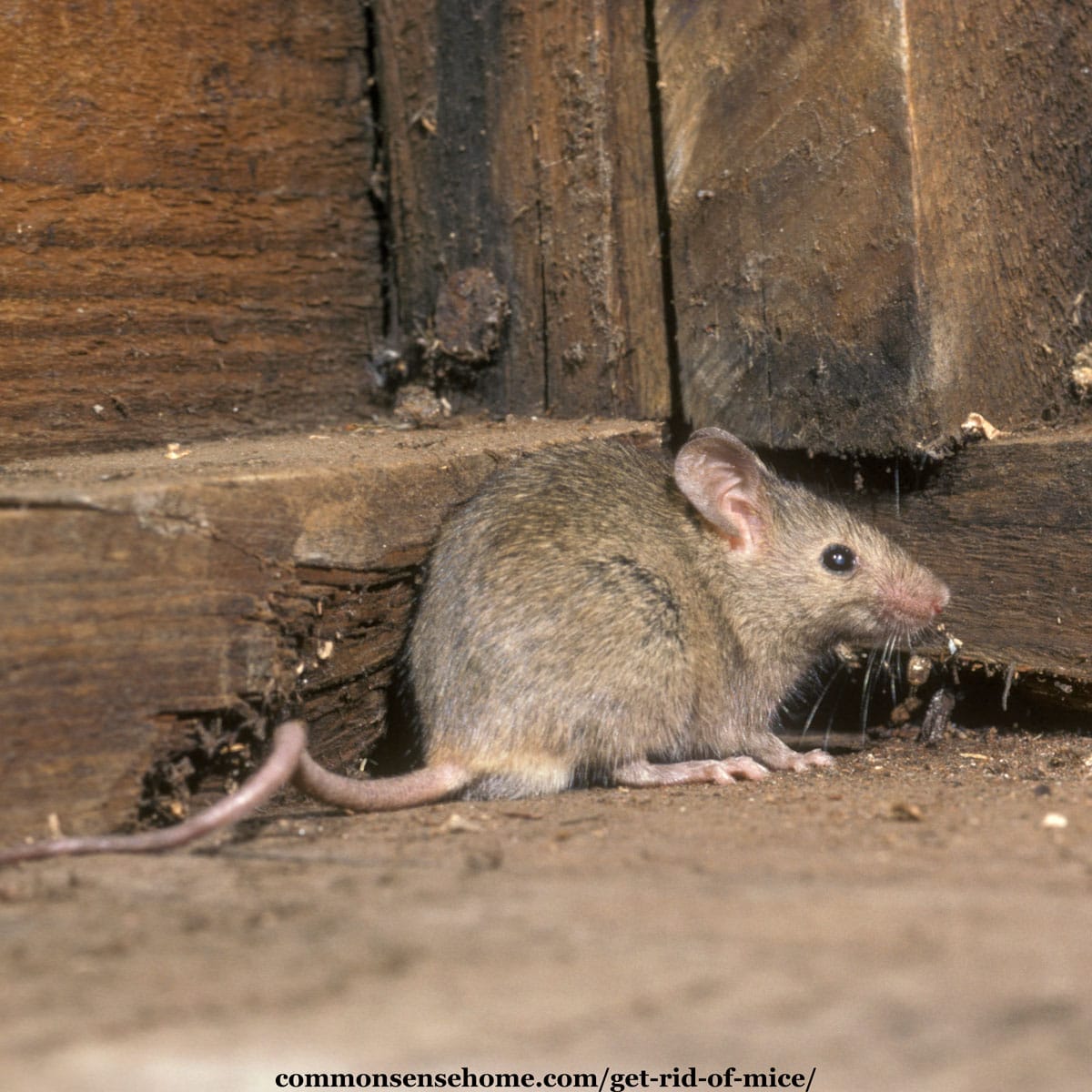
It’s probably more common to see mouse droppings or mouse damage before you see the mice themselves, as they are nocturnal.
When I was a kid, the little buggers would drive me crazy at night running around up in the attic. Thankfully we didn’t get rats in the house, but they would sometimes show up in the outbuildings around the farm.
Identifying Droppings and Urine
Killum Pest Control offers an excellent online guide to interpreting rodent signs. Please visit their site for more information, but I’ll just share briefly their comments on dropping and urine identification.
Rodent (Mice and Rat) Droppings
Fresh droppings of feces usually are moist, soft, shiny and dark, but in a few days they become dry and hard. Old droppings are dull and grayish and crumble when pressed with a stick.
The roof rat’s droppings are up to 1/2 inch long, spindle shaped and curved in contrast to Norway rat droppings which are about the same length but comparatively blunt. Mouse feces are small, averaging about 1/8 inch long, and are pointed on both ends.
Rodent Urine
Dried rodent urine will fluoresce bluish white to yellowish white. Commercial black lights often are used to detect rodent urine, however observing fluorescence is not a guarantee that rodent urine is present.
Numerous items will fluoresce under a black light, including optical bleaches found in many detergents and lubricating oil. Of course, if there’s a glowing track of pee, odds are you have mouse movement.
Mice commonly mark their trails with urine (yes, I know, you probably didn’t really want to know that…) so that other mice can follow their tracks to food sources.
One source I read said that they produce 50-60 droppings per night – ewwww…
Once you’ve found their way into your home, you need to block it, otherwise they be right back in via the pee track highway. They can climb, too – like mini rodent ninjas.
Rodent Food and Nests
You may also find food stashes and nests in out of the way corners. I remember finding a mouse nest in the back of a desk drawer in my room.
Gnawing damage is another dead giveaway. My mom had a cardboard box of old cooking magazines inside a wooden cabinet, and the mini rodent ninjas still found their way in and chewed the edges of the magazines.
How to Keep Mice Out of Your House and Garage
The best way to get rid of mice is to keep them out in the first place. To keep these critters out and keep your family safe and your goods protected, follow these simple steps.
1. Remove Food Sources
Bird food (grains), pet food and other edible odds and ends (even cardboard) that tend to pile up in garages are like mouse nirvana. Crumbs under the couch are a gourmet treat, and a cookie lost by toddler is a mouse family buffet.
Seal all food (for pets or humans) in solid containers, not just thin plastic food packaging. (Rats can and will chew through plastic bins, so be warned. You need to use metal containers to keep rats out.) Plastic garbage cans or Rubbermaid tubs for pantry storage will generally keep mice out.
Vacuum or sweep regularly. Gaps between appliances like stoves or refrigerators and cabinets can collect crumbs where they are difficult for you to clean, but handy for mice to dine.
Remember, if they can get their heads into a space, their bodies can get in, too.
2. Seal Openings
This is the probably the toughest but most effective way to keep mice out – seal entry points.
As I mentioned above, if a mouse can get its head though, the body can go through as well. The little pests only need about a ¼ inch (0.6 cm) wide opening. Check door sweeps and dryer vents, and any other wall perforations.
They can jump – up to 18 inches (I told you – mini rodent ninjas), travel upside down (you bet), and crawl along an electrical wire or pipes(piece of cake). If you can stick a #2 pencil through a hole, a mouse can probably use it to get into your home.
When you find cracks or holes, you want to seal them as tightly as possible. You should be able to find patching supplies at your local hardware store.
The Internet Center for Wildlife Damage Management recommends: Steel wool, copper gauze (stuff-fit) or screen wire packed tightly into openings is a good temporary plug. Note: If you use steel wool, you may get rust stains.
For long-term or permanent repair, mix a quick-drying patching plaster or anchoring such as Fixall® into a wad of Stuf-it® before pushing the material into the hole, and smooth over the outside.
Holes 3 inches (8 cm) or more in diameter should be covered or backed with 1/4-inch (0.6-cm) woven/welded hardware cloth prior to filling with a good patching compound.
One of our readers had good results with GREAT STUFF Pestblock 12 oz Insulating Foam Sealant. They specifically include a bitter ingredient to make the foam unappetizing to pests. Caulk may also work for small holes.
3. Reduce Outside Habitat
If possible, reduce the amount of mouse habitat outside your home to reduce the number of mice inside your home.
Trim trees and shrubs away from the home. Clean up debris, trash cans, brush piles, and other hiding spots where mice may shelter. Keep your compost bin(s) as tidy as possible (opossums and rats like to raid the compost, too).
I saw one site recommend moving wood piles 100 feet from the house and raising them one foot off the ground. Obviously they don’t live in Wisconsin. The mice will have to stay in the wood pile – their nests make great tinder.
4. Set up Barricades with Kitty Litter and Peppermint Essential Oil
One of our readers shared her experience with this natural deterrent:
I used peppermint oil dropped on plain kitty litter. I put a small bag of litter (5lbs.) in a container from dollar store added 4 oz. Peppermint oil. Put lid on and shook it well. I left it over night.
Then I put about a tablespoon of the litter in a small piece of old sheet or cotton balls whatever you have lying around. tie it into a little bundle or sachet.
Place these around your house outside about every 2 feet and in garage and basement areas along walls. The scent lasts longer than spraying the oil and you don’t have to worry about woodwork.
Remember mice have a keen sense of smell, after all they can find a lost potato chip behind a cabinet. So even though the smell decreases it’s still working.
All I do is add a fresh drop of the peppermint oil to each little sachet every 6-12 months. Its been over two years since my mice disaster so it is working well for me.
Click here to buy 4 ounces of peppermint essential oil.
How to Safely Clean Up Mice and Mouse Droppings
Because of the risk of hantavirus and other illnesses, care should be taken when cleaning up mouse droppings/remains, especially in quantity and/or in enclosed areas. (Information adapted from Environment, Health and Safety Online.)
- Wear gloves, either rubber gloves or work gloves you can wash in hot water
- Spray the droppings first with 3% hydrogen peroxide, then with white vinegar. This will kill 99% of bacteria. A bleach water solution or disinfectant is also an option.
- Wipe up droppings with a paper towel, throw towel in garbage
- Clean area with disinfectant solution or hydrogen peroxide/vinegar combo
- Wash hands with soap and water before and after removing gloves
If dealing with large amounts of droppings, you may need to hire cleaning or pest control professionals. At the very least, please wear a face mask or respirator. Please be careful! Your county extension office may be able to provide more information on any known rodent related disease outbreaks in your area.
Treat nesting materials and dead mice similarly. Always wash hands thoroughly after touching contaminated materials.
If you can’t get rid of the mice yourself, consider an exterminator or professional pest control company. Rodents can carry serious diseases and cause a lot of damage.
You may also find these other posts from our Green Home Series useful:
- How to Get Rid of Ants Naturally
- The Ultimate Guide to Natural Pest Control in the Garden
- Natural Mosquito Repellents That Work
- 9 Tips to Get Rid of Fruit Flies, Plus the Best Homemade Fruit Fly Trap
- Natural Spider Repellents – 8 Ways to Get Rid of Spiders
Last updated in 2023.
My family recently moved to a small acreage this last Oct and could not believe how bold these little critters were. We found them in everywhere around the property including my husbands truck! but with traps and keeping it clean (as well as we can with a toddler) we seem to have kept them at bay from getting back into the truck with the help of a peppermint soaked bit of felt that we hang in there like a tree freshener . As for the rest of the property, especially the garage and sun room, I have a less humane way of dealing with them. i get a 5 gallon bucket and put about an inch of antifreeze in it, its like a drug for them that they can’t refuse and it actually tastes sweet to them (same with any other pet so be careful. but if a pet does get into it just feed them greygoose vodka. it happened to a friends dog and it worked) just set the pail in the room with a way for them to get in and empty it when it starts to get full.
Thanks for including the antidote note.
Push 1/2 of a jelly bean on the metal bate bar, then top with a little dab of peanut butter. They can’t get the bats off without tripping the trap.
Thanks for the tip!
I saw that you used mint oil and that you got it in large quantity. Where can I purchase it in larger amounts?
You can get 4 ounce bottles of peppermint essential oil very reasonably priced on amazon – visit Best Peppermint Oil (Large 4 Ounce) 100% Pure Peppermint Essential Oil.
any wellness and vitamin shop will keep them in stock or any store that sells mist/humidifier diffusers
used peppermint oil weekly rather than monthly as recommended and it did not work…mice enjoying
It may be the peppermint oil (there’s a wide variation in quality), or it may be the now minty fresh mice (rodents are tough and adaptable). Another more aggressive method of control may be required.
Yes, I did essential mint oil too on cotton balls. They chewed the cotton! Also chewed on bits of Irish Spring soap! They loved it!
And now they all have very fresh breath.
Try this, called Stay Away Mouse Repellent packets put around the house, attic and garage.
And this – Victor Pestchaser Rodent Repeller with built in night light plug in
My friend tried it, the mice are gone. They can only hear the sound not you.
Whenever I need mousetraps I always use parmesan cheese and peanut butter. I mix them together and put it on the traps and it seems to work really well, we have a mouse in our house now and are trying to get it out, the cheese and peanut butter has seemed to work really well before, so I’m hoping it will this time. Good luck everyone that is trying to catch mice 🙂
The cheese and peanut butter combo sounds good. No easy way to grab and go.
I really appreciate you pointing out the different kinds of foods that will attract mice into a home. My wife and I just found out the other day that we have a mouse problem and we honestly weren’t sure where they came from and why they are even here. After reading this though, I realized that we have both bird feed and dog food in our garage and I’m willing to bet that they go through some of the openings in our garage and began eating them that way. We will move the food, seal the openings, and call in a service to get rid of them.
I had mice in my garage and tried all kinds of things to get rid to no avail … quite by accident I was running the engine of my diesel van while parked close to the garage, the garage filled with fumes which made me feel sick, this gave me an idea … I backed the van closer to garage closed the door down to near the exhaust pipe and let it fill the garage for a while … it worked a treat every single mouse left.
Just make sure to vent well before going back in. 🙂
That was interesting 😀
Poisoned mice are a danger to wild animals and our pets. I had a terrible mouse infection last year. I emptied about 3 traps almost everyday. I did use tootsie rolls as bait. Then I found Earth Kind Fresh Cab Natural Botanical Rodent Repellent . Best natural repellent ever. Worked wonders and fast. Its all natural made with Balsam Fir oil a natural pesticide and 100% guaranteed. I found it at Menards and you can also find it online.
Thanks for the recommendation. I hadn’t heard of this product before. Thankfully we don’t get many mice, so I generally stick to traps.
Be careful when using the poison packs. The poison causes the rodents to have a strong desire for water and they will even chew through the water lines under your house or in your attic. We had a problem a few years ago and used this stuff and the rats chewed into the water pipes and even into the sewer line under the house. The plumber that repaired the damage said he has replaced all kind of water lines (plastic not copper) but he had never seen a rodent chew into the sewer line like in our case. I will never use that poison pack crap again.
Many newer houses are all plastic, so I could see where this would be a real problem. Thanks for the warning.
I used this product too but with much less success. Still had mice chewing on my dishwasher wires
didnt work for me…they used it for nesting
We only recently started using vinegar to control the mice in our home, and it’s worked wonders. Our dog hates the smell of it, and the mice seem to avoid it. Vinegar really has become the all-purpose wonder-spray in our house!
Interesting.
Thanks
What exactly did you do with the vinegar?
How did you use the vinegar!
We had a terrible mouse problem this past winter. We used Tootsie Roll candy for bait. Hands down was the best bait; and because it is sticky they couldn’t grab and go like other things.
sticky yicky. sounds good. they love sweets. I discovered a funny pile while deep cleaning under some shelving. they’d piled squares of a missing chocolate bar supported by poison pellets. wonder if they ever would have come back for a snack. ROFL
Had farm rats that 3 cats could not control. I spoon sugar, I spoon bicarb, I spoon flour. Mix dry, put in tuna tins. They eat, go home and it sets in the stomach like concrete = NO RATS NOW . . .
Hows that?
Hiya, are u saying you mix dry ingredients then add to tuna in tins, or put in empty cleaned tuna tins, or in tins that have been emptied and left to dry with tasty fish oil still inside?
I believe he means dry used tuna cans with dry mixed ingredients. Once they eat it and drink anything the mix sets hard. I assume he meant bicarbonate soda too. I’ll try it.
Did it work?
maybe great if vermin are out in a barn but stinking up my place while they rot and get maggots somewhere inside my home is not acceptable. no thanks. i use traps and poisons that dry them up and occasionally am forced to endure the smell when one eats enough to get killed but not enough to dry up. a couple years ago it took me 3+ days to find one in the bedroom. It had crawled up the closet shelving, into a back corner inside the wool shawl a friend made with wool from her black sheep. the scene was more than disgusting. I will save this recipe for critters that don’t or can’t get in my home.
does Irish Spring bathsoap really deter mice and rats?
Maybe? They don’t like some strong odors, but I don’t know if that would be strong enough.
A kind way to be mouse free is to put food in an empty aquarium… the mouse can jump in but can’t get out… then empty the mouse out of the aquarium far away in a safe place for the mouse.
Ha! My son kept pet white mice in an aquarium. When he wasn’t home the mice got lonely and came and got in bed with me during the night!
Eighteen months ago we moved into a lovely Victorian terraced house on the edge of our largest town. When we first moved in there were some small signs of mouse activity, but nothing was ‘fresh’ so we presumed that the mice had left when the building was being restored. We didn’t see anything else for about six months, then one morning I was sitting in our lounge when I thought I saw something move near the fireplace. We have a cast iron wood-fired stove and that requires logs and kindling to be placed nearby. I sat very still and eventually I saw a small furry face peep around the logs and look at me. I keep pet rats so I’m not scared of rodents so I just sat watching the cheeky beggar to see what he would do. I didn’t have long to wait before he came out of the log pile, sat in front of the fire and began nibbling at some crumbs that my other half had dropped when he was making toast! Over the next few weeks we discovered that we had grey field mice ( a large family of! ) some common house mice ( larger and browny coloured ) and a small rat that had got into the house when our new electricity meter was being fitted ( the fitters had left a hole leading to the outside underneath the meter! grrr! ) We set all kinds of traps, with numerous baits and it was only the humane traps that worked for us. We live near a large park and not far from the local landfill and recycling centre ( classy area!! ) So we would take a trip out in the car each morning, loaded up with various rodents, and we would take them to the far side of the peninsula on which we live… a distance of twelve miles or so. We haven’t had any problems since, thankfully, because we have repaired all of the possible access points and our local council have completely cleared the area to the rear of the houses that we think they came from originally. This area is now landscaped and full of flowers and interesting plants, and is being used to educate the younger members of the community about respect for the environment and gardening. We’ve kept the traps, though…….just in case! 🙂
Thanks for the article, and Daryle, for your advice! I will definitely try that out. I have a very unpractical phobia: rodents. Dead or alive, they give me the heebie-jeebies so I can’t even walk past a dead one. And I’m a pretty tough woman. So in the fall, I wake in a cold sweat when I hear them running around…
at the same time, we’ve stopped putting poison out, after I read a few articles on the impact on wildlife (http://www.nature.com/news/killing-rats-is-killing-birds-1.11824), so now we have traps, instead. We bait them with chocolate, which doesn’t dry out so fast, and is mighty popular with the mice.
I’m just going to have to learn to empty them… and spray lots of peppermint around!
We got Intruder traps and really like the easy way they set, with no risk to fingers, and very reliable snap. I checked their website, and they look a little different than the ones we ordered last year. We were planning to order more, and the price is (somehow!) lower this year. Hope this also means just as good or better.
http://www.intruderinc.com/collections/better-pest-control-solutions/rodent-mouse-control
I concur with the recommendation about peppermint oil. What I read was that farmers used to block every entrance to the barn but one, spray some peppermint oil around inside, and stand guard at the remaining exit hole where they would nail the rats and mice as they fled.
My guess is that the pungent odor stung a little and blocked up their olfactory perception to a painful degree.
The constant rain and constant cloud cover in our part of Wisconsin has slowed and interfere with the wild nut and berry bushes that abound in our area. I have been wondering if the increase of seeds from the gloriously lush weeds may not be able to satisfy the critters in the woods, and we may see more mice seeking shelter and food this year. Our local newspaper editor commented that the heavy rain is the reason why there are far fewer mosquitoes this year.. The logic? He says there are also more frogs, and I guess he is right! I have also seen a lot of young (small) snakes in my garden this year, and wonder if their predation on my toad and frog buddies will be made up for by the prospective feast of mice. Once again I am amazed and humbled by the majesty and wisdom of Nature. Here’s to an other exciting, and maybe mouse-free fall! Sandy
I live surrounded by woods. I keep the mice under control by using a solid cheap poison from Aardvark in Jaws traps as mentioned by Laurie N. The traps are placed in my attic on the wall edge and accessed from the outside by opening the soffit. The bait is rarely gone and I simply have to reset the trap for the next one. I have the traps screw to 2×4 pieces so they can run away. I used to use peanut butter, cheese or you name as bait but it would dry out have to be replaced. I think I will try the mint and ammonia combo as they enter from the ground up underneath the siding corners.
I had mice in my laundry room which is located in a different storage shed. I would go to do laundry and there would be about 2 or 3 partying around my washer. I got traps, put peanut butter on them. I tried both crunchy and smooth. I tried this three times and three times they tripped the trap and had a meal. Grrrrrrr. I finally had to get poison which they devoured, all three boxes and within two days, no more mice, rats, whatever.
Sometimes it takes stronger measures to deal with the problem. I have found that the Snap-E traps seem to be more reliable than our old wooden ones, maybe because the bait goes into the little cup and they have to work a little harder for it.
I used “crunchy” peanut butter & forced a delectable chunk of peanut firmly into each orifice of the curled metal trigger on our old style wooden traps. Top off with a small creamy offering. Works like a charm. They get the easy creamy taste then throw caution to the wind & start to gnaw on the nut bits. End of problem.
I have lots of luck adding a few drops of anise oil to my bait, In don’t even have to change the bait after I catch a mouse, just add some more anise oil to the bait each time, they seem to love the smell.
where do I get peppermint oil in bulk. I need a lot. Also, will it stain wood? I need to treat wood that is visible
You can get a fairly large (4 ounce) container on amazon pretty inexpensively (peppermint oil link), but it may damage the finish on your wood. Better test on a small area, or consider using dried or fresh herbs, or significantly dilute the oil.
will the mixture with amonia keep it from staining wood?
Probably not, but if you wanted to try it, I would test on a small area.
But amazon does not ship to V Canada ,any other source???
Sorry, I’m not familiar with shopping options in Canada. You’d need to inquire with Canadian vendors.
Peppermint oil is available at any health food store and may be in some drug stores in Canada. I am not sure where bulk may be purchased. Chinese stores?
I bait my mouse traps with a sun flower seed. I push the seed into the hole where the peanut butter would be put. It never drys up and the mouse can not get the seed easy and trip the trap.
In the shell or without the shell?
No shell. I stick a couple in a dab of creamy peanut butter. Works great. I’ll try just the seed too.
These traps are excellent. Unfortunately I just caught two by the tail though, one of which got away when I tried to kill it. I should have set it perpendicular to the wall as shown. I AM SO SICK OF BEING INFESTED WITH MICE. I could sell this house. I’m so sick of it. I can’t tale it anymore. They were here when we moved in and no matter how many I kill they’re still here. I think the problems in my foundation, the holes really need to be addressed as mentioned.
Bad infestations are extremely difficult to beat. Don’t forget to check the attic, too. I still vividly remember hearing the mice crawling above my head back our old farmhouse. Good luck with clearing them out.
I have rats in my attic. Their droppings ate falling out of my air conditioning vents and onto my carpet in my bedrooms. What is the most nontoxic way to get rid of these rats? Thank you
You can try the options listed in the post for mice, but rats can be tougher to eliminate. It sounds like there is a serious waste issue that should also be cleaned up. It may be time to call a professional, especially due to the risk of disease.
they now make some expanding foams the have repellents in them. you’d have to research where they can be used, etc. I used one of the first of the to stop mice along a waterline where they kept removing steel wool etc. For 5 nights I heard them gnawing and squeaking with in anger as they tried to chew through 1″ plywood. They were SO angry! Perharps one of the foams could be used in your basement situation.
Mixing a bit of oatmeal with peanut butter , along with some dental floss, in the trap, has been a game changer. It works on even the craftiest of rodents
Thanks for the tip. Do you wrap the floss around the trap trigger?
I live alone, and recently had an 8 month stay in the hospital, when I got out and home, I was overrun with the little critters. I took a 5 gallon bucket, drilled two small holes in the rim opposite each other. I then used a plastic tobacco can (also drilled cover and bottom with small holes) put a length of coat hanger through it, and extended both ends on the coat hanger across the bucket to the two holes on either side. (Makes a little spinning barrel across the 5 gallon bucket) I added 4 inches of water to the bucket and circled the tobacco container with a ring of peanut butter. Then set the unit in a secluded place in the kitchen, following morning I had 4 mice to dispose of (they drown) over 1 week I trapped 15 mice, they are now gone, and I may catch 1 every month or two. It works!
Thanks, Wayne.
I hope you are on the mend from your hospital stay.
We used Snap-E style (the ones made by the reliable old wooden trap company), and used a generous dab of peanut butter to glue down half a honey roasted peanut. Between those and the cats we pretty much solved the problem long enough to patch the holes in our patchwork foundation.
I do have to say that our larger kitty man seemed rather offended that we humans were catching mice!
What poison did you use and where did you buy it?
what.brand poison did you use?
What kind of poison? I am trying to get rid of them in our garage. They keep eating the bait but have not gone yet. Just want them gone.
What kind of poison did you get?
What poison did you use
The laws have changed, at least here in Canada. We need a farm or other license to buy anything other than perhaps a small cube in a hard plastic casing for $5 a pop. It’s hard to get kill ’em dead stuff anymore. According to my supplying rancher friends they’re making products that don’t kill right off. The friend said they think it’s so any animal accidentally poisoned can get treatment.
One brand I used to buy wasn’t working anymore. I phoned the company. They said if I had mice inside I must keep them inside for a minimum of 7-10 days and they needed to eat off of it exclusively during that time. It turned out to be now be made with corn husks.
The only product I have any left of that I know has worked is bromadilone. They eat it, die and dry up. Diphacinone eventually will kill them but they also can eat some, find other food source, get sick, maybe crawl off somewhere – like in your best whatever – eventually die and you have to put up with the stink until the flies and insects have laid their eggs. It can be a real mess. I found one in the back of closet shelving rotted in between the shawl my friend had made from wool she grew and another shawl. IT was one of the grossest things I ever had to deal with. I could smell if for 3 1/2 days before I was able to find it.
I copied the names of 2 other available products (on Reservation land) but haven’t had time to research them. It sounds like, even if you have a farm license, it will soon be impossible to buy anything strong enough to quick kill.
If my [bleep bleep] neighbors would quit feeding wild pigeons and buying cheap bird seed that none of the nice birds eat I’m sure my problem would be less bad. It’s getting out of control. They even ate the shoulders out of clothes hanging in my closet. They love rayon more than cotton. They chewed my cashmere dressy gloves to bits.
BTW, I found a rotted mouse that died on carpet. It stained the carpet. I’d had a similar incident some years ago and it left a bit of a stain. Since I’ve been using 3% peroxide as kitchen disinfectant if figured I’d poor peroxide on it for starts. BINGO. Not only did it sterilize it, the stain totally came up. I poured on, went off to look for a scrub brush, came back with paper towels, blotted it up a few times and the stain was completely gone.
Thanks for sharing your experience, and sorry about the jerk neighbors.
You need to put gloves on before touching the traps because you are leaving your sent on them so they will avoid them. Another trick is put peanut butter on the traps but don’t set them, let the mice eat the peanut a couple of times then set it they won’t be expecting it
Must try these tips, especially from Daryle. Rats are attracted to the macadamia nuts which fall from our tree. They are very clever to avoid the traps!
Wow…that would be very upsetting knowing mice are eating the macadamia nuts. Death to those mice, indeed.???? I love macadamia nuts.
One method that does work to control mice and most rats is spearmint or peppermint. The oil of either (sometimes called essential oils) is available from your favorite supplier. Both mint oils are also a commodity, government regulated. If you know how to buy it, a quart of commodity grade peppermint oil can cost little more than those cute boutique bottles of essential oil.
The other method is to plant either or both mints around your house. The rodents won’t crawl through the mint barrier gladly.
I mix one part peppermint oil to six or more parts ammonia and put it in a spray bottle. Spray along the outside walls and in the attic. Over time it seems to stop the infestation almost permanently. If you hear the critters at night, spray again.
I know a bunnies are slowed down in the garden by mint, but I haven’t tried it for mice yet.
Mint! I know it is good at keeping spiders and ants away, but mice and rats too! Love it. Will be planting. Thanks for all the information Daryle.
I see spider webs in the mint bushes so I wonder about spiders
Spiders are good. They help control flies and other insects.
I live in zone 7b and mint will spread very quickly….invasive.
i would rather have invasive mint than invasive rodents
Amen! 🙂
Just put in big pots and cut any of the feeder shoots that extend from the pots. Keeps them in check
thank you so much for the great natural solutions!!!!!!
Are any of these oils toxic to cats ? Thank you .
Cats do tend to be very sensitive to essential oils, so if you wanted to use EOs in a household with cats, I’d recommend the other method with mint EO and kitty little packets spread around the perimeter rather than a surface spray.
All,
Do any of you go about buying peppermint oil in bulk — e.g. by the quart. We just saw a big mouse in our basement and want to take care of business! Thanks!
The biggest I’ve seen is 16 ounces, such as NOW 16 ounce peppermint oil.
Locate a farm the raises mint and processes it after harvesting it for the oil it contains .
a cheap and easy clean way to catch mice is with a 5 gallon bucket. Mice need water. Fill the bucket up 1/3rd with water and put near an area where they can climb up next to. Once they get in, the walls of the bucket are too slick so they drown trying to get out. I have caught many mice this way in my warehouse.
I have the plastic traps in the picture. I glue gunned peanuts into the bait cup so they cannot steal them and run off. Also, if they try to pull them out it increases the pressure on the trip device. I have caught 12 mice since Xmas. We live way out in the country.
I had not thought of a glue gun. Good idea.