
What Happens if an EMP Hits? How it Impacts Daily Life

This post may contain affiliate links. Read my full disclosure here.

A large electromagnetic pulse (EMP)—a sudden burst of electromagnetic radiation—can interfere with electronics and damage parts of the electrical grid. These events may be caused by a high altitude nuclear explosion or by powerful solar activity interacting with Earth’s magnetic field.
Modern life depends on electricity. Our homes, vehicles, communications, and food systems all rely on a vast network of electronic devices, power lines, and connected electronic systems. Most of the time this infrastructure works reliably in the background.
But certain rare events can disrupt that system in seconds.
In this guide we’ll look at:
- What an electromagnetic pulse is
- How it might affect daily life
- What past EMP events tell us
- How to prepare for power disruptions caused by EMP events
Preparedness isn’t about panic. It’s about understanding risks and planning practical solutions.

Would you like to save this?
Author’s note: I saw power grid transformer explosions like this as a teenager, when an ice storm shorted out the lines. It’s been decades, but I still remember it clearly.
Table of Contents
What is an EMP (Electro Magnetic Pulse)?
An electromagnetic pulse (EMP) is a sudden surge of energy that spreads outward from its source.
When this energy reaches the ground, it can interact with metal objects, wiring, and electronic equipment. Long conductors like power lines can act like antennas, collecting energy and sending damaging surges into connected systems.
In strong events, the surge may:
- Disrupt electronic devices
- Damage electronic systems
- Trip circuit breakers
- Interfere with communications equipment
- Damage transformers in the electrical grid
Most EMP events do not directly harm people. Instead, the danger comes from the disruption of modern infrastructure.
What causes an EMP?
Several things can produce electromagnetic disturbances, but two causes are considered the most significant.
1. Nuclear EMP
A nuclear EMP occurs when a nuclear weapon detonates high above the Earth. The explosion releases gamma radiation, which interacts with air molecules and Earth’s magnetic field. This interaction creates a powerful burst of electromagnetic energy that spreads across a wide region.
A high altitude detonation is particularly effective because it allows the pulse to affect a very large area. This type of event is often referred to as an EMP attack.
2. Solar EMP (Geomagnetic Storm)
The sun regularly releases bursts of energy called solar flares or coronal mass ejections (CMEs).
When these particles reach Earth, they interact with the planet’s magnetic field and create geomagnetic disturbances.
Unlike nuclear events, solar disturbances usually develop over hours or days. They mainly affect long conductors such as power lines, pipelines, and transmission equipment.
Large solar storms can damage key transformers in the United States electrical grid, potentially causing widespread outages.
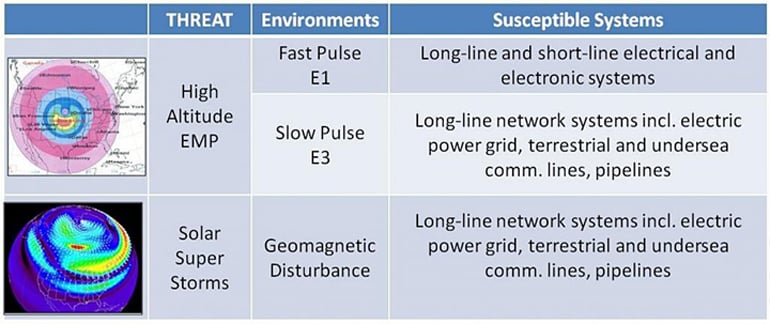
What Happens if an EMP Hits?
The effects of an electromagnetic pulse depend on its strength and the systems it interacts with. Most people would notice the event through loss of electricity and communications, rather than the pulse itself. Possible impacts include:
Power Outages
Damage to large transformers or substations could cause major sections of the electrical grid to fail. Without electricity, homes and businesses could lose:
- Lights
- Refrigeration
- Heating or cooling
- Internet service
- Cellular networks
Power outages could last hours, days, or longer depending on the damage severity and area impacted.
Electronic Devices May Fail
Some electronic devices may stop working temporarily or permanently.
Possible failures include:
- Computers
- Cell phones
- TVs and radios
- Appliances
- Generators and inverters
Damage depends on the strength of the event and how well the devices are protected.
Vehicles May Be Affected
Modern vehicles contain complex electronics that control ignition, fuel injection, and safety systems. Some vehicles may stall or fail to start if these systems are damaged. However, research suggests many vehicles would likely survive smaller EMP events. Older vehicles with fewer electronic systems may be less vulnerable.
Infrastructure Disruptions
Large EMP events could affect critical infrastructure, including:
- Communications networks
- Transportation systems
- Fuel distribution
- Banking and payment systems
- Water treatment plants
Because these systems depend heavily on electricity and digital controls, disruptions could spread quickly.
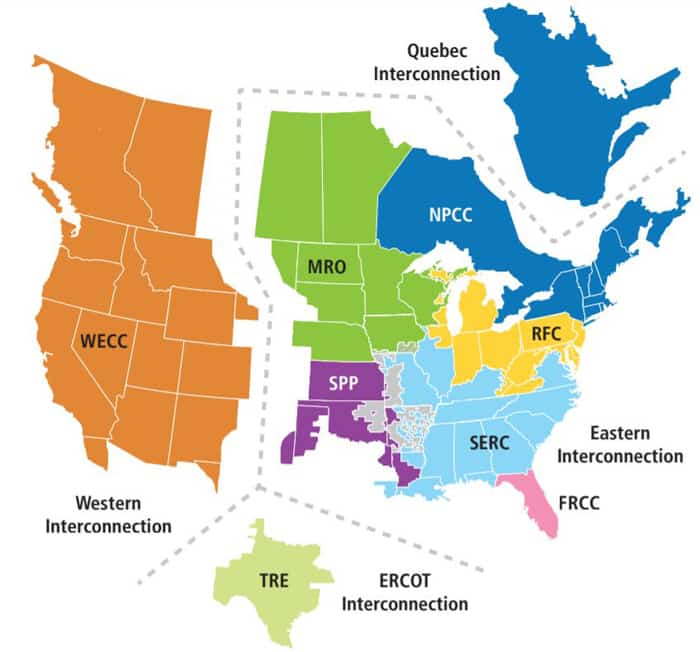
How Long Would Recovery Take?
Recovery depends on the size and scope of the event. Possible recovery timelines include:
- Hours or days for localized disruptions
- Weeks or months for regional damage
- Months or years if major grid components are destroyed
Large transformers used in the electrical grid are complex and difficult to replace quickly. They don’t have many spares. Loss of electricity would also affect water systems, natural gas delivery, and fuel pumps.
The biggest risk is a multi warhead nuclear EMP attack resulting in multiple atmospheric nuclear bursts. Multiple bursts spread out over the USA would likely cripple if not destroy the entire power grid.
Have EMP Events Happened Before?
Yes—though most have been caused by solar activity rather than nuclear weapons.
The Carrington Event (1859)
The largest recorded CME was the 1859 Carrington event. It lasted multiple days and impacted the entire planet. Telegraph lines across the United States sparked, caught fire, and shocked operators. In some cases telegraph equipment continued operating even after power sources were disconnected.
If a storm of similar size occurred today, it could disrupt satellites and damage large portions of the modern power grid.
NOTE: Scientists suspect that in 774AD there was a major flare referred to as the Miyake Event. The estimates are that it was 10x to 14x larger than the Carrington Event. As this cannot be 100% confirmed I list the Carrington as the largest recorded. The measure was based on carbon-14 tracking in trees.
The Quebec Blackout (1989)
A solar storm in 1989 triggered a geomagnetic disturbance that knocked out power to much of Quebec for about nine hours. The event showed how vulnerable modern power grid infrastructure can be to solar activity.
Starfish Prime (1962)
During Cold War testing, the United States detonated a nuclear device high above the Pacific Ocean. The resulting electromagnetic disturbance damaged electrical systems in Hawaii nearly 900 miles away.
What is the difference between Solar and Nuclear EMP?
Both types of events affect systems differently.
Nuclear EMP
- Very intense
- Very short duration
- Primarily damages nearby electronic equipment
With the proliferation of nuclear weapons, the likelihood of a nuclear EMP increases. A nuclear EMP requires a nuclear weapon delivered by a rocket, high flying aircraft or ICBM. The nuke is detonated high in the air (referred to as an “air burst” or atmospheric burst) to create the EMP.
In a worst case scenario, the nuke is detonated in the upper atmosphere, approximately 20 miles up. A large 1 kiloton to 2 kiloton nuclear electromagnetic pulse like this would be very serious. A nation state or rogue state such as North Korea or Iran are the most likely cause of an atmospheric nuclear burst (EMP).
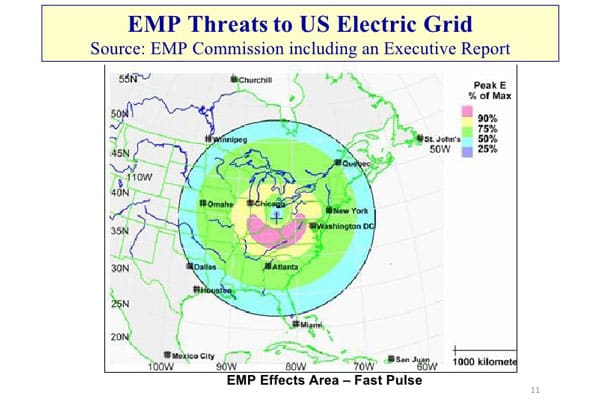
Note: In nuclear weapon tests, the EMP doesn’t expand in simple circles. The earth’s magnetosphere deflects and interacts with the blast, causing the waves to spread more strongly away from the poles and may vary widely.
The pulse is concentrated more strongly in a semi-circular band, as shown in the image above. The earths magnetic field deforms the explosion. The image below gives a rough idea of the interaction between the EMP and the magnetosphere.

The graphic above is only an estimate – and would vary in the real world based on size of the weapon, altitude it was set to explode at, the atmospheric state, magnetosphere state and other variables.
Recent News
USAF Role in the Electromagnetic Pulse Vulnerability of the United States Critical Infrastructure
US working with 77 radio stations on EMP protection
Could a surface nuclear blast cause an EMP?
A terrorist group would have trouble successfully setting off a high altitude air burst. It is more likely they would likely use a ship and float in a nuke to a major port city.
The lower altitude greatly restricts the range of the EMP damage. Unfortunately the proximity to the ground would increase local physical damage, gamma radiation and fallout.
A dirty bomb would tend to be devastating locally, but would not result in a widespread EMP. See also “Nuclear Radiation Exposure – How to Reduce Your Risks“.
Solar EMP
A solar flare or Coronal Mass Ejection (CME) is created by the sun through normal activity results in a burst of electromagnetic radiation that travels through space. This type of EMP is normally less damaging to electronics but more damaging to the power grid.
You may have noticed our bright displays of northern lights in recent years. This is the mild side of CMEs. In general, solar storms are:
- Lower intensity
- Much longer duration
- Primarily affects long conductors such as power lines
A severe solar storm could potentially affect multiple regions of the planet at once.
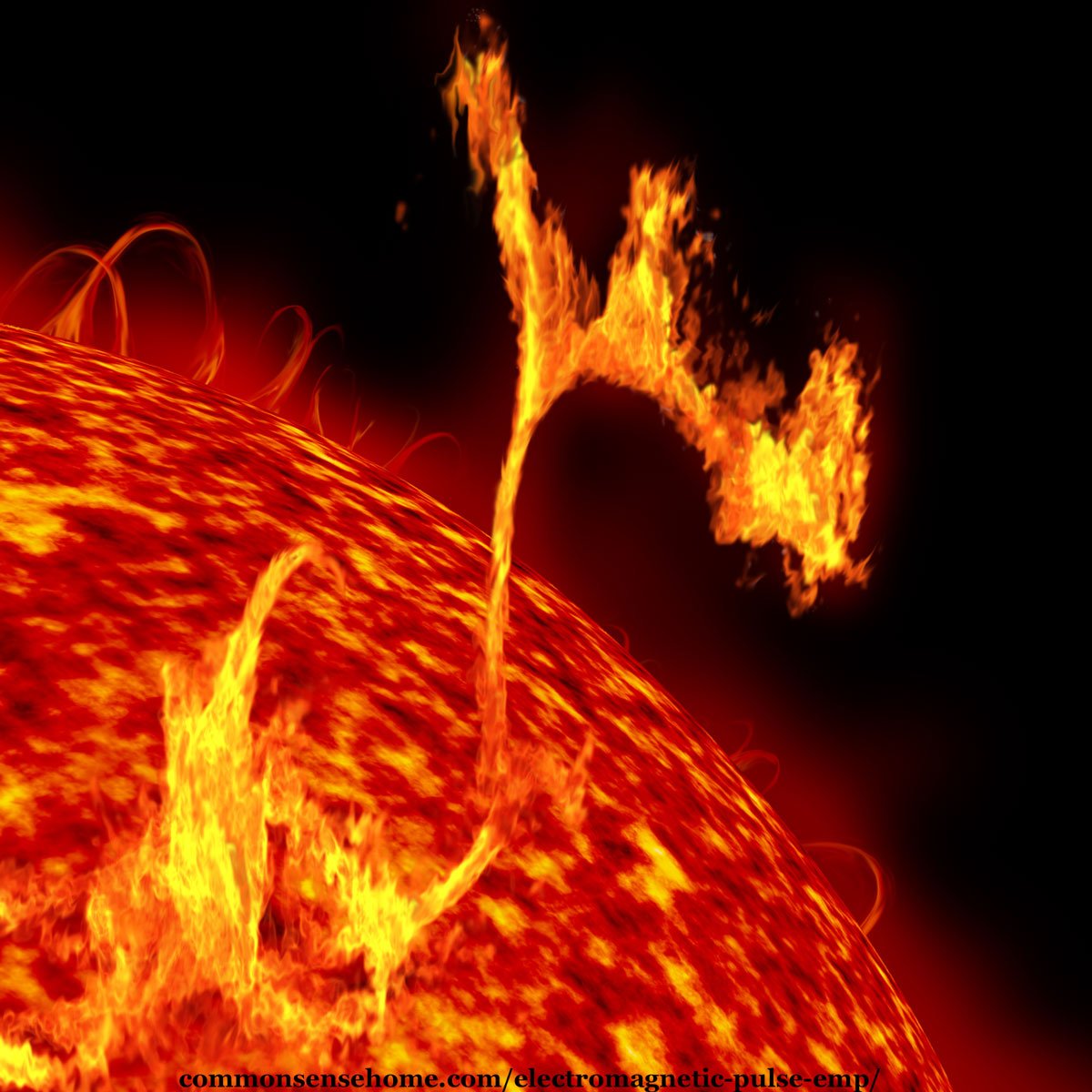
Scientists can detect a coronal mass ejection (CME) and have time to issue a warning. It takes about 5 days for a CME to reach earth.
When a CME hits the earth it creates a geomagnetic storm or EMP on earth, also referred to as a Geo Magnetic Disturbance (GMD). Our magnetosphere protects us from most solar radiation and EMP effects. Although rare, larger solar flares get through the magnetosphere and impact the earths surface. The flares that hit the surface are the biggest theat.
Why is a solar flare dangerous?
A very large, extended Solar Flare EMP could destroy some or all of the high voltage backbone transformers, locally or globally. These transformers are critical to the U.S. electric grid. Even if only a few hundred of the larger transformers were destroyed it would likely disable the entire interconnected system for weeks, months or even years.
Small electronics could survive a solar flare, cell towers could, some cellphones may survive also. The bigger problem is the power grid damage. In general a large long lived solar flare would be far worse than a single nuclear EMP, damaging or destroying satellites and the power grid.
You can get warnings and alerts for known solar flares on your computer or smartphone. Here are some references:
- Apple Solar Alerts App
- Google App Solar Alerts
- NWS Space Weather Alerts, Watches and Warnings
- Flare Aware

How to Prepare for an EMP
Most preparedness experts recommend starting with plans for extended power outages, which are far more common than EMP events.
Basic preparedness steps include:
- Storing food and water
- Keeping battery powered lighting and radios
- Maintaining medical supplies
- Planning cooking and heating options without electricity
Government agencies often recommend at least 72 hours of supplies. Many preparedness planners aim for one week or more. Life happens, so extra preps provide resilience for everything from weather events to job loss.
Protecting Devices from an EMP
Certain precautions can reduce the risk of damage to sensitive electronics. One common method is using a Faraday cage, which blocks electromagnetic energy.
Simple options include:
- Metal containers
- Grounded metal enclosures
- Specialized EMP protection bags
These methods are most useful for protecting small emergency electronics such as radios.
Preparing for Larger Disruptions
A major electromagnetic pulse could cause longer outages. In that case, households may need to rely on:
- Non-electric tools and paper maps
- Wood or propane heating
- Stored food and water
- Independent power sources such as solar generators
Developing practical skills—gardening, food preservation, map reading, and basic repair—can also increase resilience.
See EMP Protection: How to Protect Electronics and Prepare for more details.
The Bottom Line
An electromagnetic pulse EMP—whether caused by a nuclear explosion or solar activity—could disrupt the technology that modern life depends on. However, the same steps that prepare families for storms and blackouts also provide protection against EMP events.
Preparedness is not about predicting the exact crisis. It’s about building systems that keep your household functioning when modern infrastructure fails.
References
- Report of the Commission to Assess the Threat to the United States from Electromagnetic Pulse Attack
- The State of Preparedness against the Threat of an Electromagnetic Pulse (EMP) Event
- Starfish Prime
Related Articles
- What to Do When the Power Grid Fails (12 Things to Prepare)
- 10 Reasons for Power Grid Failure
- Solar Energy Questions and Answers, Pros and Cons

This post was written by August Neverman IV. August has a strong background in emergency preparedness. He served on several emergency preparedness teams during his tenure at Brown County WI Government, the Medical College of Wisconsin, HSHS, a 13-hospital system and emergency response training during his time with the Air Force and Air National Guard. Learn more about August.
Originally published 2013, last updated in 2026.
Would a steel panel 100% metal building building, grounded, be sufficient protection against EMP, be it nuclear weapon or CME? Thank you for this information.
Somewhat. The EMP is so fast that you are trying to BLOCK/SHIELD the blast. A longer CME would have time to ground (more of a ongoing spray than a blast) and the metal building would have a higher chance of redirecting the resulting charge. Oversimplification: Think of the EMP as a tank round fired hitting all at once, and CME as a wave or river of flowing. Shielding for EMP vs Grounding and shielding for longer CME.
My guess is CME would be easier to shield/protect from. BUT, there has not been a lot of testing on this, so I am stating theoretical response. My response is NOT results of lab or real world tests (other than starfishprime and the russian above ground tests). It is best guess until it happens.
Hi maybe a dumb question…
Will programmable shunts that are in the brain, that are reprogrammed by magnets and also “unprogrammed” by magnets be affected by and EMP?
My 6yo has one and this terrifies me.
It’s possible it may be affected by a weaponized EMP, but not likely to be impacted by a CME (coronal mass ejection) type EMP. Your healthcare provider or the manufacturer of the shunt may be able to offer more information.
I have a large metal gun safe with an electric only lock. The lock is supposedly “EMP-Resistant” to MIL-STD 461F. It says it functions at 50 KV/m. There obviously is a battery in the lock and no other external connections. My concern is that something like a very large solar flare occurs and renders it impossible to unlock the safe. I dont know much about how valid these EMP tests are nor how big that would actually be. Do you think something like that would render the safe unusable? Do you have recommendations on protecting it? Would it help to remove the battery?
1st I dont recommend any critical systems use electronics if you are concerned with either solar or nuclear EMP. As an example get a hand grinder not an electric one.
The spec is designed for a High Altitude EMP (airburst to take out electronics in an area). If it was a solar flare i would guess all bets are off because it would last longer instead of just a big short pulse.
I dont know enough about the electronics and mechanicals of the safe to even provide a guess as to your risk level.
I have no idea if removing the battery is a good idea or not either. Maybe contact the manufacturer
That said the MIL-STD 461F rating is much better than no protection or home made protection.
Best of luck
Just a heads up the grounding conductor is not your fault path to earth.
The grounded conductor is witch in basic terms its the neutral conductor that is the fault path to tera/earth.
Grounding electrodes ( ground rods) are basically lightning protection.
I my opinion to get a truly secure EMP fault path to earth would be a combination of lighting rod deployment with adequately sized fault path conductors to earth.
now While I was deployed to Iraq I had the opportunity to see and engage in electrical anomaly’s I had never seen or even heard about prior.
One of our biggest issues was the energization of our housing units by electromagnetic fields produced from radar antennas. In some case there was a single radar sight energizing the CHU’s (Containerized Housing Units.) in excess of 290 to 500 volts AC , with grounding electrodes not helping the slightest, depending on the region. In the AL Ambar Province there was very high content of silica (GLASS) in the earth and if you poured water on the ground rod your resistance would actually get higher.
Getting back on point .
Lighting protection tied to a ground grid or better known as grounding DELTA. completely isolated and insolated from metal structure, Faraday cage. This Would be the safest Cage.
there will be minimal residual noise. I just answered my own question.
I will use my metal 5000 square foot warehouse building as my faraday cage and I will protect it as I noted.
Does any body have a better solution ?
Correct and thank you for your service. A “ground rod” helps and will be better than nothing but it needs to be confirmed to be able to ground out for real voltages and wattages.
I assumed an extended solar flare would be easier because it would be much longer lasting but lower max voltage. I assumed a nuclear EMP would burst 20,000 to 200,000 volts so a big spike, low wattage but still a really BIG short spike. A cellphone would not deal well with that if that huge voltage flows through it even at a low wattage. So it would be more like a lightning strike. The assumptions could both be wrong also.
What you described would be more like a very large solar flare (there for an extended time). Either way you need a “good ground” – one that would continue to ground out regardless of the voltage/wattage. Exactly as you noted.
in what reality does some rogue state explode a nuke over the US and that event doesn’t erupt a major war – if not a global nuke war >> and any EMP producing nuke from a major power like Russia or China would be only a prelude to a full scale exchange …
if you prefer to go down the One Second After scenario – no terrorist group is wasting a single nuke on some possible EMP death toll >> they’d be going for a guaranteed body count before the US hunts them down in vengeance ….
The Illini Warrior lives in alternative reality. The one where ignorance is bliss.
There are more deceptive scenarios such as the “False Flag” event which is used to covertly target an enemy under the false identity of the intended target who would then be accused and attacked in retaliation.
If there’s no power, to the device, it’s protected, yes?
It depends.
Something larger, like a vehicle, where the electronics are protected inside a metal shell, might be okay.
For more delicate, unprotected electronics, they might be toast. An EMP is an electro-magnetic pulse. If it is strong enough, it will damage circuits (too much electricity), whether they are on or not.
Also, some devices still carry current even when they are “off”. Think about digital displays and electronics waiting for signals from a remote, or digital assistant devices listening at all times for the next inquiry.
what about a new in the box refrigerator or freezer? Nothing fancy with digital controls, just electronic temperature controls.
It may work, but if the power grid is fried, there’s nowhere to get power for it.
I was just wondering about medical implants. My step-father has a pace-maker, & it pumps his heart for him. Would an EMP destroy that? Is there any way to protect it?
From the discussion “EMPs and pacemakers“:
I also found a military report titled, “The Effects of Electromagnetic Pulse (EMP) on Cardiac Pacemakers”, which indicated that pacemakers were likely to survive.
“An EMP does not directly hurt people,…” EMPs are a lot more common than most people are aware of, as they have been around much longer than those produced by nuclear explosions. The following is a quote from a Los Alamos National Laboratory report, “The emission of electromagnetic radiation from a chemical explosion is well established.” This is definitely not taught in the universities. I have a BSEE and did not learn about the chemical explosion EMP from a university source.
The first report of an EMP from a chemical explosion was reported by a Russian seismologist in 1939. In 1955, a Japanese and French researcher each independently discovered that a chemical explosion produces an EMP. Most of the current research about this phenomenon is classified, because it deals with detecting the difference between an underground nuclear detonation and a large underground chemical explosion. My interest in the issue began after the John Hopkins pathologist report.
I would not state the an EMP doesn’t hurt people. https://vixra.org/abs/1502.0196
I’ve updated the post to reflect this information.
Thank you. Very interesting.
If you have a solar system, is it enough to keep a spare transformer in a faraday cage or are all pieces susceptible?
Yes and no. The size and type of EMP can cause variables that are hard to predict. The solar panels might aggregate the power of the EMP depending on the wavelengths and energy involved. Using heavy duty ground fault isolation may reduce the risk. A large solar EMP might be easier to isolate, whereas the fast burst of an nuclear or gamma burst would be harder to mitigate. A spare transformer (inverter) would be a good plan regardless.
Thanks for the work you’ve done on this, very informative.
You’re welcome, Jackie.
Sir I am an Engineering student from Bangalore.My doubt is do neutron stars emit EMP s?
There is a theory that a neutron star emits a gamma bursts… and there luckily aren’t any near earth. http://www.astronomy.com/news/2018/09/neutron-star-with-incredible-magnetism There are theories that a gamma ray burst may have caused extinction level events on earth. https://www.bbc.com/news/science-environment-21082617 Those would be so bad that there is no emergency plan… just have a party, get a lawn chair and a have good drink.
Can EMP effects actually cause fires in facilities? And are certain types of a facilities more vulnerable to fire? Most of these articles seem to focus on disruptive communications and the overall blackout and I get that? But if you are facility manager and still have to respond by actually fighting fires — has anyone explored what facilities are more vulnerable than others and what is the source of the fire?
An EMP could cause fires by overload electronics. Some facilities are likely to be more vulnerable to fire, they would have flammable material. A fire would likely occur due to electrical fires. The type of event is the biggest issue. A nuclear event has a lot of other issues. A solar flare most likely leaves a building without power. So I would suspect a fire would be particularly bad because there would be no power. And overall you are correct; EMPs would be more focused on loss of power and damage to electronics.
In the Carrington event there were most definitely fires caused by overloads. Most of the fires were in telegraph offices near paper. For some future possible event, flammables near electronics and/or power equipment would be a risk.
? Most of these articles seem to focus on disruptive communications and the overall blackout and I get that? But if you are facility manager and still have to respond by actually fighting fires — has anyone explored what facilities are more vulnerable than others and what is the source of the fire?
Any precautions for those with implanted electronic medical devices like pace makers or insulin pumps?
Contact your medical provider. There are so many variables I cannot provide any suggestions. Some pacemakers are effectively immune some aren’t. IV pumps can be protected like any other device (put it in a Faraday cage). All the best.
OK< this may be a totally stupid question, but I really don't understand electronics: (sorry to those of you who do!)
If I want to protect a computer and software, like DVD's, CD's etc., (not necessarily for use on the internet, which I DO understand won't be usable, but rather for keeping important documents and photos I have scanned, articles for reading re: disasters, etc.), does the software (CD's, DVD's, need to be wrapped and stored in a faraday cage as well? Will the foil harm them?
I'm just trying to get all my important items stored away, as there is no way to predict such an event and I need to get them protected now.
Also, how can I 'ground' a small metal trash can stored in my home? Or any other item that I need to ground?
Thank you.
Also trying to figure out how to protect a rather large generator just in case…..
In a nutshell any storage that uses metal can be impacted by an EMP. Pretty much all electronics would be impacted by an EMP. To protect your information the best option is to get it printed. A local print shop would be an option and a number of websites will print a book. You would need to dump the content into a PDF and lay it out how you want. A printed book will protect your material. If you are dealing with changing information just use USB memory and a grounded Faraday bag. Copy the info to the USB Memory stick and drop it in the bag. If you are trying to keep your computer operational that is a bigger challenge. An alternate might be a small tablet such as a Kindle fire that you could charge using solar panels, and periodically put the data onto it as PDFs. I hope this helps.
Thank you.
You’re welcome.
Sorry, stopped reading when I read “A modern hydrogen bomb is 50 megatons”
More like 300 kilotons.
Please do your research my friend as this is wildly inaccurate. Means I ignored everything else you wrote.
Absolutely correct. The modern 2017 arsenals are now in the single kiloton to 300 kiloton range. More tactical than strategic. The nuclear warheads that are in the 1 megaton+ range are generally multiple warheads in a single delivery system (ie MIRV). The Russian Tsar Bomba was the approximately 57 to 58 megaton bomb that was detonated in 1961 was the one I was originally referring to, and have corrected it and noted it here. That particular nuclear explosion caused 3rd degree burns 62 miles away so it was VERY large. But again the size of the explosion isn’t entirely the factor for the EMP, it is the location, whether it is a “fast” or “slow explosion”, altitude, and lat/long relative to the current state of the magnetosphere — so a LOT is estimates and guesses). Thanks for the feedback, I needed to clarify.
The article states that modern nuclear weapons are 50 megatons, but this isn’t correct. The largest nuke ever detonated, the Tsar Bomb, was 50MT, but most modern nukes are between 0.7 and 5 MT. I’m not an expert, but my understanding is that this size fits into ICBMs and allows separate Multiple Independent Reentry Vehicles (MIRVs) to target specific locations better. Having multiple bombs also makes it harder to shoot them down.
It’s also incorrect to assume that a bigger bomb automatically equals a bigger EMP. Most electronics will be damaged by the E1 component of an EMP, and that is caused by gamma radiation released by the bomb. While larger bombs generally have more gamma radiation, it is actually much more dependent on the construction of the bomb itself. Even smaller nuclear bombs can be constructed to optimize the gamma radiation. This construction is often referred to as a super EMP, and could magnify the damage far beyond what was seen in the Starfish Prime test.
I agree with all your comments. You are correct, a bulk of nuclear weapons in Russia and USA are MIRV or tactical. You are also correct in that they are much smaller in megatons. I was focusing on the larger nukes. But as you alluded to, there are variables. Unfortunately all reported values of EMP wave activity are actually only estimates or extrapolations off Starfish Prime and others. There are a ton of variables, i.e. location of explosion, state of the magnetosphere (is it fluctuating north or south), solar activity and of course as you pointed out specifics of the weapon itself. Most “experts” think an EMP would likely be a larger weapon at higher altitude – not the smaller tactical ones.
Either tactical nukes or a strategic nuke is a major risk, as tactical nukes are ground level; meaning if they are near you, the explosion is your biggest problem and if you are farther away fallout is the problem which is an entirely different discussion. Also you are absolutely correct that the weapons could be designed to amplify EMP. In other words, a specialized nuke could turn more of the explosion into energy that would destroy electronics. In the end its a bad day if a high megaton high altitude nuke goes off or a high altitude specialized EMP nuke or a LOT of little tactical nukes go off. The end result is a very bad day…
I have an older metal file cabinet, would it work as a Faraday cage for smaller items?
Yes its possible. Here is a simple trick… if a magnet will stick to the metal it is conductive and will likely absorb electromagnetic energy. You would need to ground it so that the energy was directed away this could be a house ground or better yet a dedicated lightning ground. You would want the objects inside isolated from the metal (bagged in some sort of shielding) so that they were not part of the electrical flow.
My 2 cents? Focus on a very likely event: snowstorm, tornado, hurricane and such. Have food, water, first aid and shelter to weather the likely storms before you prep for an EMP. A large EMP event is so big its really a hard thing to prepare for. A small one would be more like being prepared for the 72 hour emergency / couple week emergency as a small one would not take out the entire power grid, so it would be a “wait it out” situation. Best of luck.
If one has electronically dependent devices (generator, etc) stored in a metal shipping container,
one would need to ‘ground’ the container in the same way a house electrical panel is grounded?
Thank you for your informative article!
Yes it is very similar to a home electrical panel, the EMP creates an electrical spike that travels along wires and electronics at varying high voltages and varying amperage’s (outside the controlled power we use). If the metal shipping container was closed and grounded to a grounding rod for lightning with heavy gauge wire, it would likely route the spike to the ground instead of inside the container. The shipping container would act as a Faraday cage as it would capture the energy and route it to ground through the cable – note the type of metal the shipping container is made of and proximity to the peak pulse area would impact survivability of electronics inside the container.
Thank you for your answer, time, and speedy reply!
HOW DEEP UNDERGROUND WILL A EMP PULSE GO .EXP A POLE WITH A HAM RAIDO ANTENA ON IT .IF ANTENA IS HIT BY A EMP HOW FAR UNDERGROUND WILL IT FOLLOW THE COAX.
An EMP pulse is electromagnetic energy. Once an EMP interacts with metal/wire it creates an electrical pulse in the metal. It will go to “ground” much like an electrical circuit -which incidentally is why electrical items get damaged by an EM pulse. As far as how far underground it will not go underground unless the wire in the ground is isolated (shielded/sheathed). In your example you you have an antenna above ground the antenna EMP will discharge to a ground point wherever it can . So it would follow the coax to a ground point. The general recommendation would be that the tower be disassembled and stored, or be in place but disconnected from any electronics and well grounded with something like a lightning rod to redirect the EMP away from any electronics. A large EMP is hard to prepare for.