
Oil Pulling – Does it really work? (Plus How to Do It)

This post may contain affiliate links. Read my full disclosure here.
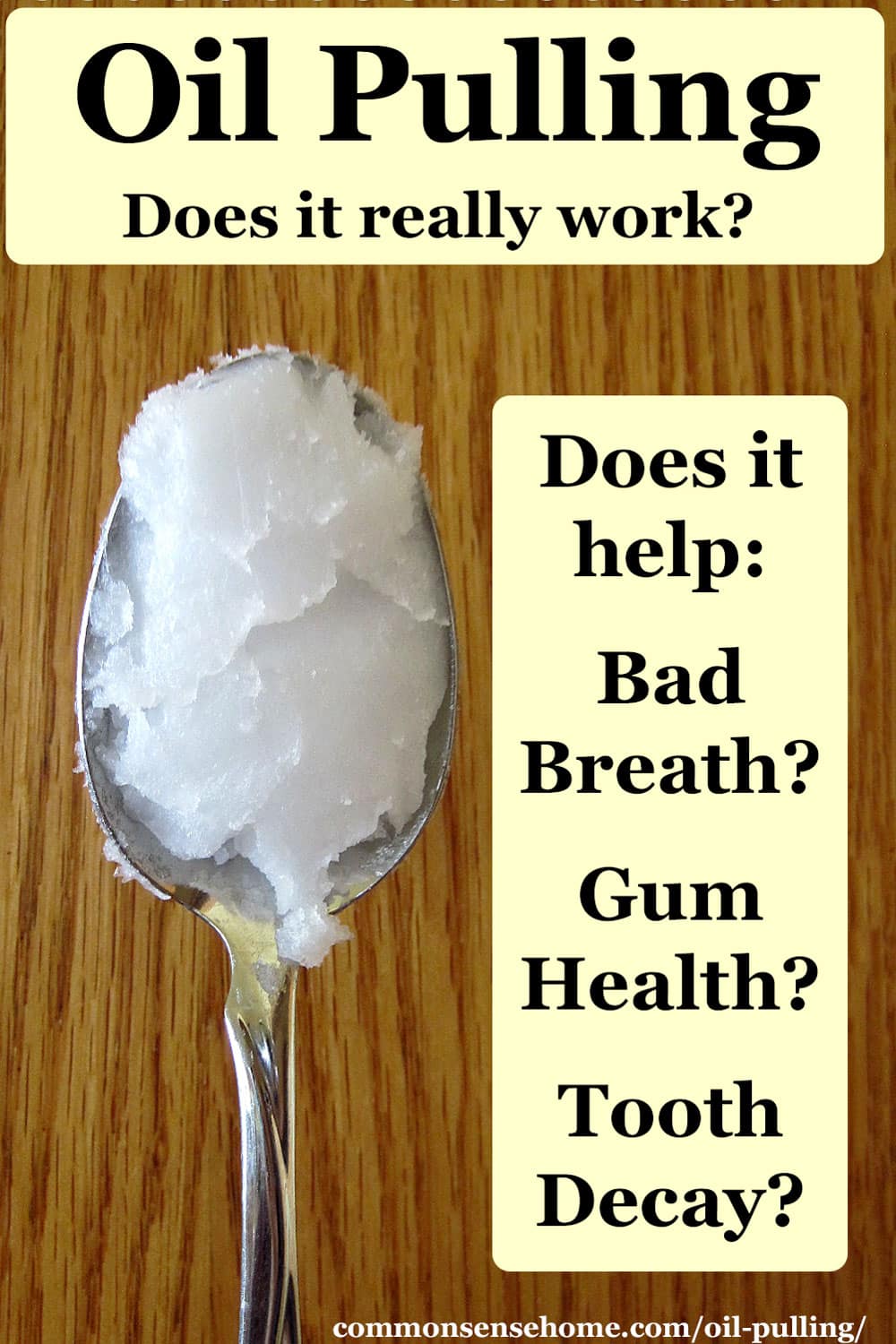
Does oil pulling really work? For some things, the benefits are clear, for others, it’s questionable. I’ll share how to oil pull, and what benefits you may see from the practice.
Would you like to save this?
Table of contents
What is Oil Pulling?
Oil pulling is a dental hygiene practice that involves swishing a spoonful of oil around the mouth for 15-20 minutes, forcing it back and forth (pulling) through the teeth. When you finish, spit out the oil in a waste bin or compost pail. (Coconut oil down the sink or toilet drain may lead to clogged pipes.)
Rinse the mouth with water or salt water, and brush and floss as usual. If you use a tongue scraper, using it right after you pull is a good idea. (I have one similar to this copper tongue scraper, and copper is naturally antibacterial.)
I do oil pulling daily as part of my morning routine, and spit the used oil in my compost. Most recommendations suggest doing it first thing in the morning before eating or drinking, and repeating up to three times per day.
I find solid coconut oil easier to use than liquid oil. I put a spoonful in my cheek and let it warm up and melt. This gives me a minute or two to get used to that much oil in my mouth. You can start with smaller amounts and work up to a tablespoon.
If swishing for 15 – 20 minutes is too much, start with 5-10 minutes and work up to a longer time period. You don’t have swish constantly – you can take a break now and then. Once you get used to it, it’s really not a big deal, but my cheeks were a bit sore at first.
Which oil should I use?
The most commonly used oils are sunflower, sesame and coconut. I prefer Nutiva coconut oil, and keep a small jar on my counter that I refill from my gallon container.
Earth Clinic contributors discuss using sesame, sunflower, olive, walnut, macadamia, coconut, Udo’s Oil, Total EFA Oil and others. Some people reported that their teeth took on a yellow tinge from using olive oil, so other oils may be a better choice.
What does oil pulling do?
To read some claims, oil pulling does everything but cook you breakfast in the morning. If we look back at the Ayurvedic roots of the practice, the tongue is linked to various organs. Working the oil around the mouth is intended to provide a cleansing affect throughout the body.
Scientifically, we know that many of the oils used are antimicrobial, so they reduce problematic bacteria in the mouth. The pulling action activates salivary enzymes and emulsifies the oil, so it acts as a surfactant, loosening plaque buildup.
I’ve found that it makes my teeth feel smooth and clean, and has lightened some of my teeth stains but not removed them. (No magic cure for whitening teeth here, sorry.)
I notice that it helps clear out sinus congestion. After pulling for a while, the crud works loose from my nose and throat area, and I can spit it all out when I spit out the oil. Plus, it’s great for getting out stuck bits of popcorn hull or other fibrous pieces of plant material that brushing and flossing miss.
The American Dental Association states there are no reliable scientific studies supporting the practice, but they also say it’s safe to put neurotoxins in your teeth.
Let’s take a look at some of the studies indicating that oil pulling may improve oral health, and possible benefits.
Reduces Bad Breath
Mouth bacteria is commonly associated with bad breath (halitosis). When researchers compared commercial mouthwash to oil pulling with sesame oil, they found that both worked as well for treating halitosis.
Unlike commercial mouthwash, the oil helps to moisten dry mouths and sooth chapped lips.
Improves Gum Health
Gingivitis is inflammation of the gums. Left untreated, it can lead to periodontitis, which is associated with tooth loss and systemic diseases. This may be where the big health claims come from – clear up the gums, and the other problems may also improve.
This 30 day study indicates that oil swishing reduces plaque and gingivitis, specifically: “A statistically significant decrease in the plaque and gingival indices was noticed from day 7 and the scores continued to decrease during the period of study.”
Another study compared the use of oil pulling with chlorhexidine mouthwash, with favorable results.
May Help Fight Tooth Decay
In the study, Effect of oil-pulling on dental caries causing bacteria, researchers tested sesame oil for 40 days. Their conclusion was that the volunteers saw a notable reduction in the susceptibility to dental caries. Specifically, they noted that the oil helped decrease plaque causing bacteria.
Sesame and sunflower oils on their own do not fight mouth bacteria, but the action of oil pulling changes them (enzyme action and emulsification action) so that they can lift contaminants from teeth.
This study concludes: “The myth that the effect of oil-pulling therapy on oral health was just a placebo effect has been broken and there are clear indications of possible saponification and emulsification process, which enhances its mechanical cleaning action.”
Is Oil Pulling Dangerous?
I read some accounts of people who experienced mouth irritation from oil pulling. If this happens, discontinue, try a different oil or pull less frequently. Don’t swallow the oil, as it contains dead bacteria and other things that are better out than in.
Some people also express concern that oil pulling may pull mercury out of metal fillings and put it into circulation in the body. I asked our holistic dentist about this potential problem. He said this was not an issue because you spit the oil into the trash.
I have fillings in my teeth and have never had one come loose during oil pulling. My son did manage to loosen a temporary filling, which needed to be replaced. We used a filling repair kit to plug the hole until we could get in to see the dentist.
Should you do it?
Oil pulling is cheap and easy to do, and evidence suggests that it improves dental health. What do you have to lose other than some plaque?
You may also enjoy:
- Things We’re Embarrassed to Talk About – What’s a Healthy Bowel Movement?
- Psoriasis Healing – From Curse to Blessing
- Apple Cider Vinegar Tea (Detox Tea Recipe)
Originally posted in 2012, last updated in 2021.
It’s so great when you can see actual studies that prove it works. Thank you for the work you’ve done!
I was told to do oil pulling before taking my daily thyroid meds because the oil pulling actually detoxes you body of all bacteria and nutrients and could impede with the body’s absorption of medication. Since I don’t have a thyroid, this would ne detrimental to my health, so I thought I would mention it in case other readers have life-necessary meds. 😉
Adding my two-cents worth of direct experience. Did some oil pulling using virgin coconut oil (ridiculously cheap here in the Philippines, $3 for a 250ml bottle). I did it in the mornings, per some web advice, even before my first drink of water. I’d swish it around the mouth for ten min as I tidy up my bedroom or prepare bfast. I even ‘scrub’ my teeth with my tongue. After I dispose of the used oil (down the drain, I don’t worry about clogging because we’re in a tropical country and it can be further helped by pouring the remaining hot water from the kettle), I take in a fresh tbsp, this time to get my digestive system working. It seems to work pretty well. After coming across this site, I’d like to shift pulling to evening before bed instead as ‘pulling out the toxins’ after a day’s work seems to make some sense.
Thanks for sharing your experience.
Do thin teeths (front ones) can be preserved life long naturally without any dental treatments?
Maybe. There is no one answer. It depends on your diet and dental care.
Does Fluoride is good for teeth or not because dentists recommend it many times for teeth having sensitivity and pain
I don’t use or recommend fluoride products. I believe other options are better with less risk.
https://articles.mercola.com/sites/articles/archive/2013/04/30/water-fluoridation-facts.aspx
I’m just 21 and so afraid of losing teeths especially the front ones so can. Really enamel can be build up naturally by following the methods given in cure tooth decay by Ramiel nagel
I personally know people who have used Ramiel Nagel’s methods to heal cavities. I have not tried it myself, because his rules are pretty strict, but I do believe those who told me it worked for them.
Does rough teeth which have lines (because of cleaning abrasive of braces by drill or scaling tool) on them can become smooth by oil pulling ?
I also have thin teeth so they will be strengthen and remineralize by oil pulling?
Oil pulling is not likely to make rough teeth smooth or thin teeth remineralized. For that, diet change and supplements are your best option. A good resource is the book Cure Tooth Decay by Ramiel Nagel.
Sometimes even the those cleaned teeth feel sensitive and different does that mean there are chances of chipping or cracking it or it can be preserved till long without dental treatment because now I’m afraid going to dentist?
Those rough little deep lines after cleaning have become a nightmare for me plz help can’t stop thinking about it every time have a fear of losing it
I can’t tell you what’s going to happen to your teeth over the internet, but you could try this remineralizing tooth powder recipe from my friend Chris – DIY Remineralizing Tooth Powder that May Cure Tooth Decay. It may help improve the feel of your teeth.
Sometimes those cleaned( removal of adhesive of braces by scaler tool or drill) teeth feels sensitive and different does that mean that there are chances chipping or cracking it or it will be preserved till long without dental treatment I’m afraid going to dentist now ?
Rough little deep lines on my front incisors have become nightmare for me can’t stop thinking about evertime there is fear of losing it
Afraid or not, you should probably see a dentist. I am not a dentist. I can only assume that if they did your braces correctly, there should be no serious tooth damage, because otherwise everyone who ever had braces would have big problems with their teeth.
Actually I went to dentist I did my X-ray and he said that everything looks ok just u have much loss of enamel on front 4 teeth that’s the reason for transulency and he said if there is no pain or sensitivity there is no need to treat because natural teeth are always better!
I want to ask that Can those Rough deep lines can go away naturally at home because I’m afraid going to dentist now.
And I want to know that what kind of big problems would be there for those people who had braces
I’m sorry, but I’m not a dentist. I do know it is possible to build up enamel on healthy, living teeth. I’d suggest trying the options listed in the Cure Tooth Decay book and using the remineralizing tooth powder.
Oil pulling will help improve gum health, but I have not heard of it building up enamel on teeth.
I agree with Honky Tonk in TN. Do not oil pull if you have amalgam fillings. I speak from experience. Recently I decided to try oil pulling, and did it only once. I used unrefined, cold pressed organic coconut oil. I don’t recall if I brushed after to remove any deposits the pulling may have loosened, as Laurie suggests, since I hadn’t read that before coming to this site. I also added a small amount of coconut oil to my Trader Joe’s floride-free toothpaste on my brush several times because I read how good it can be as well. I fractured a tooth. Since that damage, I am afraid to even try OraMD, which is a natural oral hygiene product that only contains peppermint oil, spearmint oil and sweet almond oil, for fear that something else can go wrong. All of these natural remedies are great, but they can be very powerful.
This is all good stuff, HOWEVER, please PLEASE please do not oil pull if you have mercury fillings. The oil pull can have some serious effects on these fillings and the teeth. oil pulling can pull the mercury layer upon layer at a time in your mouth well after an oil pull treatment, thus giving your body exposed mercury poisoning. The worst I had seen of a close friend of the family doing an oil pull was that she lost her mercury filling after an oil pull right before bed. She swallowed the mercury filling that became dislodged due to doing a few oil pulls that week. It’s bad enough she suffers from that wired thing called fibromyalgia atop of this heavy metal poisoning. There are a few holistic dentists in North America. There is even a website to locate them too. Can’t remember the site name though. They would help in situations like this.
The link to find a holistic dentist – http://holisticdental.org/find-a-holistic-dentist
Just a note…if you should do oil pulling, when you are done….spit the oil into a napkin or into the trash —– not into your sink….Coconut oil will solidify, your pipes to accumulate and a mess with clogs!
Do you have to brush your teeth normal after oil pulling?! And can you use mouth wash after?
It’s generally suggested that you brush after to remove any deposits that the pulling may have loosened. I suppose you could use mouth wash after, but I don’t see much point in doing so.
I’ve got very very sore and bleeding gums. I don’t like taking painkillers but it was getting too much. I tried it for 10 minutes and softly brushed my teeth after. No blood and definitely not as sore. Im going to start doing it twice day now!!!!!
So glad that you saw an improvement! Thanks for sharing your experience.
I’ve tried oil pulling with Coconut Oil in the past, but between my urgent need for food first thing in the morning and my dog whining to be let out, I have trouble doing it first thing :(. I shal follow your recomendation however, to do it at some other time of the day, I take it preferrably befor eating a meal?
I also disliked the taste of oil in my mouth so I added a little bit of xylitol – which is also reputed to be good for the teeth – and that made a world of difference!
I completely understand the morning time crunch. Yes, you’re looking for a time frame where your teeth aren’t newly coated with fresh food bits.