
ICF Construction: Lessons From Over 2 Decades in an ICF Home

This post may contain affiliate links. Read my full disclosure here.

When we were researching our “forever home”, we chose Insulated Concrete Form (ICF) construction for a number of reasons. It’s tough, energy efficient and designed to last a lifetime with minimal upkeep.
After living in our ICF home for over 20 years, I can confidently say it was one of the best decisions we made.
Would you like to save this?
Table of Contents
What is ICF (Insulated Concrete Forms)?
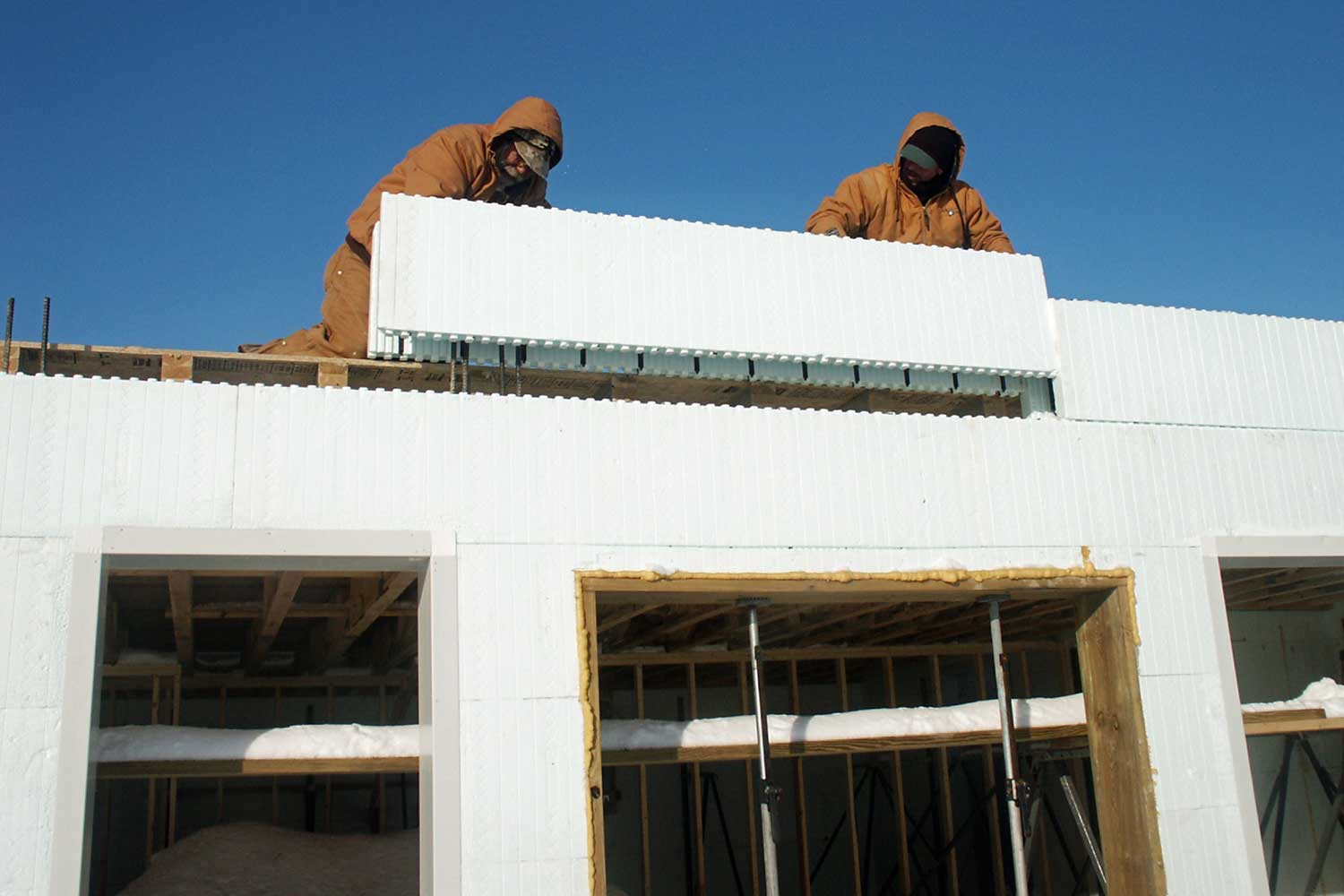
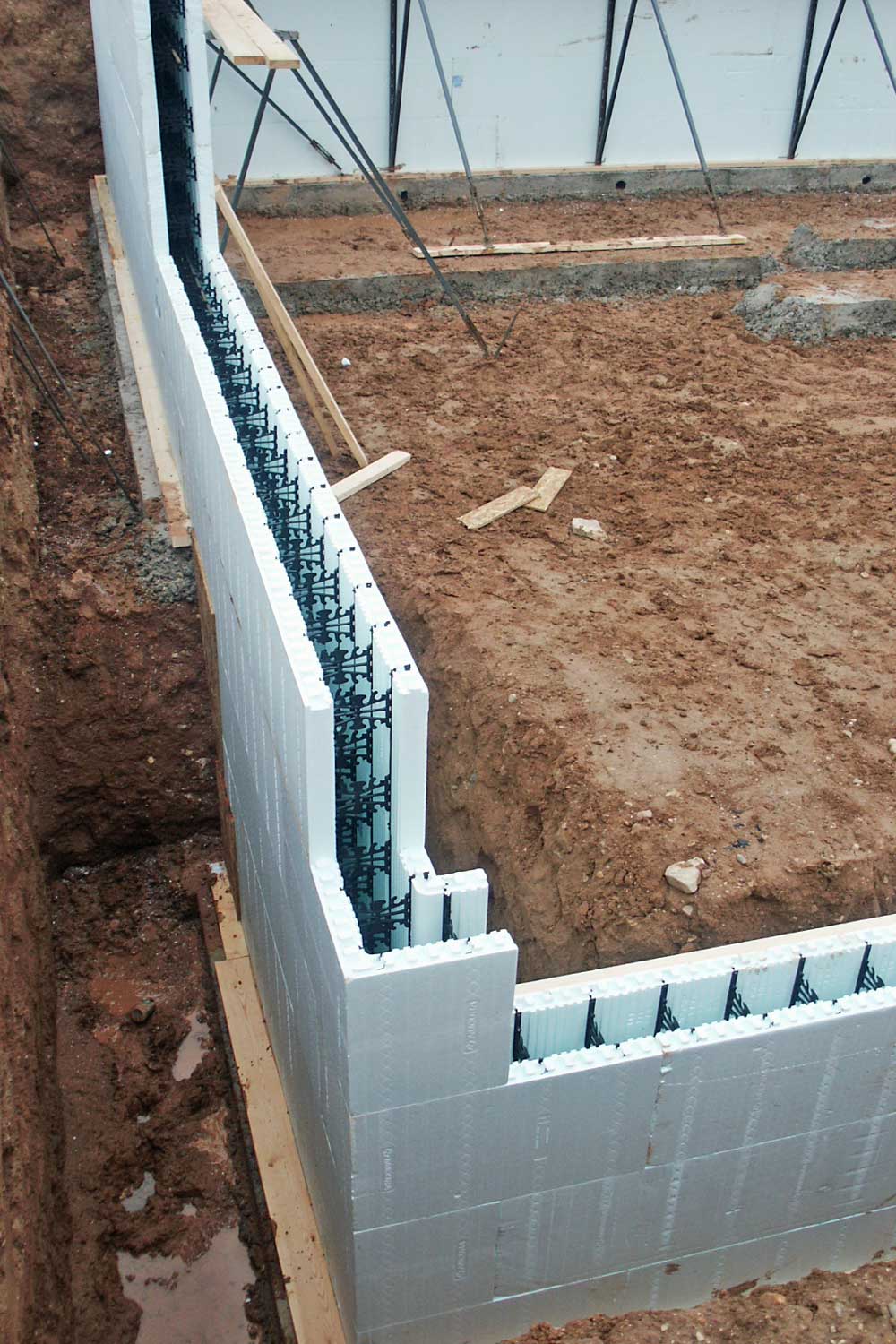
Insulated concrete forms (ICF) are a building system made from interlocking foam blocks—often called ICF blocks. They are stacked like Legos to form walls, reinforced with steel rebar, and then filled with concrete.
Think of it as a high-performance wall system:
- Foam insulation on both sides
- Reinforced concrete core in the middle
- Continuous insulation with minimal gaps
This creates a solid concrete wall that is dramatically different from a typical wood frame home. Instead of studs and cavities, you get a continuous structure with:
- Reinforced concrete strength
- Excellent insulation
- Very low air infiltration
The result is an ICF house that behaves differently—in a good way.
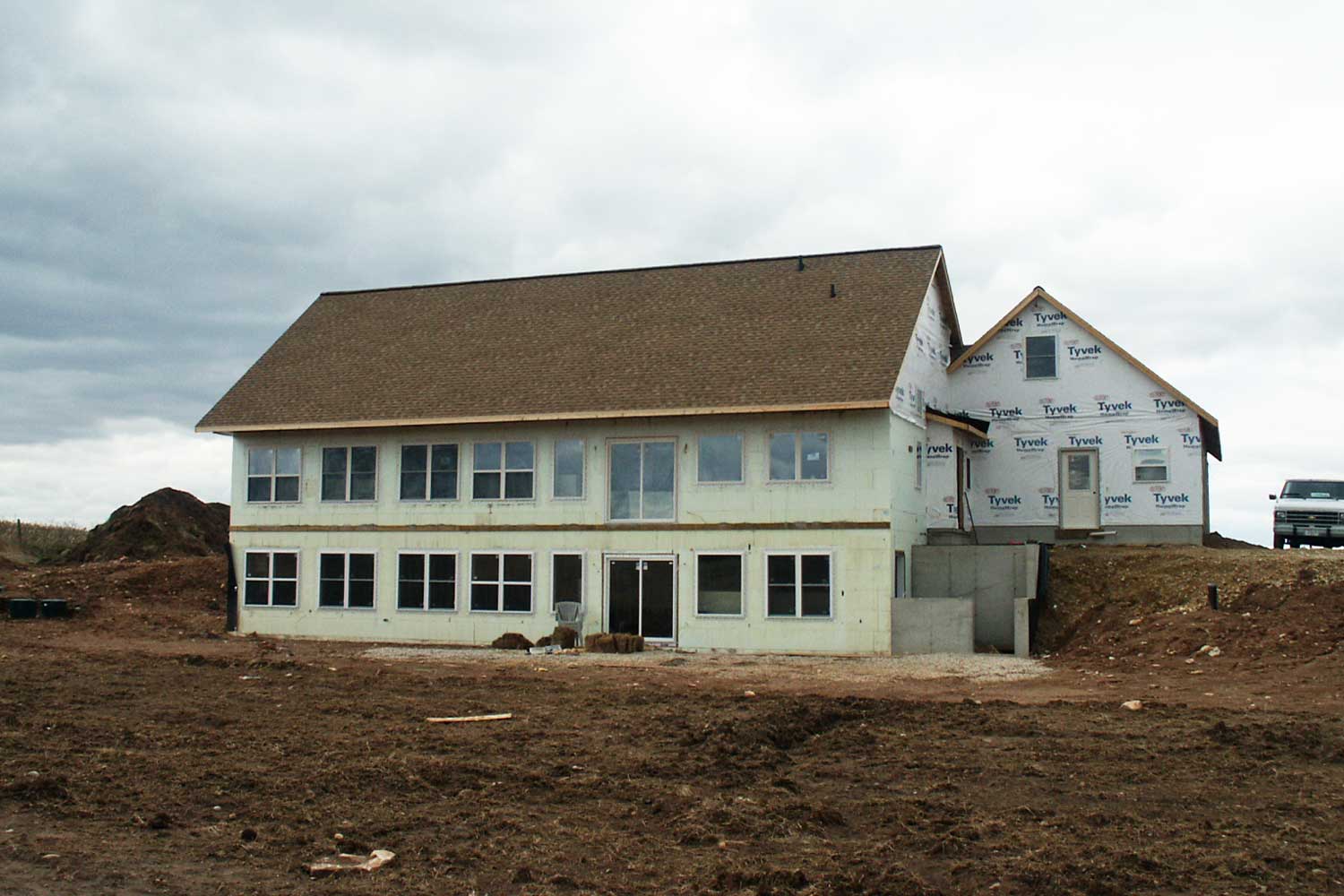
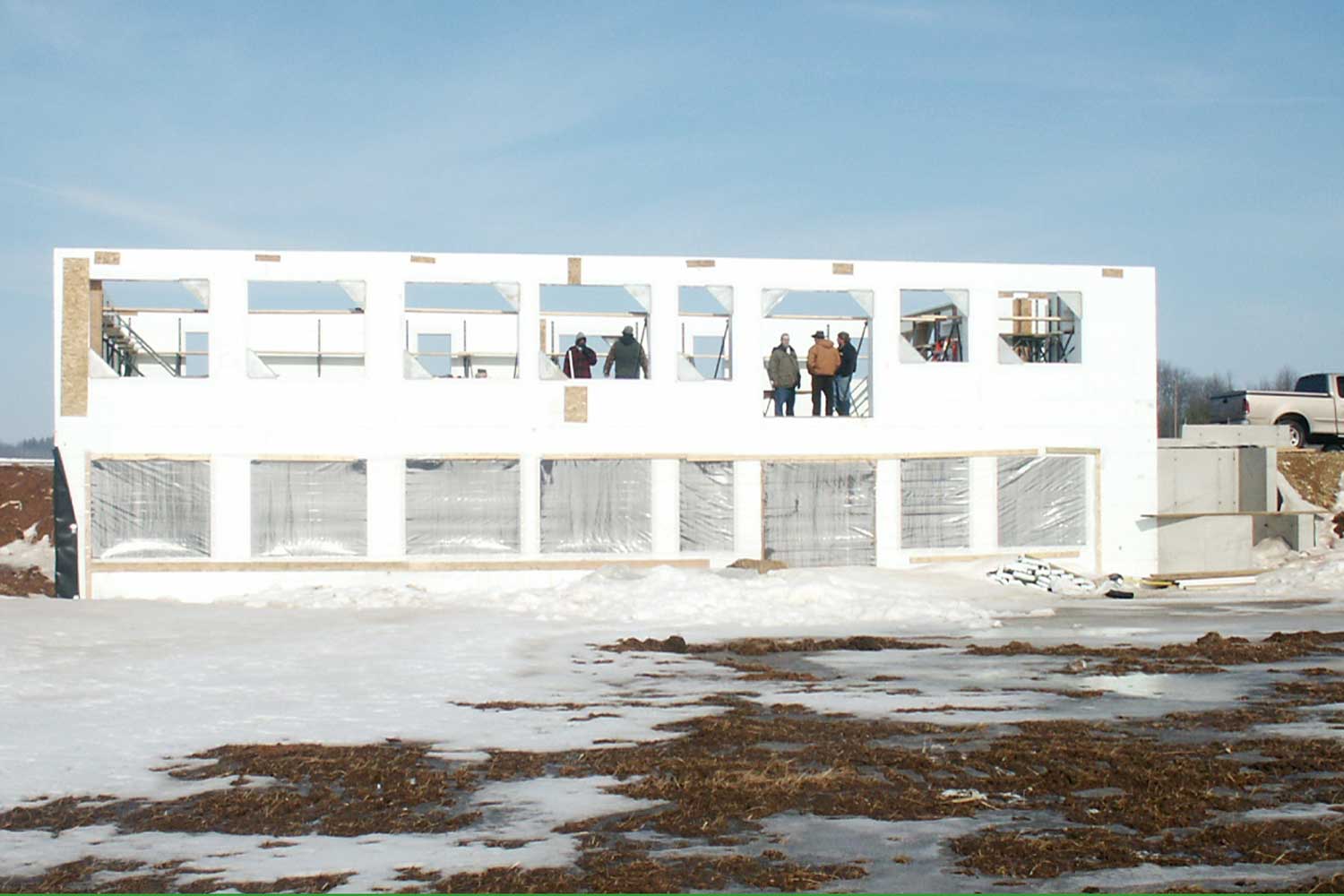
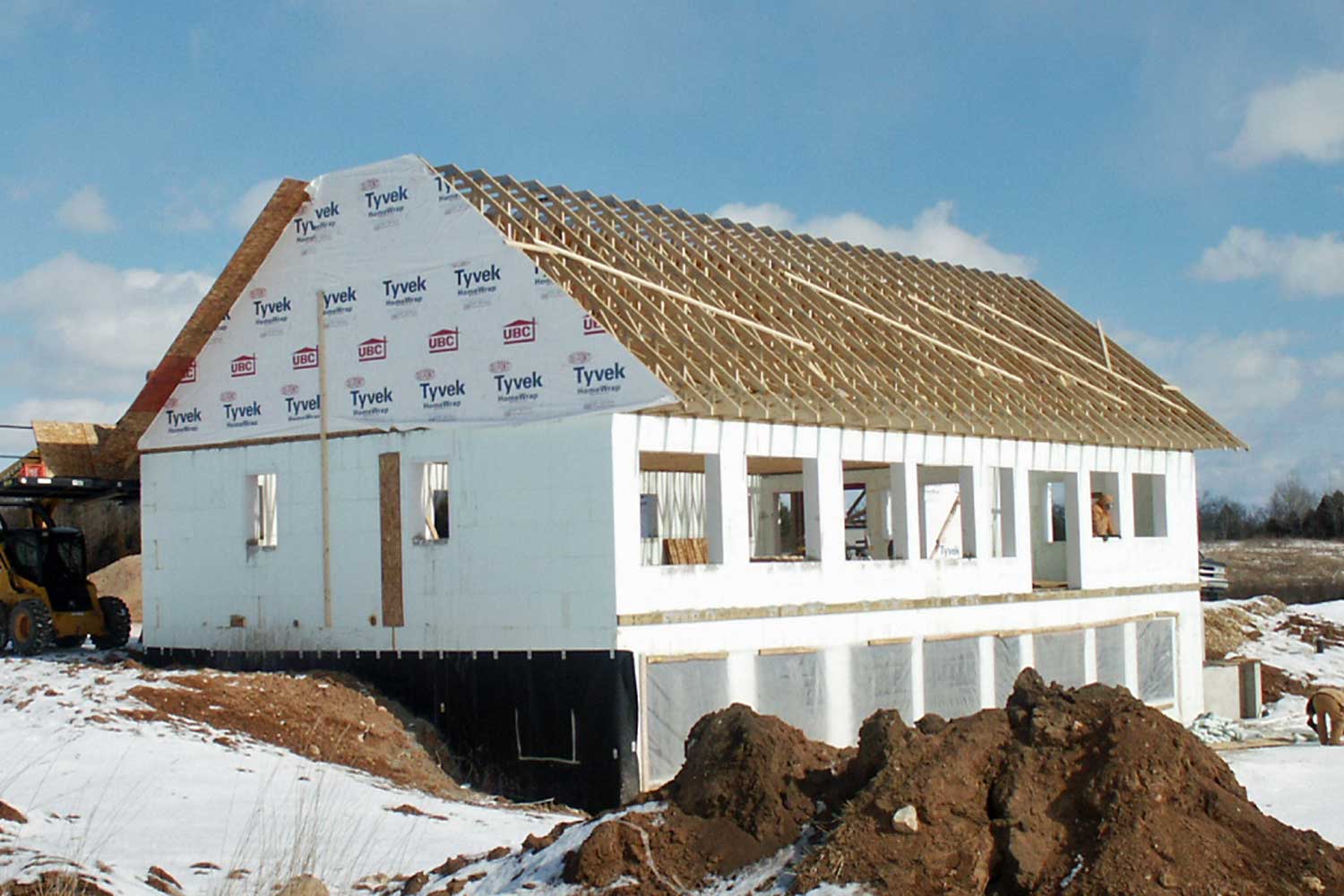
ICF can be used for basements, underground homes or entire multi-story homes. They can start at the foundation and go all the way to the roofline, as in our construction. Some builders use only insulated concrete foundation forms and combine them with other building methods above ground.
ICF vs. Wood Frame Construction
Most homes in the U.S. use traditional wood frame construction, which relies on studs spaced throughout the wall. Those studs create thermal bridges—areas where heat moves more easily through the wall. With ICF walls, you don’t have those interruptions.
Key differences:
Wood Frame:
- Insulation interrupted by studs
- More air leakage
- Lower overall efficiency
ICF Building:
- Continuous insulation
- Minimal air infiltration
- Reduced thermal bridging
- Higher overall performance
Even well-built wood homes struggle to match the real-world performance of an ICF structure.
ICF Energy Efficiency & Thermal Performance
One of the biggest advantages of ICF building is energy efficiency. Because the insulation is continuous and the structure is airtight:
- You avoid drafts and temperature swings
- Walls stay consistent—no hot or cold spots
- Heating and cooling systems work less
The concrete core also adds thermal mass, which helps stabilize indoor temperatures. When we fill the house with cool night air in the summer and close it up during the day, and it stays cool.
What that means in real life:
- Heat the home once → it stays warm
- Cool it down → it holds that cool longer
A study found that homes with ICF walls used ~44% less energy for heating and ~32% less for cooling compared to wood-frame homes.
This works great with our passive solar heating. There is an overhang on the south side of the house to block summer sun, but let winter sun in. We have windows at the east and west ends of the home to take advantage of winds off Lake Michigan.
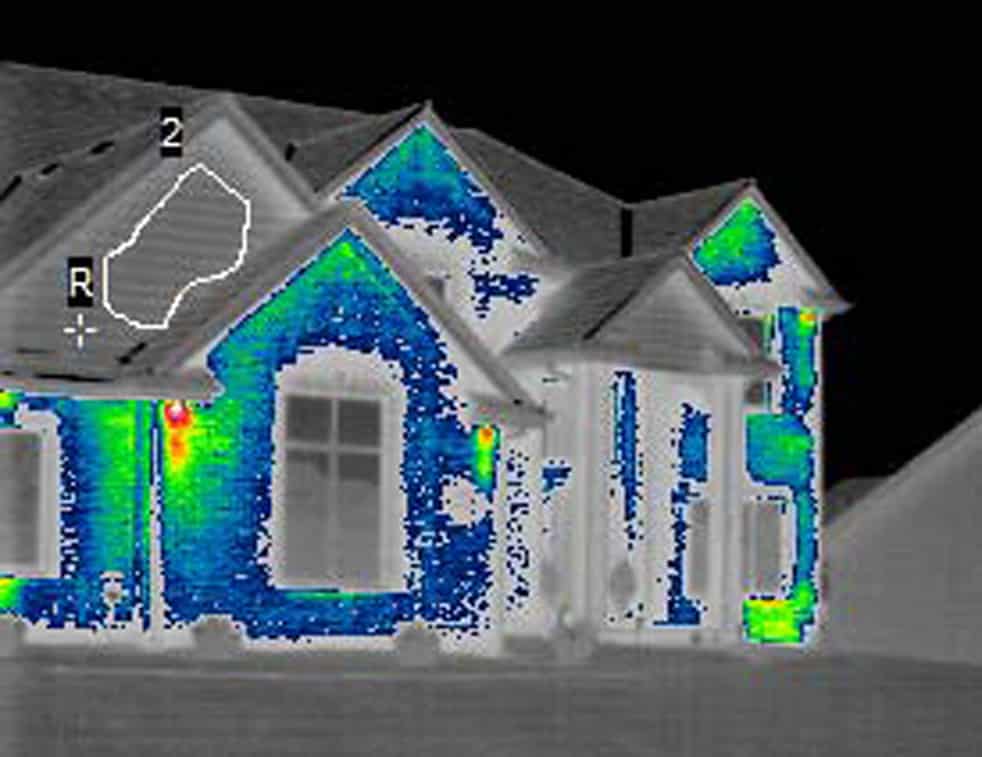
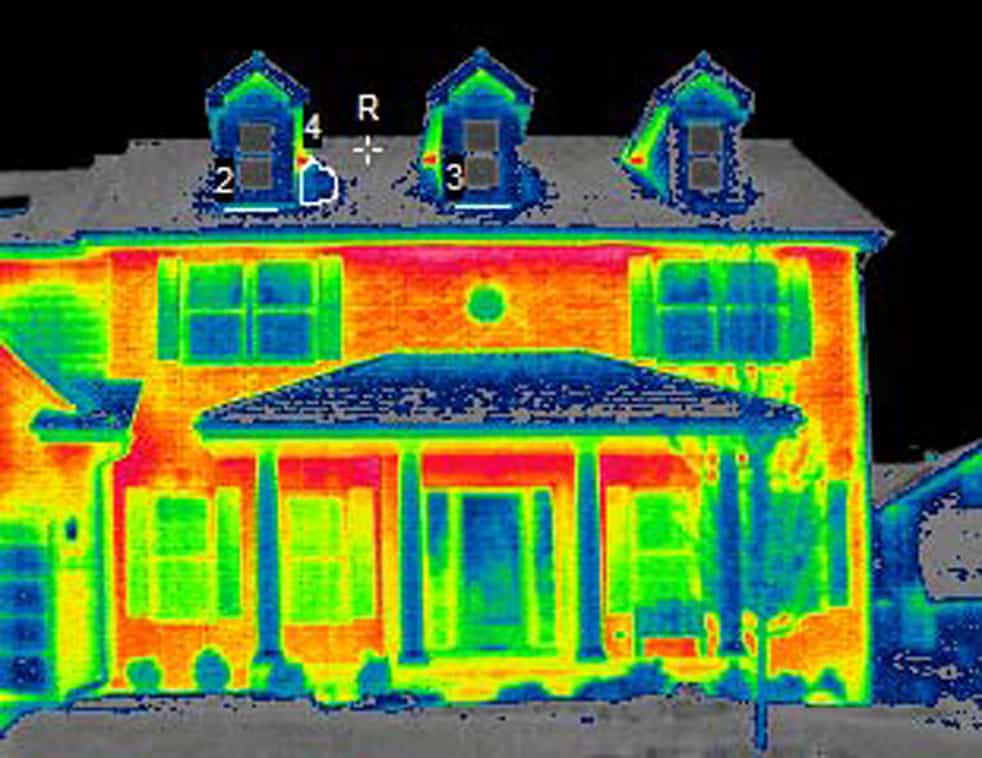
Thermal images courtesy of Reward Wall Systems.
Our Real-World Heating & Cooling Experience
I’ve crunched the numbers, and our home ranks in the top 5% of homes for energy efficiency per square foot.
For heating, our rough breakdown is:
- ~10% passive solar
- ~40% wood heat
- ~50% propane (radiant floor system)
We are able to heat the entire home with a relatively small system—something that would be difficult in a standard wood frame house. The air conditioning system is also smaller than the typical system needed for a wood frame home.
Because they are so airtight, ICF homes require planned ventilation. We use ceiling fans to keep air moving, and have a whole house fan that we run at night. We installed an HRV (heat recovery ventilator) to bring in fresh air if it’s too cold or hot to open windows.
ICF Durability
This is where ICF construction really stands apart. You’re not just building a house—you’re building a reinforced concrete structure.
Storm Resistance
ICF homes are well known for standing up to:
- Tornadoes
- Hurricanes
- Severe storms
We had a tornado pass within five miles of our home—and barely noticed anything unusual inside. An online search of “ICF hurricane proof” will yield dozens of images of ICF homes left intact where surrounding homes were leveled.
Fire Resistance
While the contents of the home are still flammable, the ICF wall system itself is highly fire resistant. You have no chance of an electrical fire being concealed inside a concrete wall.
Pest Protection
ICF construction is pest resistant – nothing eats concrete. Termites and rodents can get through the foam, so in termite prone areas, use pre-treated forms. Sealing near ground and around windows and doors is important.
Radiation & Seismic Activity
Concrete can stop all kinds of radiation, including alpha, beta and gamma rays. There’s a reason that nuclear containment vessels are built out of concrete.
With appropriate reinforcement, ICF construction is highly resistant to earthquakes and other shifts.
Longevity
A properly built ICF home can last for generations with minimal structural degradation. There’s no rot, no warping, and far fewer failure points compared to traditional wood construction.
Cost of ICF Construction
ICF construction cost about 5–10% more than a comparable wood-frame home.
Factors that influence cost:
- Material prices
- Labor (especially experienced ICF crews)
- Concrete pumping (multiple lifts required)
That said, long-term savings often offset the upfront cost:
- Lower energy bills and potentially lower insurance costs
- Reduced maintenance
- Increased durability
How ICF Walls Are Built
The wall construction process looks like this:
- Assemble wall framework with ICF blocks and V-buck openings
- Add rebar reinforcement
- Install bracing to hold walls straight
- Pour concrete in stages (“lifts”)
- Repeat until full wall height is reached
Pouring in lifts is critical—too much at once can cause a blowout. Once cured, you have a solid reinforced concrete wall system with insulation built in.
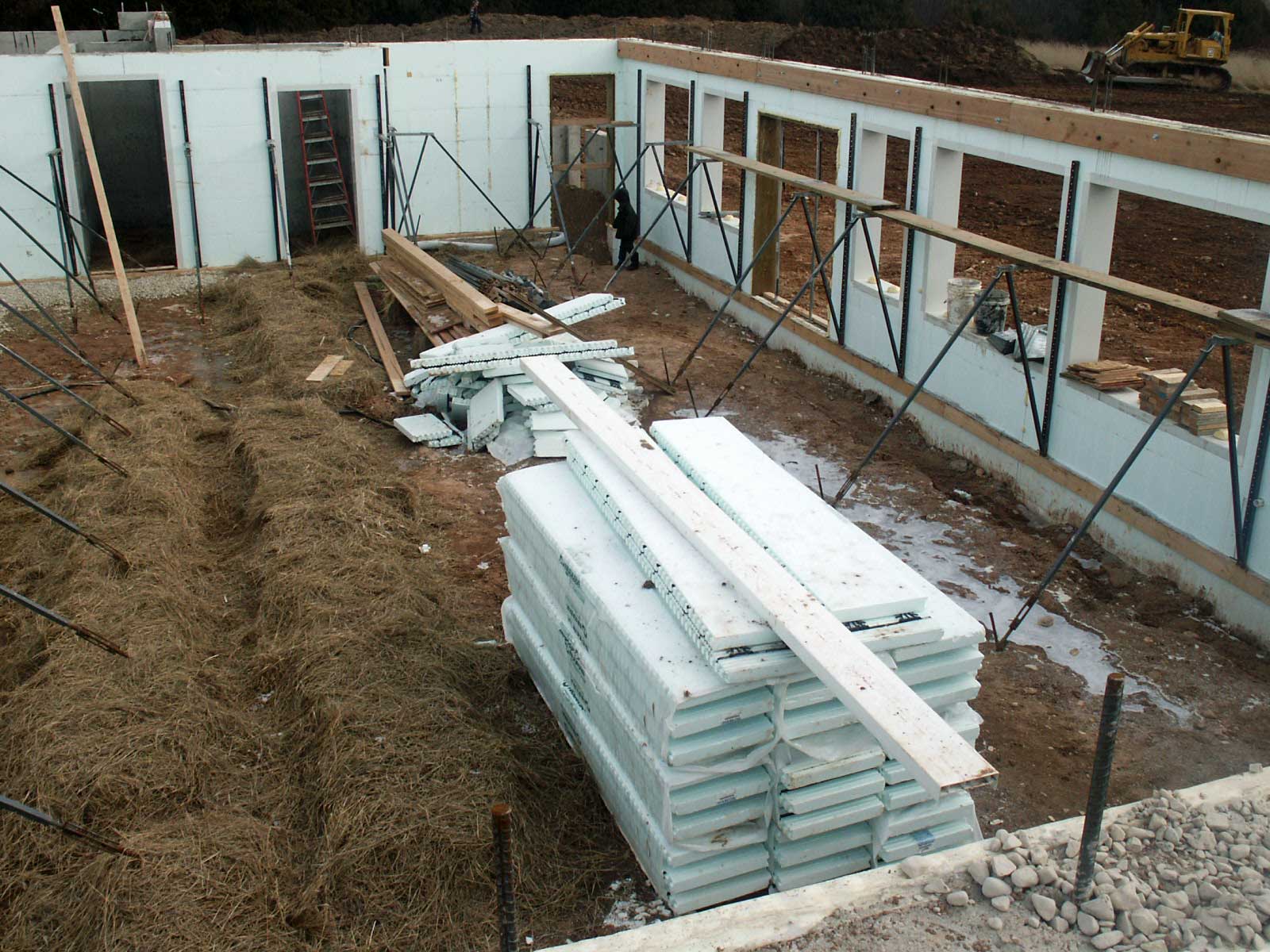
Our home uses these forms from the foundation to the roofline. Other options are basement/foundation only, or for a safe room. Windows and doors use “bucks” (box outs that create a frame for a window to fit inside).
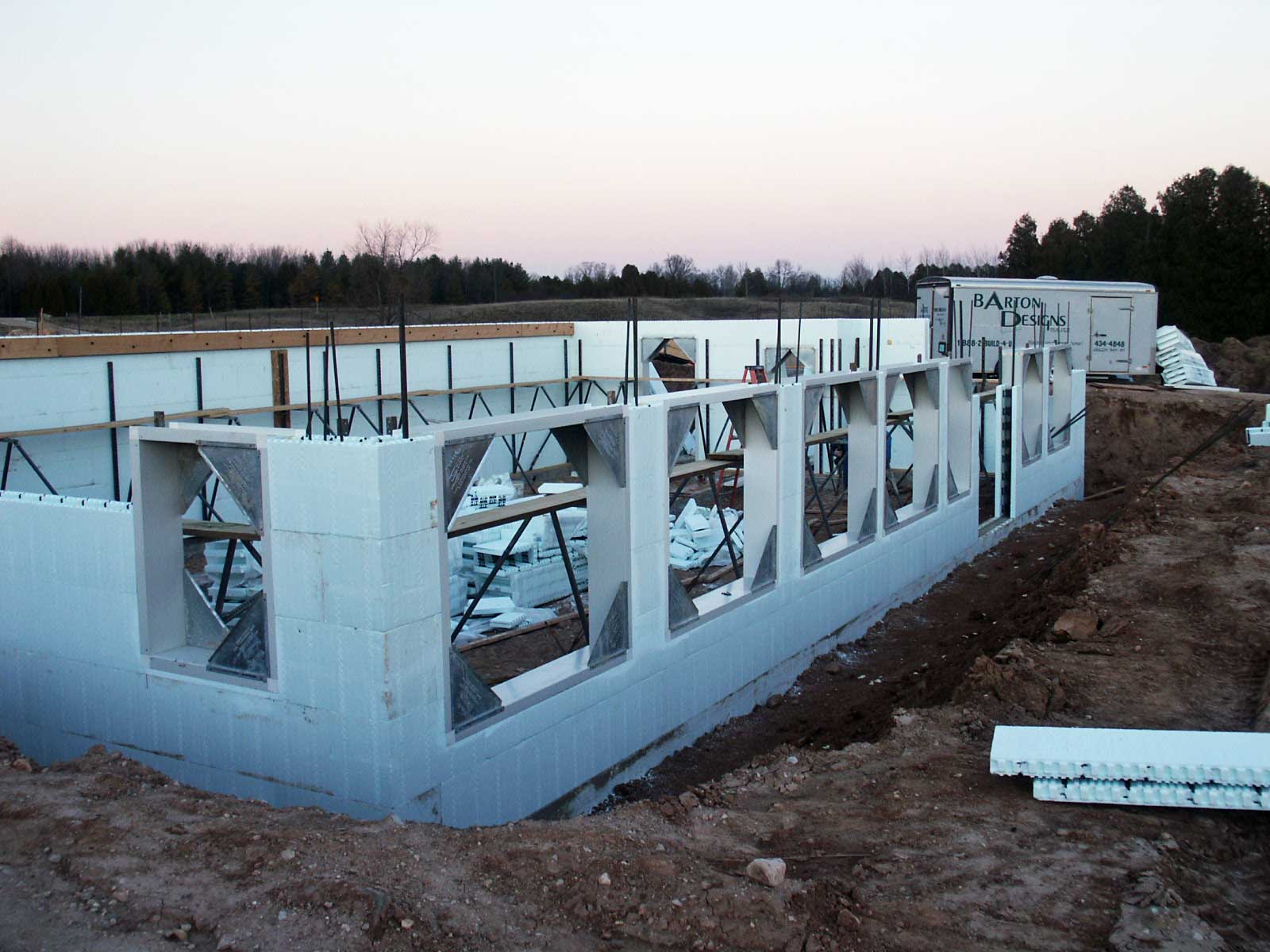
Because of the need to use lifts, the concrete pumper truck must visit multiple times (once per lift). The multiple concrete pump truck visits are a big part of the cost, along with the rebar labor. (It’s a lot tougher to lace rebar through walls than to just lay it in a flat slab.)
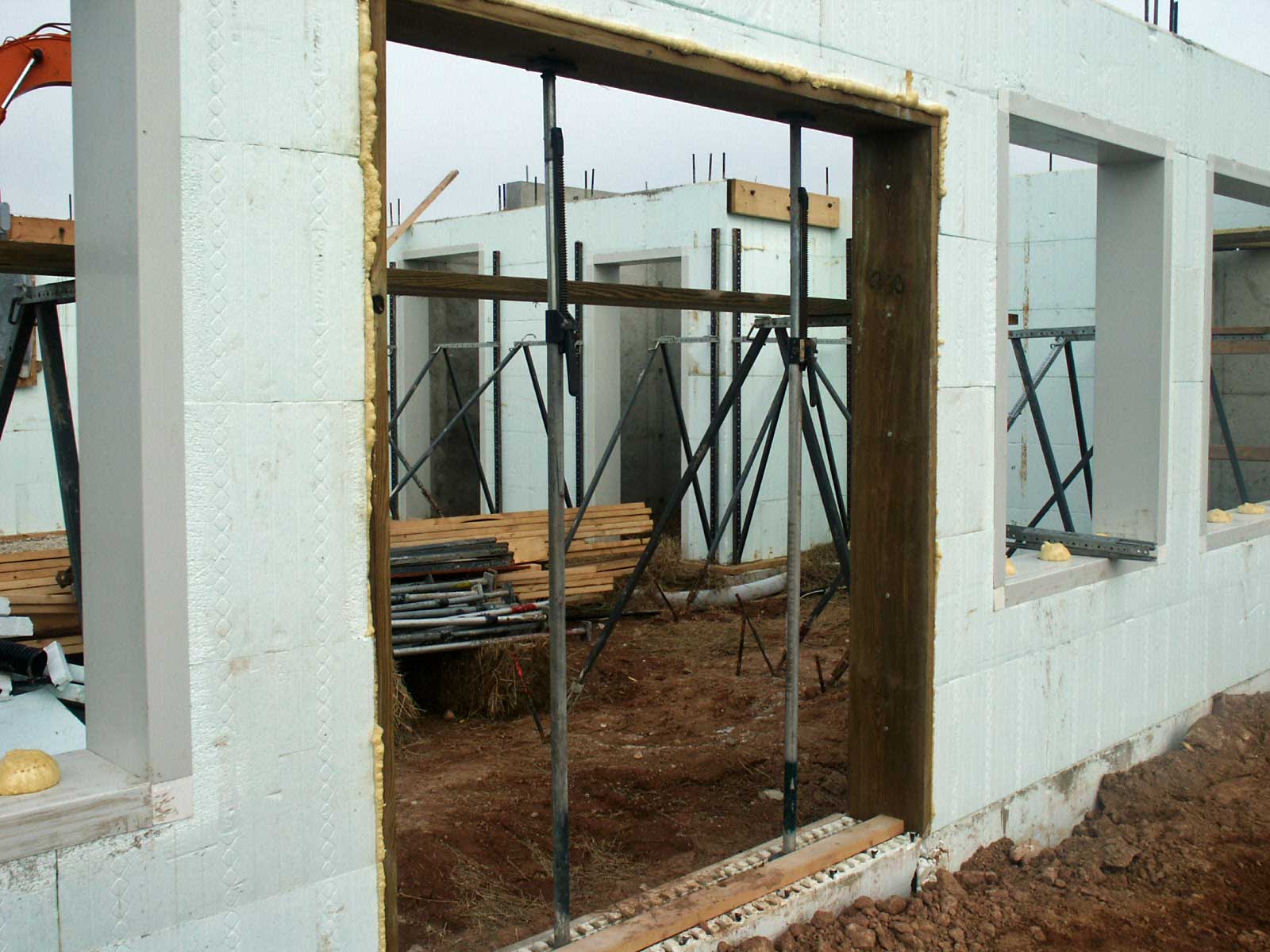
The builders add layers until they reach “floor” height. Then they add a header/hanger to support inside trusses. At the roofline, they add hurricane ties for the roof trusses.
Plumbing and Electrical in ICF Construction
Plan all wall penetrations in advance. Unlike wood frame homes, you can’t easily modify walls later.
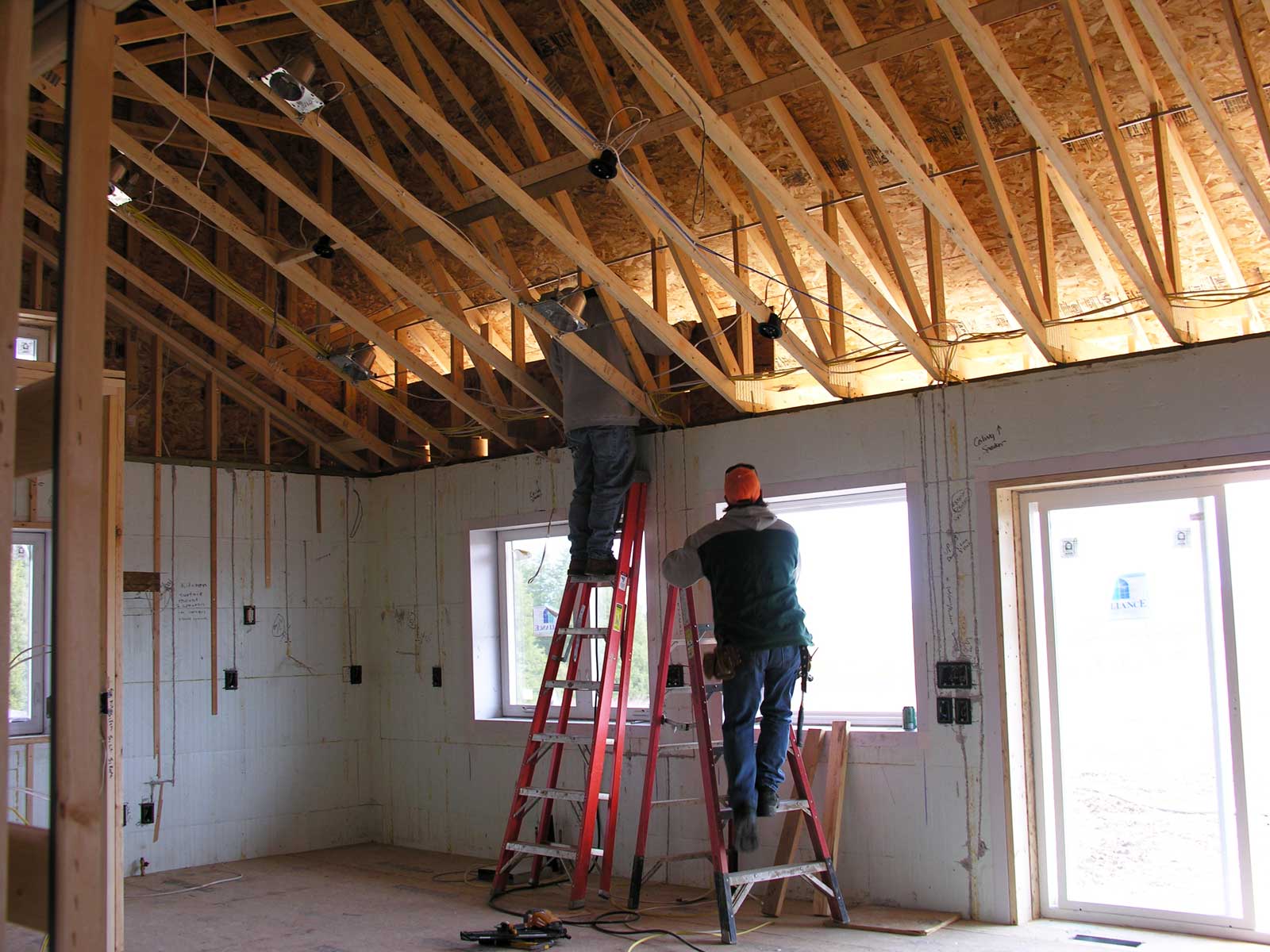
- Electrical is run by cutting channels into the foam
- Wiring is placed and sealed with spray foam
- Plumbing in exterior walls is minimized when possible
Finishing an ICF Home
Inside and out, an ICF house looks like a normal home.
- Drywall attaches to built-in fastening strips
- Exterior can be siding, brick, or stucco
- Interior finishes are the same as conventional construction
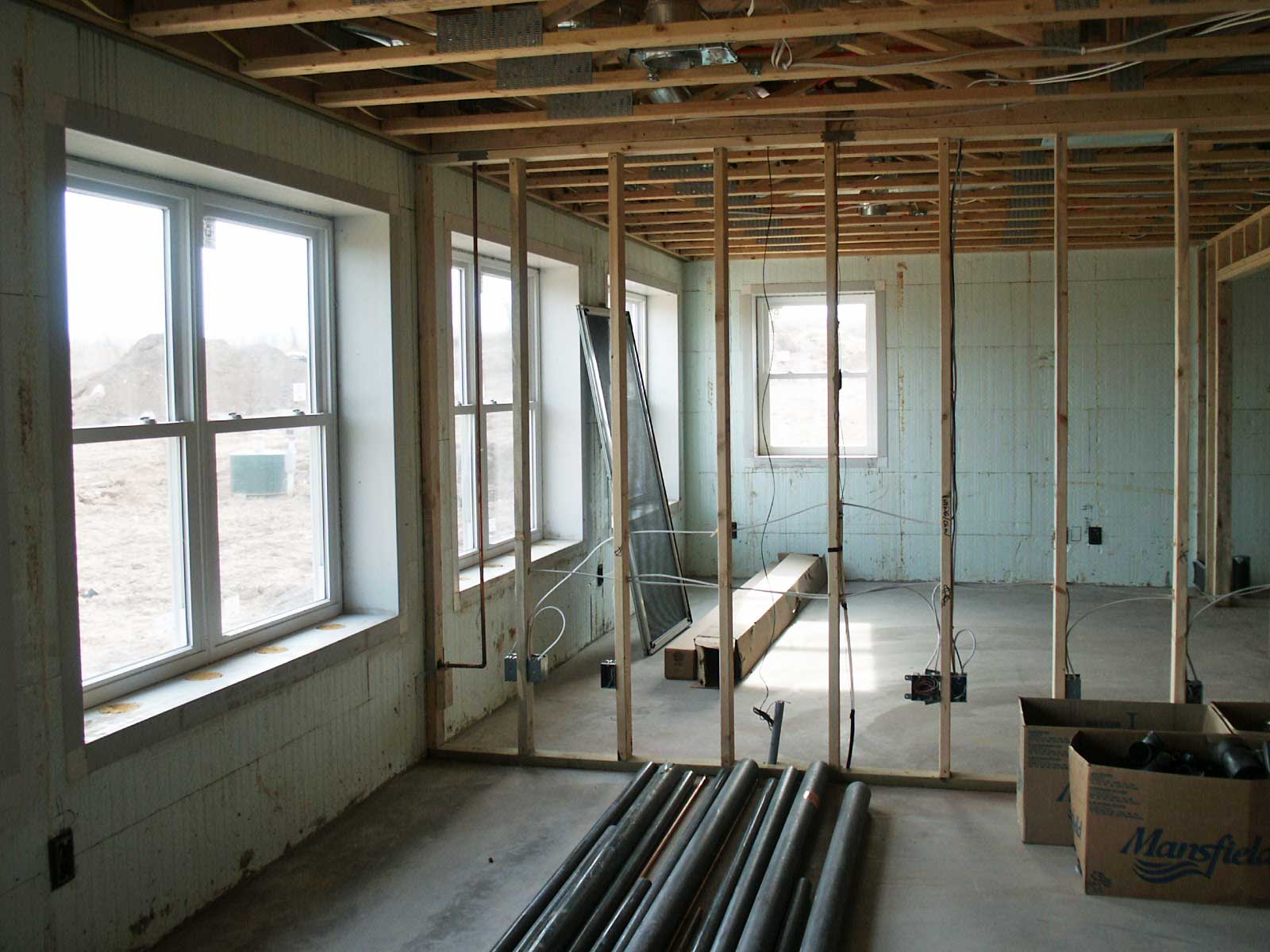
The biggest visible difference? Deep window wells and thicker walls.
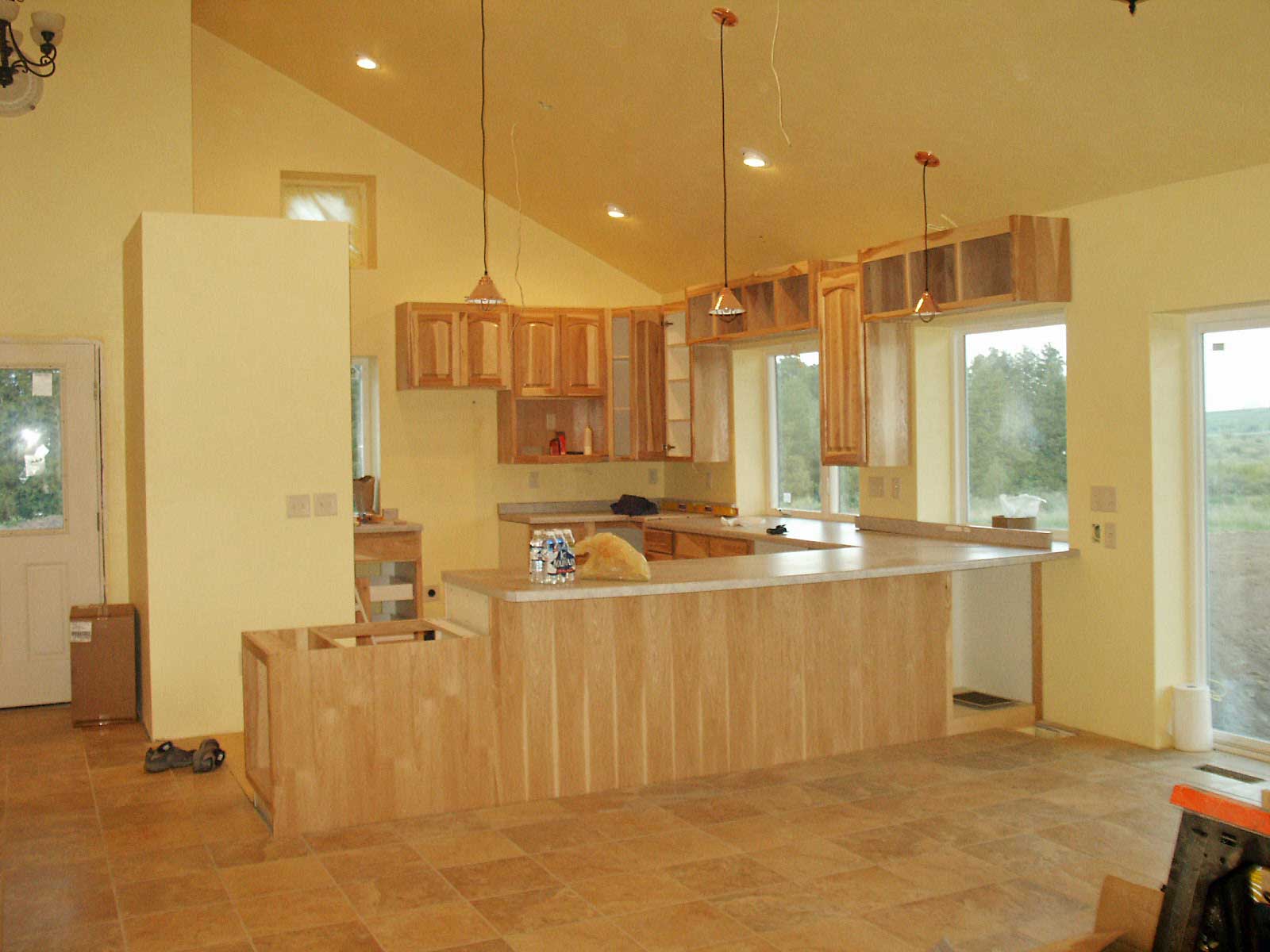
About the only thing that is a little tricky is hanging things on the exterior walls. There are no studs and the stripping is hard to find under the paint and drywall. I use removable adhesive tabs instead.
Living in an ICF Home – What We’ve Noticed
After more than two decades, a few things stand out:
- Extremely quiet – outside noise is dramatically reduced
- Stable temperatures – fewer swings day to night
- Low utility bills – even in a cold climate
- Solid feel – the house feels anchored and secure
Visitors often comment that the home feels different, even if they can’t immediately explain why. Several people who’ve come to our open house note that the home doesn’t look its age.
ICF Lessons & Recommendations
Our first home was stick built, our second is ICF. If you’re considering ICF building, here are a few key takeaways:
Plan for Ventilation. These homes are tight. Use spot ventilation (bathrooms, kitchen) and install an HRV or ERV system.
Use an Experienced ICF Builder. This is not the same as wood frame construction. Mistakes are hard to fix after the pour.
Choose Durable Windows & Sills. Tile or waterproof sills are a smart choice. Our existing window frames are vinyl to reduce heat loss from the home and prevent rot. ICF homes can have larger temperature differences within the window well, leading to condensation.
Plan All Penetrations Early. Running new lines later through a concrete wall is difficult. Leave extra conduit paths if you expect to need to go through a wall in the future.
Seal Carefully at Ground Level. We had one small gap during construction—and mice found it.
Is ICF Construction Worth It?
For us, absolutely. Compared to our previous wood frame home, the difference is significant:
- Better efficiency
- Greater durability and safety
- More comfort
- Lower long-term costs
If your goal is a high performance home that’s built to last, ICF construction is well worth considering.


Related Links

This article was written by Laurie Neverman. Laurie has a masters degree in mechanical engineering with an emphasis in renewable energy. She helped to operate and maintain the world largest flat plate collector solar water heating system. Her family’s home use three types of solar systems and is Energy Star and Wisconsin Green Built certified.
Originally published in 2012, last updated in 2026.
Hello. We are looking forward to disseminating this technology of construction in our country, Libya. We suffer from extreme heat in the summer and extreme cold in winter, due to the poor techniques used in construction, which lack insulation.
How doe you run electrical wire through the walls in ICF construction
They run electrical and plumbing by cutting channels into the interior foam along the strips that provide anchoring. After the electrical and plumbing is in place, they foam over the top and trim it flat.
We are considering purchasing an ICF home mid construction. The property has been sitting unfinished for about 9 months. The person building was out of state and the house was started just as Covid hit. He couldn’t travel back and fourth and his contractor was not able to complete the project. I think they ran out of money. Roof is on and some window’s are in. Still needs the big sliders for the bedroom and family room. Rough plumbing and air conditioning ducts are in. The property has been open to the elements. Located in South Florida. Would the open exposure damage the ICF foam? It is on a canal which is my husbands dream and very hard to come by now. Anything else we should think about before saying yay or nay?
Please respond soon if possible as we need to make a decision soon.
Hi Carol.
The weather (rain or snow) isn’t an issue with exposed ICF forms, but UV radiation exposure can start to break down the forms and weaken them over time. Since you are in a high sun area, this would likely be more of a concern than here in Wisconsin. The references I found suggested that ICF not be left uncovered for more than three months, but if there’s shade or overhang, it may not be a problem.
Before you make such a big investment, I’d made a smaller investment in having a full home inspection done to look for any problems due to the house sitting unfinished, as I suspect it’s being sold “as is”. If someone who is familiar with the wear and tear homes take in your area gives it a thumbs up, you should have peace of mind for purchasing your dream home.
This is an edit. The property was open to the elements but the roof was put on as scheduled so the structure / foundation was completed as planned. It appears
they stopped after air conditioning duct work and rough pluming was put in.
Even with the roof on, the sun still shines at an angle on the side of the building. That’s where your UV damage, if any, would show up.
I don’t know if you have wooden subfloor, or concrete floors, but anywhere there’s an opening in the exterior shell, materials around that opening should be thoroughly inspected for damage.
There is a Quad Lock distributor in Sonora, Mexico.
is your product known or used in Mexico?
It’s not widely used, but searching “ICF construction Mexico” does bring up results with different companies who build with Insulated Concrete Forms, and homes in Mexico that have withstood hurricanes due to ICF construction.
I am in Milledgeville Ga. I have about 100 Amvic forms I need to get rid of. No corners.
Call 478-456-2267.
I built an ICF house in 2008. This was the first house I ever built and it turned out great
Good day, I’m interested to know if you used ICF for the basement as well, and if so, what moisture barrier you used.
Also, now that we are 8 years past your 12 year mark, is there anything else you would have done differently?
Yes, we have ICF from the basement to the roofline. The only part that is stick framed is the peaks at each end of the house.
To the best of my recollection, the only covering of the exterior of the ICF below grade is the dimpled black plastic moisture barrier. I sorted back through photos and didn’t find evidence of anything else.
We built in 2004-2005, so we’re at about 15 years now. It’s still performing well. Thankfully nothing new has popped up that would be an issue.
Thank you for that information! It was a pleasure reading through this and finding out all you did for your home’s longevity.
I lived in GUAM, HOW can I buy the ICF BLOCKS. MY GARAGE SIZE IS 24FT. BY 40FT. And what’s the cost?
I don’t sell ICF forms. You would need to contact an ICF distributor. Search on “ICF distributor Guam”.
Laurie, I’m in the planning stage of a new [probably] owner-builder home in southern CA. Why does every article I read about cost comparisons refers to cost per SqFt, not cost per linear foot? Are they referring to walls width x height, or SqFt area of home?
My home will have about 373 linear feet of 10ft high exterior walls, including garage. I priced (retail) 2×6 Fir @ 24″OC @ $2,110, using Rockwool R30 insulation @ $4,935; total $8,045 (no tax, no labor, no allowance for doors, windows, cement pumper, standing time, bracing, etc.).
I priced ICF 4″ thick STRAIGHT blocks ONLY with rebar and concrete @ $25,375 (using single-block price). So, materials only, that’s a $17,330 difference.
Even if I round the stick-build up and the ICF-built down, there doesn’t seem to be any favorable comparison. Yes, that’s about 4 1/2% of a $375,000 finished home, but in dollars, quite significant.
In a different scenario, anyone finding a way to shave $17k off their construction costs would jump at it. I’m expecting to be 100% solar and all-electric (with batteries and generator backup), so my utility costs should be near zero, even in a stick-built home.
My questions to you are (1) Do my numbers seem remotely correct?, and (2) what costs have I not considered which would add to or subtract from either way of building? For example, does it take longer to build ICF walls vs wood framed? Is the hourly labor cost higher for ICF vs wood framed (higher skill level required), etc.? Thanks.
Everyone refers to cost per SqFt because they are talking sqft area of the home.
ICF will cost more to build. I haven’t done a current cost estimate because we are not building right now, but in addition to the wall costs, the finishing costs also tend to be higher because sub-contractors have to work differently with ICF than stick built. If I remember correctly, our build estimated costs would be about 6-10% higher than stick built.
Where you make up the money is in operational costs, especially heating and cooling. ICF is also highly resistant to storm damage.
That said, if you don’t plan to stay in the house very long, it’s likely not worth the additional investment.
You must also have plywood sheathing over your studs to have an apples to apples construction comparison. Labor costs are more on stick built. ICF goes up , concrete poured, ready to go. Stick built is wall framing, sheathing, then insulation installation. Three processes for contractors. When we built our ICF in 2004-5, labor was the largest expense even though we did almost all the interior finishing and electric ourselves.
wonderful ICF home . planning to build one on large forested property . will have legalett slab on grade air heated floor with outdoor boiler gas/wood furnace . I may go for a second floor for added south facing fiberglass 3 ply laminated storm windows . We get micro burst now and again . Will go for HD steel doors . icf garage . Fully off grid system with propane generator(s) . wood cook stove for winter and propane for summer . same size windows , etc… Just too much to put in a comment .
Best regards and enjoy your home .
C. Bruyère
I hope your build goes smoothly. We get a lot of wind in our area, and the ICF is a blessing.
What is the cost for a 1800 sq ft house plan and a 3 car garage
You’d need to work with a builder and specific design plans for a specific location to get an accurate quote. We do not build houses.
I’ve been thinking…(i’m still learning) for passive air movement couldn’t you do the same as they do in Earthships? ( which is to run a 12-14in. tube underground capped for air flow at one end and run the other end to the house with a mesh screen to stop bugs form entering. this would be air conditioning system.) and if not couldn’t you just run a dehumidifier in the basement or main floor? I don’t think a fan would be enough. You want to get rid of the moisture not move it around right? This was a really great article along with great questions and replies. But I agree the home NEEDS to breathe somehow. which makes me wonder if gaps need to be strategically placed for air flow if nothing else leave a couple windows cracked . Nobody has talked about Carbon Monoxide poisoning. or stale air. I couldn’t imagine a teenage boy’s room.(gym locker smell that wont leave.) Or the off gassing of a pet in need of an overdue bath. LOL Eventually the home will need to air out somehow.
there are good design elements in the Earthship, Strawbale and IFC/CBS builds now if I could only figure out a way to incorporate them and the county to exept them .LOL Oh well back to my research.
In most areas, there would likely be some bickering with building inspectors on non-conventional HVAC elements. A local friend tried the tube option in her earth sheltered greenhouse, and found it performed well under expectations. Another friend tried to use it for cooling in Tennessee, and found that it offered little relief. Both of these were owner installs, so there may be design or installation errors, but they tried to implement as best as they were able.
We have a lot of windows place for good cross ventilation, so as the weather allows, we open up. We also have ceiling fans in almost every room for spot air movement, and HRV (heat recovery ventilator) for indoor/outdoor air exchange without heat loss in winter. We have forced air heating, and sometimes fire up the dehumidifier in the basement when moisture levels run high. (We were running it recently with the record setting rains.
CO sources are largely isolated from the living areas, and detectors are in place.
I’m planning on building a house in the north Texas area, known as “tornado alley”. I’m looking for any feedback from anyone having any positive or negative experiences if ICF construction in that area. Additionally, I’m told the clay soil in my area will prevent me from putting in a basement because if shifting. any suggestions?
There are a couple reasons why people don’t put in basements in Texas. Cost is the primary, but water table, clay contraction and expansion and generally higher frost line are all reasons. If you can afford a basement and don’t have clay (google “map clay soil Texas”) if you are in a high clay area, probably best to avoid unless you want to bring in soil or create some sort of buffer for contraction/expansion. I strongly recommend 4ft+ roof overhangs. Even in Wisconsin our overhang cuts our summer heat load (shading the home and not dumping heat into the house envelope) plus it reduces wear and tear on siding. Talk with the builder about doing hurricane ties embedded in the ICF for the roof. It will give the home (roof) even more strength. You will want good ventilation (a bit more than a normal home) because of how tight the ICF is. Also the home will heat and cool slowly (long swings) so you will want to think about that for heating and cooling. If you let it get too warm in daytime it might not recover overnight like a stick built. We have been very happy with our ICF home.
What kind of siding did you use over the exteriors of your ICF home? Recommendations?
We opted for a Dutch lap profile vinyl siding due to cost. It’s sturdier than standard vinyl siding, and the style we chose has a slight pattern to it, which helps conceal the high levels of dust we get out here.
Metal siding or brick are also good options, but note that brick requires special ICF forms at ground level for support due to the weight. I don’t recommend Hardi-plank or other composite siding. Too much risk of moisture wicking in from edges and trashing the siding.
I’ve wanted to add onto our existing poly steel home but can’t find anything on how much it may cost or if it is even possible. Any suggestions or info?
A competent ICF builder shouldn’t have an issue with adding on to an existing home, assuming there is room to do so and the foundation can be tied in properly. It’ll be more work than adding on to a stick built house, but they cut through the walls and tie the old and new together, just like any addition.
Costs will vary by area and scope of project.
Laurie thank you so much for this article. I had read it back in 2015 when my husband and I were planning to buy a new home. We came across your article and decided that it would be best to build a new home from scratch. The problem was that for the longest time we couldn’t find any ICF installers in our area. We almost starting building an upgraded stick built home but last year we found a company that helped us get back on track. I can truly say that I look forward to moving into the home when it is all finished. I’ll keep everyone posted. for anyone in Massachusetts I can recommend Daniel and Arthur from http://bluegreenbuildingconcepts.com/ They have been great with us since the beginning and really seemed to listen to our biggest concerns early on.
Can one assume that an ICF type home would be perfect on the East Coast of South Florida close to the beach? What type of foundation process would work best?
Were thinking of Building A home about a 1/4 mile from the Ocean.
ICF has been successfully used in hurricane prone areas, including Florida, for some time. As for the foundation, I’d suggest working with a local builder to design something appropriate for conditions. I’m not familiar with water table levels and underlying geology in that area.
I have two questions. I’ve seen ICF work great up North. I now live in very humid Charleston, SC. Do ICF homes have any issues with mold or dampness in the very humid South? Also, considering I live in a hurricane prone area, are there better options than a truss roof i.e. a concrete roof to match the stability of the walls. Thanks.
Excerpt from the article MOISTURE AND ICFS: THE FACTS:
From the article STORM-PROOF ROOFING in The Insulated Concrete Forms magazine:
Another alternative for storm safety is a safe room within the house. For instance, our roof does have hurricane ties, but we also have a concrete walled root cellar with concrete ceiling in case of truly severe weather. You can learn more about safe rooms here.
This is interesting…many are paying more per square foot for a stick built home than GA ICF’s builder quoted for an ICF home:
https://budgeting.thenest.com/estimate-home-building-cost-per-square-foot-25885.html
The stick built price quote per square foot seemed low, but pricing may be different in your area.
To GA ICF Dilemma,
We are looking to do the same as you. We have not hired anyone yet, but I have communicated with Dan of http://concretehomesga.com/ who said that most of their projects were coming in at $130.00 to $ 140.00 per sq. foot and that the the final cost of the project will depend on the individual plan and finishes chosen.
Our feeling is that less space than we might ideally want, whether we use this builder or another, would be worth it, to have the long-term savings. Right now, we pay on average $400 a month for electric and sewer, plus termite insurance and have had many costly issues with our stick-built home (we did not build this one). I would be interested in who you are talking with, since both of us are in the preliminary phase.
Hi Sarah.
Dan was is one of the ICF contractors I mention. He must be busy. I haven’t heard back from him in days. His general quote was around $125 sq/ft. What other contractor(s) have you been in touch with? They’re not easy to find in GA. Please share any information you may have. It’s been very limited. I would settle for CBS construction if I cannot find ICF contractors at this point. They are in either South Ga or Tennessee.
Not many in the Metro area. 🙁
What other issues are you dealing with in your stick built home? As stated above, I am renting a home and notice many things that are not to my liking. However, this is temporary. But moving forward, this is not the type of house I want to live in. Please feel free to share other contractors you found..
Thank you.
Hi there GA ICF Dilemma,
I haven’t chatted with Dan in a long while myself — hope he’s okay. I didn’t want to bother him again until I was sure we were ready to pull the trigger. Our issues with the stick built home are mostly resolved at this point but we don’t want to spend the rest of our lives maintaining a “regular” house IF we have the opportunity to build a virtually maintenance-free house. That is not a certainty yet but we hope for it in the future. The main issue with this house was that it was not properly weatherized which caused MAJOR issues several years in with water, carpenter ants, mold, etc. It’s taken a lot of work and money just to get it to the point we thought it was at when we purchased it and even then, “retro” weatherizing is never as good as doing it properly when a home is built. Regarding pros, I’m assuming you’ve looked here but in case you haven’t, it’s one more good resource: https://www.icfmag.com/
IF THE OWNER OF THIS BLOG IS WILLING, I WOULD SHARE MY EMAIL ADDRESS WITH YOU, BUT DON’T WANT TO POST IT PUBLICLY. LAURIE, thank you for the opportunity to converse here. If you are willing to get in touch with me privately via email, you could pass mine on to GA ICF Dilemma or send his to me, either way. Thank you.
Sarah – I’ll pass along your email to GA ICF Dilemma.
Thank you, Laurie.
You’re welcome.