
Before You Plant Sunchokes, You Need to Read This Post

This post may contain affiliate links. Read my full disclosure here.

Sunchokes (AKA Jerusalem artichokes) are gaining popularity for their health benefits. I’m sharing how to grow sunchokes, when to harvest and how to use them – plus the big mistake that we made when we first planted them.
Would you like to save this?
Table of Contents
What are Sunchokes?
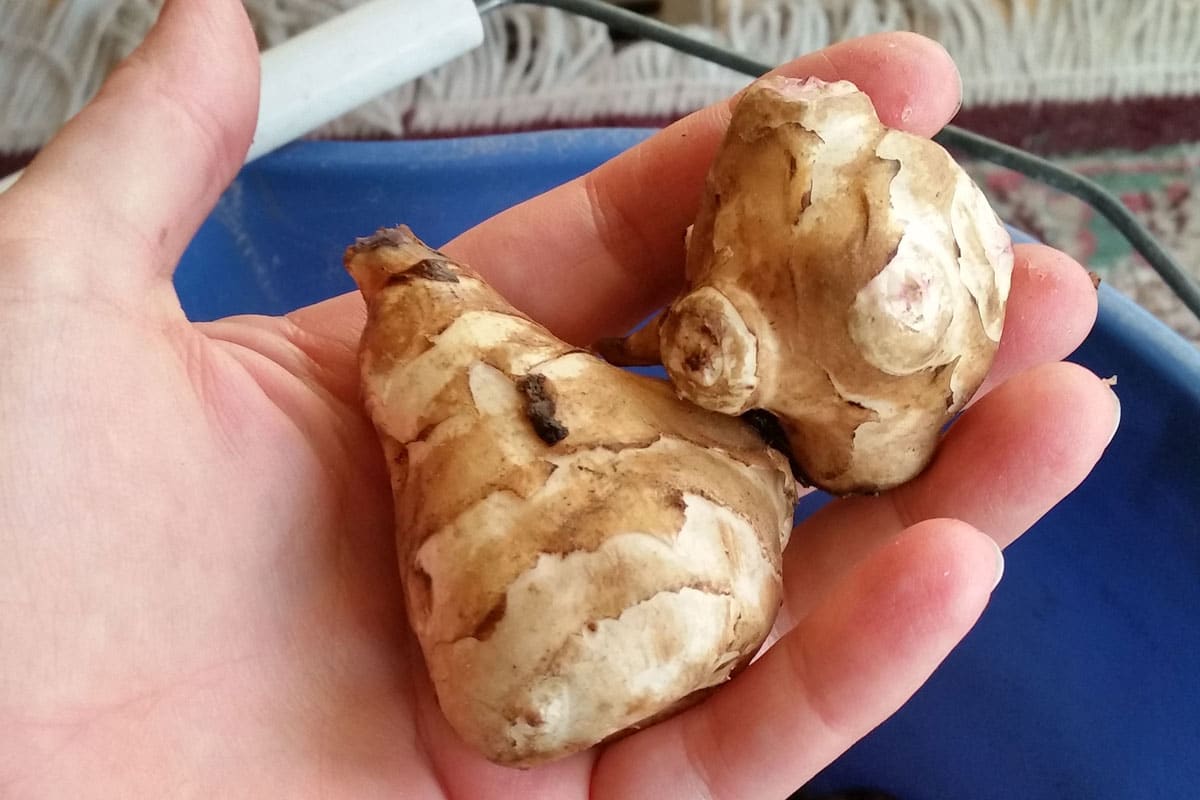
Sunchokes are native to eastern North America. They are also known as Jerusalem Artichokes or Sunroots. They are not related to Artichokes, but they are related to sunflowers. The whole “Jerusalem” thing is supposedly linked to the Italian word girasola, which means sunflower.
Sunchokes are a perennial plant that grows six to ten feet tall. While they do have pretty yellow flowers, most people grow them for their edible roots. Their roots are high in inulin, and eaten raw or cooked.
Historically, Native American valued them as a food source, especially during late winter when food supplies run low.
How do you Grow Sunchokes?
Grow sunchokes from roots or sections of root, planted in spring or fall while roots are dormant. You can grow the plants from seed, but starting with tubers is easier and faster.
For best results, use the following planting guidelines:
- The plants prefer loose, well-drained soil, but will tolerate poor soils. (Lighter soil makes harvesting easier.)
- Space sunchoke tubers 12 to 18 inches apart, 4 to 6 inches deep.
- Space rows 4-6 feet apart (they will be prone to spreading).
- Soil temperature at planting should be at least 50°F.
- Plant in full sun.
- Do not plant in areas that are consistently wet, as wet soil will rot the tubers. Plants are drought tolerant, but produce best will a regular supply of water.
- pH of soil best between 5.8 and 6.2 (neutral soil)
- Preferred growing temps = 65 to 90 F.
- Cover your soil with an inch or so of organic mulch for easier harvesting and root protection.
- Plant in a dedicated bed that can be mowed around for control. Or sink barriers into the soil around the sunchokes at least 24 inches deep to prevent spreading. (More on this below.)
When are they Ready to Harvest?
Harvest sunchokes in late fall or early spring. They require 110 -150 days to maturity, depending on the variety and growing conditions. Light frost increases the sweetness of the tubers.
Unlike potatoes and some other root crops, sunchokes do not store well. Their skin is thin and dries out easily. I keep them in the refrigerator for 1-2 weeks. They keep best in the ground, dug as needed for use.
In northern areas, a thick layer of mulch may keep your tubers accessible longer. It may also encourage mice or voles to move in and have a snack, but there’s usually enough to share.
For bigger roots, avoid crowding plants and water regularly. You can also cut off flower stalks to encourage root growth. Please don’t cut off all your sunchoke flowers! They flower late in the season, when pollinators have few flower choices.
How do I Eat Jerusalem Artichokes?
Sunchokes are edible raw or cooked, including the skins. They are difficult to peel and turn grey quite quickly, so a good scrubbing is a better option.
Raw, sunchokes are similar in texture to a water chestnut or jicama. After a light frost, they take on a somewhat nutty flavor. For my part, they taste best raw after a frost.
See Jerusalem Artichoke Recipes for easy recipes and cooking tips.
Do Sunchokes Cause Gas?
Sunchokes are loaded with inulin. Inulin is a type of starch that acts as a prebiotic in the digestive tract, feeding our beneficial bacteria.
Inulin is a widely used filler in many foods to bump up the fiber counts. It also increases calcium absorption in the body, and doesn’t spike blood sugar. There are even sweeteners made for diabetics made out of sunchokes.
See Jerusalem Artichoke Benefits: Nutrition, Flavor, and Uses for more information.
Eating a large amount of sunchokes may lead to “mild gas”. They have the nickname “fartichokes”.
I can verify that eating a large portion of boiled sunchokes will give you horrible, gut-racking gas like you have never experienced before… except for that one time when you were pregnant and thought it was a good idea to eat prunes, cheese curds and cucumbers in large amounts all at the same time.
Start slowly when eating sunchokes, and perhaps avoid serving them in large quantities at dinner parties. Give your digestive system time to build up the right bacteria to deal with the extra inulin.
Readers have suggested a couple of different tips to beat sunchoke gas. One suggested that you eat some sunchokes raw, and don’t scrub all the dirt off.
I assume that some soil microbes come with to help aid digestion. Another reader says that harvesting after frost is a big help, as the frost naturally breaks down some of the inulin for you.
A Word of Caution About Growing Sunchokes
“Easy to grow” and “disease-free through heat and drought” are code words for “You will Never Get Rid of this Plant!”
When I first planted sunchokes, I skimmed over the note in the seed catalog that said “they will spread and may be invasive”.
I planted my tubers late in spring, in one corner of a garden bed. There were nine rather wrinkled little roots, and I didn’t think they would all survive. Not only did they survive, they thrived. We tried to harvest the whole patch that first year, but must have missed a few.
The next spring they were back, and they were spreading. We tried to keep up eating them, but the fall was muddy and we couldn’t get in to harvest.
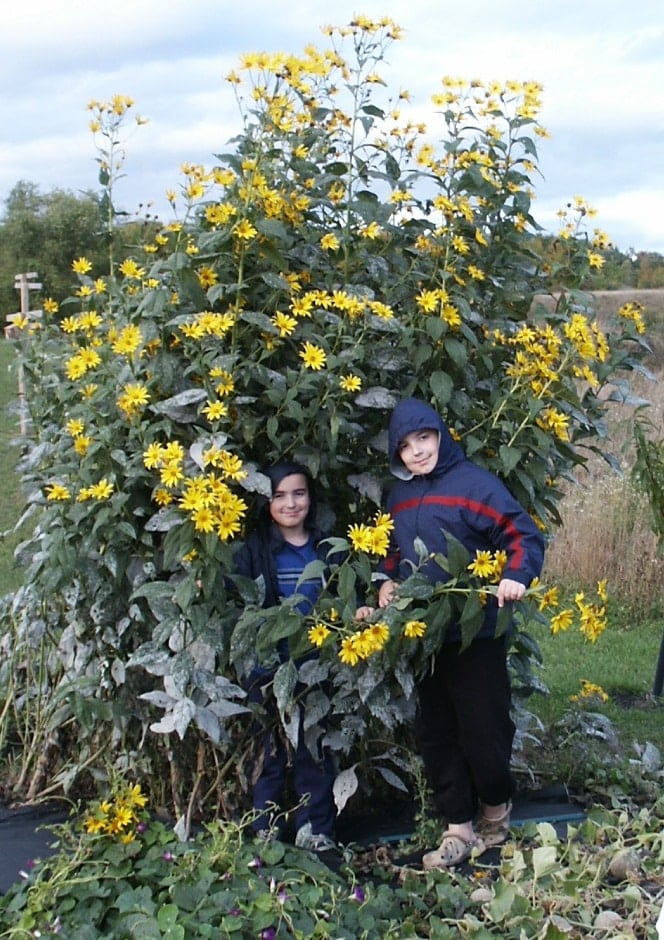
By the third season, we had the lovely thicket of 12 foot tall flowers you see at the post. As I was digging them in fall, I tossed some damaged roots off into the tall grass away from the garden.
Sunchokes Spread from the Smallest Bit of Tuber
Fast forward to spring. Those root bits haphazardly thrown into the weeds – they’ve now sprouted into plants. There’s a new sunchoke colony.
I decide to get rid of extra sunchokes. Two friends come over.
Four different adults attack the patch. Bushels and bushels of sunchokes leave the garden. The patch size is reduced roughly by half to start the spring.
Time passes. My boys work the bed again. They remove more sunchokes from the same area that the adults have already gone over.
Before I put the transplants in, I work over the same area one more time. THERE ARE STILL SUNCHOKES COMING UP! This area has been gone over by four adults and two kids, and there are still sunchokes hiding in the dirt.
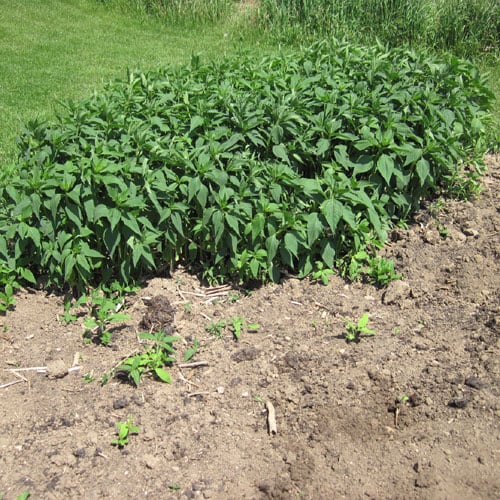
Here’s the main patch. You can see the smaller outliers in the foreground. That area should be clear.
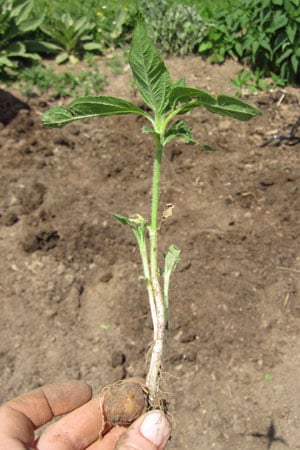
Here’s a nice, innocent looking sunchoke seedling.
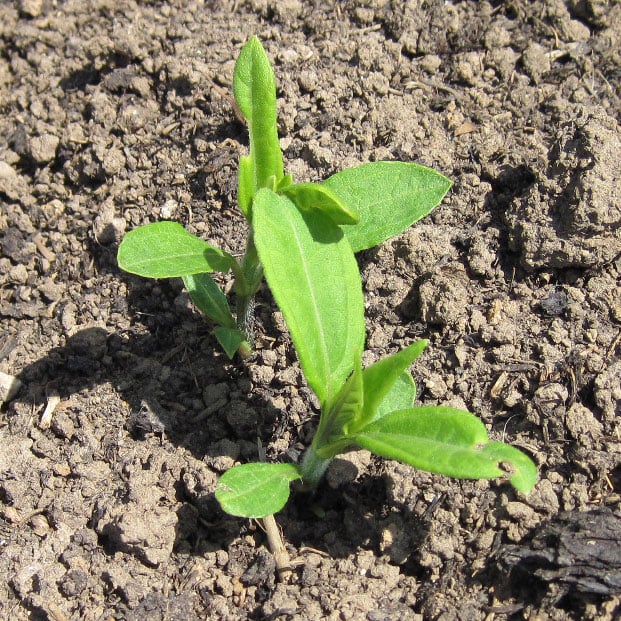
Once we dig it up, we see that this single tuber is trying to regrow an entire sunchoke thicket.
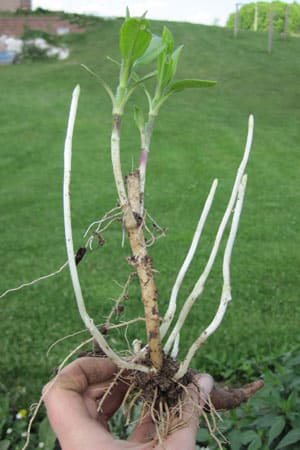
Even tiny pieces, no bigger than the tip of my thumb, can regrow entire large, vigorous plants.
They’re virtually unstoppable. Weeks later, and I’m still digging up shoots from among my cabbage seedlings.
Plan Ahead with Your Sunchoke Plantings
I urge you, do not plant sunchokes anywhere else you might like to grow other plants at some time in the future. You will spend very large amounts of time attempting to remove them if you do.
Plant them in their own area that you can mow around, to keep them under control. You can also plant them in pots – as long as they are big pots. Try one tuber per 18 inch diameter pot. Look for varieties that naturally grow shorter, and have an option for providing support if needed.
My neighbor says her horseradish plants are the same way. Plant both at your own risk. Maybe we should plant them next to each other, to see which one wins.
Alternatively, introduce pigs or chickens into your sunchoke area and let them tackle clean up duty. Jerusalem artichokes make a fine fodder crop.
What Tries to Take Over Your Garden?
Sunchokes are good for you. They look pretty, taste okay, and are quite expensive to buy in many areas, if they are available at all.
They’re a “perfect” choice for a new exotic vegetable to try. I just wanted to let you know that you’re likely to have a lifetime commitment with them once they enter your garden. Don’t say I didn’t warn you.
Are there any other plants you’ve grown that want to take over your garden? Leave a comment to warn other gardeners before they end up fighting them, too.
Also, if you could include in your comments roughly what area you are from, that would be great. Some plants will spread in some locations but not in others.



This article is written by Laurie Neverman. Laurie and her family have 35 acres in northeast Wisconsin. They grow dozens of varieties of fruiting trees, shrubs, brambles, and vines, along with an extensive annual garden. Along with her passion for growing nutrient dense food, she also enjoys ancient history, adorable ducks, and lifelong learning.
Originally published in 2012, last updated in 2026.
Sometimes you just have to reach for the herbicide because nothing else works.
An active glyphosate (Roundup is most common) *should* do the trick since they are systemic. Try to avoid ones made in China as they are often weaker mixes than they claim.
I would mix more concentrated than the directions say, especially if you have hard water. One or two applications should do the trick if there are no seeds waiting to re-establish the plant.
Wait at least a month between applications and don’t worry if you don’t have immediate results overnight as it takes days to work.
If you don’t want to use chemicals that’s fine. Just be prepared to deal with that plant in your garden forever.
I’ll take the sunshokes over the glyphosate any day. I never want that stuff to come anywhere near my garden – http://www.non-gmoreport.com/articles/may10/consequenceso_widespread_glyphosate_use.php
I had to laugh at your so serious concern with your lack of ‘control’ of this wonderful plant, as we had 200 acres of Sunroot (Helianthus tuberosus, or Jerusalem Artichoke), back when we were also ignorant of their true beauty, and fought them as a weed in our corn and soybean fields.
Eventually, our animals, an older and wiser retired farmer, and a study of how the Native Americans used Sunroot, taught us what a fantastically productive and nutritious crop that Sunroot truly is, and we planted acres of them, instead of fighting them.
All animals benefit in health by consuming them. No one gets gas from them, if they have the right beneficial gut flora, so, if you want to avoid any possibility of gas, eat your first one straight out of the dirt, unwashed, when you are digging them, as the dirt around the tubers attracts all of the necessary pro-biotic bacteria needed to digest them. They are truly a miracle of excellent nutrition, and the ‘ultimate survival food’, which virtually single-handedly kept the Northern Hemisphere from starvation, during the Maunder Minimum and the Dalton Minimum of the “Little Ice Age”.
We should all be planting more of them, right now, because we are heading into another “Solar Minimum”, right on schedule, again.
It is a very special and peculiar plant, but, once you understand the plant, it is a pure joy to grow, to eat, and easy to control.
First, plant only one variety of ‘true Sunroot’, within any one isolated area, because they form no viable seed that birds can spread. Two true Sunroot cultivars planted, side by side, if they a far enough unrelated, may cross-pollinate to create viable seed, reportedly, tho’ I have never seen it happen in my experience and we had three very disparate varieties planted side by side, for years.
Real “Sunchokes” are not just another Sunroot, but are a commercial cultivar, hybrid of Sunflower (Helianthus annuus) and Sunroot (Helianthus tuberosus), and they do form viable seeds, which birds will spread. These “Sunchokes” have their place, but they can be very hard on neighborly relations, so I rarely advise their use.
Plant them in well-manured deeply-tilled raised beds, hills, or ridges, no closer than 14- 15″ apart, 18″ is preferable, for largest tuber production. In 36″ rows that is 10,000 plants per acre, or, in 4′ raised beds, on a diamond pattern, in 4 – 15″ rows, it is 20,000 plant/A.
A tuber or ‘eye’ of less than 1/4 ounce is sufficient, in damp soil, but drier soil requires larger pieces, to insure proper germination and your desired population. It takes at least 220 pounds of carefully hand-cut tubers to make a 10,000 population (330#@1/2oz. pieces is most advisable), in damp soil, and up to 4000#, if you plant the largest whole tubers, in drier ground. You may want to use a 24″ spacing, if you plant whole tubers, as EVERY ‘EYE’ WILL PRODUCE A STALK!!!
Never fail to dig Sunroot every year, and attempt to get every tuber, no matter how small, or they will come back too thick, otherwise, as even the pieces of roots will produce a plant, no “eye” is necessary!
Only dessication or molding (primarily sclerotinia) of the ‘heart’ can kill the ‘germination’.
So, any piece of heart with a small amount of ‘pulp’ around it, or any piece of root 3/4″ to 1 1/2″ long, depending on soil moisture, will create another plant.
So, never use a disc or any other type of harrow on them, as it will only break them in pieces and double or triple your population.
You will never kill them by digging them, as they only come back better than ever from the lack of their own competition and the aeration of their soil!
Anywhere that the brace roots break off the end of the tuber, another plant will come up, no tubers are necessary to have a productive population.
Only pigs can smell, dig and eat every piece of root large enough to germinate. You will never see such healthy pigs, or taste such delicious pork, as those fed on Sunroot.
Chickens can kill them, by continually eating the tops, right after their emergence from the soil. So, let chickens forage in Sunroot only after they are taller than the chickens, so they only work on the lower sun leaves, rather than the new cotelydons. This also gives your free-range chickens spectacular cover against raptor predation!
If you wish to rotate Sunroot acreage out of production, for the next season, you can cut silage, long before the killing frost, then sow rye, and the next spring pasture cattle on that ground, when the Sunroot plants are 10″ to 15″ tall. The cattle will prefer the Sunroot, and eat them right down to the ground, when they are at this weakest stage, they will not grow back.
You may cut the Sunroot for hay or green chop, to feed animals, after they are 2-3′ tall, depending upon variety, or let cattle graze on them, rotationally, up to when they bloom, then, let them alone, until after a hard killing frost.
However, if you want to kill Sunroot, yet, have no livestock to kill them, turn them under as a green manure crop, with a moldboard plow, at 10′ to 15″ tall, when they have spent the energy of the seed tuber, but have yet to start forming any new tubers.
It is usually best to follow Sunroot a short-season grass, like corn, instead of any bean, which may also be susceptible to sclerotinia (white mold).
No animal turns its nose up at Sunroot, but no animal loves the “earth apple’ more than horses, which react to them like candy, especially after they have been cooled or frozen, as the cold breaks some of the inulin down into fruit sugar.
Larry M. Aden, lma@amass.us, Cell: 712-660-3949, Nemaha, Iowa 50567
Great comment, Larry. Thanks for sharing your knowledge. One of my favorite parts of blogging is meeting people with more experience than I have that I can learn from.
Awesome response! 🙂
What a fantastic comment! Thank you.
Thank you I came here by accident as I wanted to know more about tubers I planted over 15 years ago. Never saw them til last year and now…well I will take it one year at a time Lemon Balm I love the aroma, holistic value but …I am going to try your suggestion and move towards road as I did some Sunners and let them enjoy themselves… Have great week Thanks for all the feedback
EIGHT years ago we built a little house in the woods and ran out of money for landscaping. Some nice person gave me free Yarrow. “Deer won’t eat it” they said. It has now taken over parts of my yard. Do not ever plant yarrow or snow on the mountain no matter how much money you do not have….agh! Have Mercy!
I am amazed. I still have the very same ONE row that I originally planted several years ago???? It is in the back of my garden and I love it . LOL Maybe mine behaves because our place is so hard to grow a LOT of things??? Too many walnuts trees!
Oh my! Oh my! I planted chuffa seeds in pots (as I had read that they were incredibly invasive,) and after reading the comments and looking at my pots I am praying that they don’t some how escape! We have at least 6 acres that is tilled ground with out anything planted on it! I would have a chuffa invasion for sure! I planted them in hopes of finding a healthy snack for my husband who is diabetic!
Don’t worry – if it escapes onto your acreage then the wildlife will take care of it – a lot of farmers plant chuffa in their deer food plots and apparently they always have to replant! I think turkeys like it too if I remember right.
you can add catnip/catmint to the list. I find it everywhere on the property. Doesn’t really bother me though as it has not actually spread to our veggie or flower gardens.
Have you tried spraying the sunchokes with vinegar? Maybe you can kill them that way.
They’re coming up right next to my other seedlings, so I don’t want to do anything that might damage the other plants. I have catnip all over, too, but I like that – as do the cats. I use it for mulching new seedlings to keep the bunnies away.
I have heard that if they are left alone and get to the point where they can’t spread, they will crowd themselves out. We live on limestone. Every time we plant a tree or bush, we have to dig out rock. And gardening is easiest done with raised beds.
So I have my chokes in a raised bed. Something I have found, though, is that if the small birds don’t eat the tiny seeds that form on those tiny sunflowers, they will come up from the seed that scatters with the wind. I’ve had chokes come up in unusual places that could only be from the seed, either being scattered by wind, or deposited after going through the birds’ digestive system. Sorta like mulberry seed.
It sounds like sunchokes would be a perfect survival food &/or beginning plant for someone with poor soil &/or lack of growing experience…as long as they can mow them down if needed, right? 🙂
You can mow them, but they grow back, repeatedly.
Oregano. We planted oregano, sage, & thyme about a foot apart from each other. The oregano spread, and we weren’t dilligent, so the thyme & sage lost & didn’t come back after a few years. We finally tilled the area, and I’m going to be dilligent in pulling out the oregano this time. There is even some oregano growing 6+ feet away in the pathway. I’ll leave a little of that, because we just mow the pathways down every so often and I can always choose to harvest a little oregano before we mow it.
Oregano is part of the mint family. So is it’s cousin, marjoram. The entire family are voracious spreaders.
Oregano has taken over my world.
Mine battles it out with the lemon balm in the center of the garden.
THANK YOU for letting us know! I was thinking of planting some….now I’ll find another plant.
Most gardeners already know that mint can be rather invasive. But it is one plant that I enjoy mowing and weeding because it smells so good!
Easy solution. PLANT IN A COUPLE OF CONTAINERS. The you have all that nutrition but under control. Why let plants control you, when it should be the other way around – good nutrition and valuable probiotics (sic.) are too valuable to dismiss. I only cut up a little for salads to give it crunch and a nutty taste so never eat them in great quantities to give me digestive issues. Just use common sense in planting and eating. End of story.
Sorry, I am referring to the sunchokes. If the containers get too bulging you can always break them apart and have new containers next year. Try the Youtube version of growing sunchokes, if you can listen through this guy’s 8 minute presentation.
https://www.youtube.com/watch?v=IZnx_1yQ6gg
I checked out the link, you are right about the presenter. I checked his video on kombucha just yesterday. It was an hour long, had good info but could really have been shorter or done in 2 parts.
That’s a great idea. But. We live in Texas, land of high heat, loads of intense sun, and infrequent rain during the summer. The plant police would likely arrest me for cruelty to plants if I ever attempt growing something in a pot again. Unless there is some defense for utter forgetfulness and oblivion. I have pots on my patio, right outside the back door, that I pass several times a day. And still forget to water. Since I’m currently wrestling spiteful bermuda grass, I shouldn’t add another invasive to our yard. Then again. ..if the sunchokes could choke out the grass…at least I’d be waging war against a pretty and edible plant!
I’m not in Texas, but I’ve pretty much given up on container growing because of our winds. They just wick the water out of everything. Both this summer and last, it’s been dry, and I can barely keep the garden beds wet enough to keep growing.
Have you considered a hugel pot? Bury some pieces of wood in the bottom. They absorb water and release it back. Look up hugelkultur. Same idea on small scale.
That’s interesting. I’d rather just plant in the ground, but for someone who needs to make it work, that’s a cool idea.
Lemon Balm. The bane of my existence. The previous occupant of our home had a small garden last year. In one corner was a lemon balm plant. I left it there and it came back this spring. With a vengeance. I have since removed it from my garden because it was trying to overtake everything and it is happily thriving in my flower bed now. The garden, I fear, will never be the same. I have baby lemon balm sprouting up everywhere. Crowding out my veggies and even growing throughout the beams surrounding the garden. Anyone want some lemon balm? I have a never-ending supply!
Isn’t lemon balm in the mint family? Need I say more?!?!?! BUT you can rub the leaves on your skin to repel bugs. I actually tried to grow some this year in my veggie garden but it didn’t come up.
I’ve got lemon balm wandering all over the garden, but it doesn’t bother me much. I use handfuls of it (along with catnip) to mulch other plants to keep bunnies away. It is indeed a member of the mint family.
I know this is an old post, but I’ve had a lemon balm plant in my vegetable garden for years. While it does sprout runners, I just clip them back. In the spring before I put in transplants, I put a weed barrier cloth on the area around the lemon balm giving it about 4-5 inches of bare ground around the main base and pin down the cloth. It keeps contained without any problems.
I use lemon balm in place of 1/4 or 1/3 of the basil when I make pesto.
That sounds like a nice mix.
Lemon balm, me, too, me, too. So invasive. Spread all through my lawn, from its enclosed in ground pot. Yummy, though, but not yummy enough to need a whole lawn full of it.
We planted Lemon Balm around a boggy area – helps keep the mosquitoes away! (and yes it smells wonderful when we mow)
I have gotten to the point that lawn too expensive, always trying to keep it alive, in woods I have started growing herbs, lemon balm did over run my lavender but it is a great addition to wild yard, mowing does smell so good. Plus the ability to use something Non Chemical on my skin against fleas, mosquitoes, gnats…
Too many people jumping to kill things, instead end up with round up in their wells, food. I have fought round up for years but now it is in wine, beer, bread so keep using.
I love my kids too much, my water too much.
One day I hope that people will wake up to the fact that’s it’s a bad idea to grow our food with poison.
I have heard that pigs like these and they are about the only thing to be able to find and dig them all up. If I get pigs in the future I may plant these to give them something to root for.
That’s exactly what our American Guinea Hogs did! Our Jerusalem Artichoke (picked up at a local organic farm stand) grew over 14′ tall and were a garden marvel that never went too far as we put our new piglets in the area as their first paddock. They made quick work of all the bulbs and we’ve never had one come back, we actually miss them! – How I ended up on this website!
We also found pigs are excellent to get rid of BUTTER CUP! Try getting rid of that in soggy, shady areas of WA state…Our goats and heritage breed sheep would have made quick work of them if they had been given access as they devoured what we had in another plot.
We also have mint and lemon balm that grow out of bounds quickly here. Our Egyptian spearmint has gotten 6′ tall in some areas but happily eaten (especially during summer heat) by all manner of livestock as it is not so strong as peppermints. Our Lemon balm we have taken out of garden beds (was a companion planting experiment) and now use it to line the driveway, planting and trimming it like a hedge- (Lemon Balm Lane)…Lemon balm is also extremely beneficial for your rabbits after they’ve kindled! Our does ALWAYS eat it then, just as our ewes would devour ivy after lambing! Comfrey, I give to anyone with a garden or animals, I have experienced many reasons why no homestead/farm should be without it! It was a valued fodder in times past and is quite high in protein. My only Warning: it is like Velcro with an Angora rabbit’s fiber!
*Another note, I think the valuable practice of herbal hedgerows really should be a more readily utilized addition to the benefit of all herbivores. Like it was mentioned above, animals know what they need and if you offer them a variety of herbs and give them ready access, at all times of the year, they will happily address any ills with the corresponding herbs long before we caretakers/husbandman may have been able to perceive a challenge.
Thanks for sharing your experience, Staci. I think adding herbs to homestead animals forage options is a great idea that should be more widely used.
Wow! My mom planted these once… she told me that they were called “faux sunflowers”. She planted a few in a flower bed right next to the side of her house, right in front of her dining room windows. They were very effective at blocking said windows from getting any kind of light! Anyway, that was 10 years ago and she is still pulling a few up every spring. Her “crop” was much smaller though probably because it was in a contained spot.
They sure are pretty!
Hey! Thanks for the warning! Here in Australia the plant that’s giving me headaches is the Oyster plant (also known as Bear’s Breeches). It looks nice and shiny and big and has pretty purple flowers but their roots are long and tuberous and impossible to just “pull” out of the ground. They don’t respond to any form of weed killer. If you leave even a tiny bit of root in the ground (and you’re bound to, these things snap easily and are really, really long, and dense) it’ll come back as another plant. One small little shrub will grow into another bush, which roots itself along the ground and spreads fast. A plant can become several very quickly, and can take over the yard. They’re drought tolerant, frost resistant and aren’t daunted by full shade or full sun. The only way to rid yourself of them is to dig up the dirt – all of it, about a meter each side of the plant, and under – remove, discard somewhere SAFE (like the bin), and replace the soil in the garden. Or do what I’m doing, which is removing each peice of root I find when it sprouts. It’s not fun. I’ve heard quite a few americans in forums say “oh, but I’d love that plant, it’s so lovely!” – Listen to me. NO YOU DON’T. Trust me. This advice may save your garden.
It’s very easy to permanently get rid of oyster plant. Just cover it with a sheet of black plastic or a thick layer of cardboard or newspaper. It will die off completely in a couple of months.
I planted a guara. It is drought tolerant, grows by runners much like the sunchoke, has lovely white and pink blooms in a meadow effect. It is night-blooming, VERY FRAGRANT, and WE ARE ALL ALLERGIC to it! It gives us horrid headaches, and it is right outside the front door, and when the door opens, the fragrance enters the house. It has plagued me for 17 years now! I have solarized, hacked it out completely, repeatedly, etc. Still comes back.
Cut it as close to the ground and try a chemical called Remedy. I’d paint it on the cut w/a small brush. It is used to kill trees. Wear gloves.
When we moved into our home there was a nice patch ( 4′ x 4′ )of an attractive tall growing plant that shielded our back patio nicely from view of the street and neighbor. The next year it was larger, and the third even larger…nearing 10′ in landspace. We called it the ‘bamboo’ because it looked somewhat similar in the stalk though the leaves were entirely different. I tried a couple of nurseries in hopes of discovering what this wonderful plant was, it grew so tall and quickly, birds would nest in it in summer and the chickadees loved it in winter.
Then I saw it in the backyard of a friend. She hated it. She said she liked it at first too when she moved in, but noticed that it doubled in size every year and so the 4th year she tried to exterminate it, but it kept coming back. This made me start to wonder. But still, I was unable to have someone correctly identify it for me, and my spouse was quite attached to it’s privacy features.
One spring I saw flyers in several nurseries warning about Buckthorn, a plant I was familiar with on property and wanted to get more info on. So I looked it up on the internet, was brought into our state’s DNR Invasive species plant website (something I recommend everyone to do now, to familiarize oneself. It’s amazing how many invasive plants are being sold in nurseries), and lo and behold, I discovered a picture of my mystery plant.
Japanese Knotweed.
Edible, but will take over your yard, and can break up your sidewalk, driveway and yes…even your house and is more or less next to impossible to get rid of, a task that takes many years.
And here, my hubby was encouraging it’s growth for it’s wonderful neighbor-view blocking properties!
When it got to be over 20′ in landspace with shoots popping up in the yard 20′ away, he started listening to me. So we’ve been attempting to get rid of it, and it’s just sending shoots further and further out into our yard. We can only keep cutting them down and limiting it’s height with weed killer. Apparently just one little teeny sliver of a root is enough to get this thing going, and the roots spread underground up to 60 feet away.
Nice. |:-\
The good thing that has come from this, it has decreased my frustration with the thistle problem we have. THAT is controllable compared to *this* thing.
http://www.mda.state.mn.us/plants/badplants/knotweed.aspx
(I did sauted up a batch of young stalks, like asparagus. It was fine, but my hatred for the plant now prevents me from considering it digestable)
Here in Washington State they are trying to eradicate knot weed, the department of ecology will do it for free here.
They asked all of us along the creek if they could check for it, and said they would remove it at no charge.
Check where you live and see if yours will.
I was told by a local beekeeper that Japanese knotweed was a great food source for his honeybees. Since they are in serious decline due to colony collapse disorder or pesticides or whatever else, it’s something to think about. Maybe removing it completely isn’t always a good idea. Just sayin’.
There is some good in almost everything.
Japanese Knotweed is one of the premier treatments for Lyme Disease. By the “Law of Signatures,” that makes sense. It tends to grow in Lyme endemic areas, and like Lyme, it is incredibly difficult to eradicate once it begins to take over. If you stop using Roundup, you might be able to sell it as a major cash crop to an herbalist. Resveratrol, the main component in grapes and red wine, is also present in Japanese Knotweed.
Look up how much resveratrol supplements cost these days, and you’ll see what I mean about cash crops. An ethical herbalist wouldn’t accept it all sprayed down with toxic chemicals, but you might be able to get an enterprising someone to harvest your yard for you on a regular basis and pay you for it. Worth consideration! Plus, you’d be helping to eradicate a much more destructive illness — Lyme Disease.
Best of luck to you,
Laura
http://www.dcnr.state.pa.us/cs/groups/public/documents/document/dcnr_010254.pdf
Thought this was interesting. I didn’t know about the Lyme connection. We have tons of knotweed behind my also along the township’s walking trail. Send the herbalists my way please!
If you want to organically kill it, I would suggest using good old vinegar. Vinegar kills any plant. I use it to clear weeds from stone walkways and it’s much better than adding toxins to your property like Roundup. Roundup is sprayed on plants we eat and then slowly poisons us. (read about GMOs too.). I’d suggest cut the stalks of Knotweed you don’t want down to the ground then cover with vinegar. It’ll go into the spreading root system and kill it off. It works on the invasive bittersweet vine too, but realize if that’s climbing a tree, don’t pour it on the ground or you might kill the tree as well. Again, cut the vines (which can get very thick) and pour on the fresh cut.
Vinegar fail sot kill plants, UNLESS one uses the industrial strength vinegar [about 40% acidic]; which requires using protective gear.
We tried eradicating weeds and grasses one summer, using the regular home-use vinegar from Costco, even mixed in a bit of rock salt for good measure….weather had been dry and hot; the plants should have sucked it up and died….instead, they thrived. We could almost watch them perk-up and stretch to the sky again. Hardly any had wilted over after 48 hours.
But then, this is the Pacific NW; soils tend to encourage somewhat acid-loving plants.
Use 20% concentrated vinegar with a little dish-washing detergent as a surfactant (some people also add salt). Buy vinegar at 20%, or higher and then dilute. Spray when there’s no chance of rain for a day or two. It works systemically, so kills down to the roots. Caution: be very *very* careful using this stuff (!!) 20% won’t hurt that much if you get it on your skin but it *will* take your skin off. Always wear gloves (preferably nitrile), long sleeves, don’t breathe in mist, consider a filter mask & goggles. Google research before using. See also: https://bellechemical.com/concentrated-vinegar/ https://www.thespruce.com/vinegar-as-a-natural-weed-killer-2132943
10-15% is good for soft weeds, 20%+ for tougher plants.
Don’t chop or dig up Japanese Knotweed. Any piece, of root or upper plant, will regrow. The municipality here (West Vancouver, Canada), hires a private contractor to go around and do stem injection with Glyphosphate (Roundup, basically). Nasty but it is the only thing that will kill the plant AND not lead to more spreading.
Are you sure it is edible?
Earthdace – we don’t have it here, but a quick google search does verify edibility. Instructions for harvesting and eating below.
Chickens love them we have them in there yards and they don’t last.
Yes! My chickens love them too. I give the girls the peelings of the sunchokes when I slice them for salads (soooo delicious and crunchy). They go crazy and all grab for those first before eating any other treats I may be giving them at the time!
I haven’t thought of growing sunchokes in their yard. Will they actually grow, or do the chickens just dig them up and eat up any green growth???
I’m not sure. Depending on the number of chickens, the amount of yard and how well established the sunchoke patch is, the sunchokes may be able to survive the “attention” of the chickens.
“Plant both at your own risk. Maybe next to each other, to see which one wins” Love it! Thanks for the warning. I just planted some mammoth sunflowers, hopefully I can keep those under control. 🙂
I’m still pulling up sunflower shoots, every spring and summer, from a patch I grew 5 years ago. Wonder if it’s a familial trait. Very hardy and very vigorous. Considering planting Sun chokes in an abandoned field near my home. Since they’re native plants, no-one will ever know, right!?
There you go! I haven’t planted sunflowers in years. I just thin out the volunteers.
Yes, I accept volunteers as well. I just plant other things around them. Sunflowers attract beneficial insects, butterflies, and goldfinches!
I am still growing sunflowers in that same garden space – a small bed around my mailbox, and I have not replanted them. They reseed themselves. I may try to dig up the bed, and plant some Jerusalem artichokes.
Four O’Clocks are some of the most persistent hard to kill plants I’ve ever dealt with.
Please, Please, Please, don’t plant comfrey I rue the day that I planted that one innocent plant I shall never be rid of it! It has taken over much of my herb garden(only with constant weeding has it not devoured it) it has spread to other areas around my yard, a huge patch next to the shed, it is coming up in the marshy area in the back yard, it is coming up in my peonies, it has come up in the ditch out by the road . . . you get the drift. You can’t dig it out any miniscule speck of root grows a new plant & believe me they are hardy & they also reseed freely, JOY!
I had one (comfrey) come up in my yard , didn’t plant it. grew quite big before I knew what it was. I cut it down then used round up on it all summer,
Thought it was dead. Well two years later it’s back, ugh. Last year not a sign of it. So I am trying again.
Comfrey is useful medically, plus it’s a great bioaccumulator for the garden. You can make it into a tea (like compost tea) or apply the leaves and mulch. – https://commonsensehome.com/comfrey/
Comfy is a restorative to soils. It fixes nitrogen each time it is slashed. Try to dig it up and it will grow more. Till it at your peril. Chop it and drop the leaves for a mulch on your fruit trees and build the soil with it.
Get some chickens!! They annihilated mine in a matter of hours and I love them! Laurie and Rachel are so right, very good stuff. You can even make a bone knit serum out of the leaves and heal ulcers and broken bones. Amazing fertilizer – let the leaves soak in water for 4 week and spoon it into your tomatoes and potatoes (similar to potash). Till it in for green manure. Noted as having more protein than any other leaf structure know to the plant kingdom, makes it great fodder for all animals.
Thanks, Roni.
I would urge you NOT to feed your chickens comfrey in any quantity. It’s toxic and though it does a good many good things, if fed regularly to chickens they will begin to lose weight and feathers, get sickly and die long before they would without comfrey. Please study the literature before planting or using. If the roots are disturbed (broken or cut), just like potatoes and johnson grass, they will regrow more from each piece though cutting the leaves for soil building and other uses, including fodder for animals in small amounts, will not cause spreading.
Comfrey is toxic to animals and humans. It also has carcinogenic qualities where animals are concerned. The following clarifies this.
http://www.ncbi.nlm.nih.gov/pubmed/21170807
As I understand it, this “study” utilized massive amounts of comfrey – not a valid comparison to how comfrey is used and has been used for over 2000 years (as the abstract also notes).
My chickens free range and willingly eat it… But they won’t touch it unless they need it! I’m a firm believer that animals are smart and know when they need something!!
There are plenty of documented cases of wild animals traveling miles to access a particular mud or plant to treat illness, so why not domesticated animals with options, too?
I eat comfrey leaf pieces and the yummy purple flowers right from the plant throughout the season. The leaves are an acquired taste for sure. And if you are letting the leaves rot/ferment/age for use as fertilizer the odor will definitely get your attention.
I’d have to honestly say I’ve only experienced side effects from those “fartichokes”.
The toxic chemicals in comfrey are in the roots and according to all studies “possibly” in some small amount in the leaves. Testing the leaves for PA has never shown enough accumulation to be toxic to humans or other animals.
I love comfrey! It’s so beautiful…. just keep chopping and dropping to mulch and feed your garden… but yeah don’t plant it where you don’t want it or can’t control it
It is just a touch invasive. Good pollinator plant for predatory insects. Most adult predatory insects want pollen and nectar. And, to my misfortune, it doesn’t thrive in Arizona. Now, up in Penna, yep. Best place for it is along a pasture. Animals will keep it under control, and pigs will tear out the roots.
get roundup on your skin and it can give you cancer. get comfrey on your skin and it can build better ligament connections and strengthen your bones
Evidence?
Some discussion of possible Roundup/cancer link here – http://www.ewg.org/agmag/2016/05/does-monsanto-s-glyphosate-cause-cancer
More on comfrey at Comfrey Uses and Remedies.
The bulk of evidence appears to show that glyphosate is not carcinogenic. A quick look through Pubmed turns up many papers showing no carcinogenicity over multiple studies (here’s just one review published last year- http://www.ncbi.nlm.nih.gov/pubmed/25716480). The lack of a plausible mechanism for carcinogenicity is also telling. Glyphosate affects a plant-specific pathway unrelated to any kind of human enzymes that affect genomic DNA that could lead to a cancer.
I’m envious of Laurie’s sunchokes though. The grasshoppers in northern Colorado this summer are severely affecting them as well as other garden veg. Maybe I can send some to anyone who wants their sunchokes under control 😉
From something I read, can’t remember the specific article, said there is a class action lawsuit against Monsanto for false advertising on Roundup packaging because of the claim that the enzyme it targets isn’t found in humans or animals. This article also states that up to 90% of wheat grown in the USA is treated with roundup 7-10 days before harvest. Something you might want to research.
WHO and CDC have bothy warned of roundup carcinogenic properties…so thyere’s that…..
Round Up you do not read the lawsuits for decades. Proof, studies are readily available online from USA Universities and Foreign 30 years articles have been published
If you believe Roundup (Glyphosate) to be safe, take a look at this video of a conversation between Toni Mitra, a concerned Canadian and a scientist, Anthony Samsel, co-author of a paper about how this substance alters DNA. https://www.youtube.com/watch?v=0C7E25lBCg4
YES! Thank you for listing that.
Glyphosate is not just cancer causing. The bad effects are long-lasting in the environment, MOST of the manmade chemical compounds have been deliberately designed to persist in the environs.
Also, Monsanto has coerced/fooled growers to apply it MULTIPLE times on food plants, “to help desiccate the seed heads off easier”….that means, there are at least TWO applications on grain foods, and those leave residues people are eating. GMO’d good plants are designed to REQUIRE using Glyphosate on them, and to prep the ground.
Glyphosate is a listed “antibiotic” because it literally kills all the good bacteria in the dirt…those bacteria are then missing from the foods that should have them in them, and, that is why GMO’d, glyphosate-prepped ground and foods, LACK most minerals…those plants get just barely enough basic fertilizers [also manmade] to grow cosmetically nice products, but which have been nutrient-deficient crops, for decades.
Once you start studying microbiology, anatomy, biology, etc., you start seeing how sub-clinical malnutrition is RAMPANT in world populations. People have been being fed nutritionally deficient produce, and massively less produce, for over 30 years. One can see the results walking around any street or shopping center….poorly formed skeletal systems, increases in diseases, etc.
As for the claimed “toxicity” of many herbs: The FDA and industries partnered back in the 1960’s, to publish false and misleading information designed to scare people away from using wild plants as food and medicines. Are some “toxic”. Sure…but, that is a very broad subject. SOME are labeled “toxic” because they have chemicals in them that kill cancers, or cure other ills. Some are labeled “toxic” because they have hallucinogenic properties best used in a supportive, guided situation by experienced guides. FDA partnered with State “noxious weed” departments, to make edible weeds and medicinals illegal to grow…like milkweed—which is a terrific food, and, is one of THE only planet sources that can save someone’s dying liver. Chaparral bushes, back in about the 1970’s, were literally scorched-earthed by officials, all over the SouthWestern USA, because people were starting then, to learn it could stop tumors from growing, by drinking a couple cups of that very bitter tea, daily.
Those who trust sites like PubMed, or MedScape, are buying into Pharma drug industries’ party line…the very ones that have been, for over 50 years, working consistently and aggressively, to wipe out herbs and foods people might grow and collect, and scare them from using them…even though people have been using them to their benefit for thousands of years, and, even though ancient references like the Vedic texts and the Bible clearly state “let plants be your food and medicine”.
Moderation and knowledge are key.
…ALSO…be very careful what you trust of “research”. It is a known fact that most research has been poorly designed, and, manipulated to get the results the funders desire. SOME is so cleverly manipulated, no one who didn’t work on it 1st-hand, would ever find out it had been faked. So, if some big industry claims research shows something is bad or good, you need to do some very careful vetting, to determine HOW the research was set up; HOW it was run; and, really read what was written, to see if that was actually used to write the opening synopsis of the research–often, what teh synopsis says, is not related to the study data at all.
I have planted Sunchoke as a privacy screen along my front fence, this is it’s 3rd year and it really hasn’t grown as well as I thought it would, it gets only about 5 feet high and has yet to have a single flower. I’m going to dig it up to harvest the roots for the first time in a week or so and will plant back into the space for the wall of green.
Also, I have Comfrey growing all over from an old timer’s big unused garden next door. It is a nice looking plant but I had a very large one growing in the middle of my lawn, I just kept mowing over it for 2 years and this year it did not grow back.
Interesting. What area are you in, and do you get enough rain? Mine are still growing like weeds, even where I just tossed discarded roots into the tall grass.
Noooo don’t put roundup on anything, especially such a beneficial plant like comfrey!! Please stop buying and using chemicals!
Comfrey BoK14 does not spread unless you dig the root cut it into some pieces and replant. leaves are a wonderful green manure/mulch and no flowers or roots/rhizomes.
Send me some comfrey!! I planted a couple two birds, they died, & I would love to have more as I feed them to my rabbits. Brittneyshaleen@gmail.com
Oh my gosh. Tubers. Not two birds.
lol – thanks for the giggle.
You cracked me up!
LOL!
Sorry, but I have a few friends with auto spell check that makes the most enjoyable posts. That was a good one!!!
Yeah, I have a “smart phone” that I call a dumb phone that does the same thing to me all the time!
Comfrey is toxic. Only do it if you don’t like your rabbits. Liver damage. http://livertox.nih.gov/Comfrey.htm
David Hoffman, one of my favorite herbalists, has written a detailed article on this subject titled, “Is Comfrey Safe?”
(PAs = pyrrolizidine alkaloids, which have been shown to pose a real risk of hepatotoxicity (liver toxicity))
He notes:
Glad to see this information as I understood there was more that one variety of comfrey and one is apparently more beneficial and then one has greater toxicity. (Not sure however if the “more beneficial” variety is also the variety with “greater toxicity”). In any case thank you both for this info.
Thanks for that post quoting Hoffman, Laurie Neverman.
As a participant in a couple of Facebook plant-focused groups, it’s been my experience that people can be quick to latch onto a fear-promoting message about this or that plant, requiring no evidence whatsoever. It’s enough for someone to say, “But it’s been known to cause cancer yada yada yada and your fragile kids might stick it in their mouths yada yada booga wooga” and Bammo. Conversation over. Suddenly a dozen more will jump on the bandwagon, agreeing that they’d heard it was a bad egg, and the one or two voices of reason often appear lost in the morass.
I also deal with this regularly when introducing children to lawn and yard edibles. Some concerned citizen will come along and terrorize them if they’re seen eating yew ‘berries’, when the toxic seeds are usually spat-out and even if swallowed in quantity, pass quietly through the gut. Recently there was a scare about rhododendrons – completely ignoring the fact that every case of poisoning involved large quantities of so-called ‘mad honey’ and not a single case of a kid munching on leaves.
Excellent critique of the PA toxicity concern. Thanks again!
…And about those sunchokes… The tubers in your photo look like the one called ‘Stampede’ for its capacity to fully develop in short growing seasons… could it be that your experience would have been very different if you’d simply started a different strain? I know many people who grow them and eat them and not one considers their decision to plant them a mistake. I’ve only eaten round-ish ones like you have, and i agree about the grainy texture, although i think it works fine boiled and mashed.
Perhaps if you were able to reconcile yourself to selling the excess, you might learn to appreciate their vigor. After all it will not be permanent. No single species can dominate a patch of ground interminably. It is a law often forgotten. Fight them less and they’ll use-up their niche sooner. Whether you believe in God or not, the process of ecological succession is an orderly one and (ecological) Band-Aid plants–as i call them–don’t thrive forever, whether their origin is foreign or very local.
-A bit of oligosaccharin food for thought…
Hmmm… I didn’t think I sounded terribly alarmist, or that I hated sunchokes, only that they liked to take over garden beds, and other areas. As for selling them, I think that would be a tough sell in our area, where people don’t tend to take to quickly to new foods. Also, they are a hassle to harvest compared to many other crops. Best flavor comes after a light frost, and our falls are always busy scrambling to put the garden to bed and harvest and preserve everything before winter sets in. Spending hours on end grubbing for tiny tubers – well, it’s not on my list of favorite things. We’ve also gotten some sort of worms that moved in last year, so the roots I carefully dug and stashed last fall were only about half edible, since half the tuber was rotten and worm infested. They don’t hold well in the root cellar, and in the fridge they like to grow fur in the crisper drawer, so they’re really best eaten straight out of the ground. Perhaps if our patch was better managed, or we could rotate animals in to do clean up duty, we’d be better off. Like most plants in my garden, planted on purpose or volunteered, I keep experimenting year after year, in hopes that I will eventually find just the right use for our family.
Helpful
Poisoning in animals is such a cruel death …
too much of anything is toxic….even water. Common sense….not so common i9t seems
After ten years of planting comfrey, I finally have two plants! They’re showing no sign of spreading, which I wouldn’t mind. It took them several years of babying to establish, but last year they were actually starting to look like comfrey instead of clusters of tiny dying leaves.
Horseradish also stays where it’s put, or has to this point. Sunchokes are still questionable. I have them in an isolated area (parkstrip) and planted them for the first time last year.
Location: Northern Utah, urban desert
Thanks for sharing your experience and location, Lauren. Plants sometimes behave differently in different areas.
I think comfrey must need a fair bit of water. The original plant I had didn’t spread for years. It was above a retaining wall in an area that didn’t get watered with a sprinkler often. The wall collapsed, the property owner refused to replace it. For years I hauled out dirt every spring and autumn until the slope of the ground was stable enough to quit falling. A few comfrey started. Now, there’s so much of it at the base of the bank I usually end up cutting it back when it flowers because it’s not far from the back door and there get to be too many bees. I’m in a semi-arid climate. There’s an underground spring or dampness that feeds it. The original plant from 35+ years ago never spread much at all but the ones below grow a good meter high on their own. If you want it to grow try putting it where it will get natural moisture. If there isn’t any, then I guess you’ll need to water it.
On the horseradish topic. I had it in a buried pot. I dug it up 3 years ago and used some of the root. I hadn’t given it much water and the root was quite dry. The tap root had pushed through the pot. (think I wrote about this earlier). I’ve given it a bit more water this time around and the leaves are huge – almost twice what they were when I dug it up. I had to cut some off because they were shading and covering the thyme. I read you can use the leaves in place of grape leaves for making crisp pickles. I think I’ll try it this; my pickles are never crisp. Does anyone know of this? I have no idea how much to add to the pickles. I don’t mind some heat but don’t want killer hot pickles.
I think you’re right about the comfrey and water. Ours is at the base of a retaining wall were it tends to stay very dry, and hasn’t spread much in years.
On the horseradish – try a leaf or leaf portion per jar. The currently recommended processing times will make any pickle recipe soft.
I have a “no can” pickle recipe that we use that I got from a neighbor that keeps them crisp. They are brined and refrigerated. It’s at https://commonsensehome.com/no-can-dill-pickles/
Comfrey is commonly used in permaculture as a chop and drop plant in fruit guilds. In some locations, it grows like a weed and spreads. But in other places, it is finicky, sickly and dies easily.
The better your soil, the more problems with invasive plants. In another location with mediocre soil, few plants become invasive because the soil just isn’t good enough to cause them to spread.
Where I am, even goldenrod doesn’t grow very well. Purslane doesn’t want to grow here. Not even cactus like it here. But buckbrush, sumac, winged elm, hickory and oak trees pop up everywhere.
So it is good to know what plants are invasive. But YMMV (your mileage may vary). Some things seems to be pretty invasive everywhere, like bermuda and mint.
Haha, take it as a compliments, comfrey loves good soil! Also improves soil 🙂 It also has gread medicinal properties, so my suggestion would be to make the best of it and use it!
I hear that there is a variety of comfrey that has sterile seeds. If you are careful to to plant only that one it will be a little easier to keep it from spreading too far.
Bocking 14 cultivar of Russian Comfrey…. Wonderful plant that doesnt spread. Very hardy and grows rapidly. We use it around our fruit trees, and for medicinal uses as well.
Great post about Comfrey ‘Bocking 14’ http://balkanecologyproject.blogspot.bg/2016/02/comfrey-believe-hype.html
Regarding comfrey spreading, what I have read is that there are two forms of comfrey, both with aggressive but different growth patterns. True Comfrey propagates by seed, so clipping the flower shoots at minimum or cutting it back several times a year and punctilious weeding of seedlings is a way to control spreading. The other form spreads by the root, so corralling it with a deep edging and further punctilious weeding are possible control measures. Clipping of foliage frequently will probably help to starve the plant into meekness.. Comfrey is a very beneficial plant for humans and livestock as well as making dynamite compost (if no seeds are included). I planted both forms this spring. The True Comfrey put up numerous seed shoots and the ripe seeds drop out easily, so I may regret not clipping them all back in spring #2. This is the one I planted near a baby crab apple as a guild plant. The rooting cultivar (Bocking 16, don’t know how it differs from #14) is planted where it can go a little wild and not do much harm. The soil there is gravelly, thought the planting hole got lots of good stuff, and I kept a wide, dense ring of mulch around it. It grew well, but did not spread beyond the mulch ring. I’ll keep an eye on it this spring, keep it cut back and pray it is not as invasive as blackberry.
Comfrey is highly recommended as an understory plant in orchards in The Holistic Orchard.
I’ve had the same experience with lemon balm. It’s everywhere, even in my lawn. You can’t kill it! Smells nice when you step on it, but totally invasive.
I let my lemon balm go to seed and have it everywhere now. Used to pull it and feed it to the chickens in bunches, then lost my chickens. Guess what came up thick besides wheat after they were gone. Yep. Lemon Balm.
And about J artichokes, please don’t go to some fancy exotic tuber company and pay ridiculous prices for a few tubers when you can do as I did. Bought a package at Safeway of a few tubers and stuck them in the ground. Years later, scads of them but they stay in the same area as planted for me. The patches get thicker when not harvested but mine are staying in bounds. I’d suggest a very large trough, pot or bath tub rather than planting them in the ground. Like potatoes, comfrey, johnson grass and most any tuber, ya plant em once and ya never hafta plant em again.
The inulin is an indigestible form of fiber and is the cause of their being called fartichokes. But that changes after the first frost or freeze. Inulin changes into sugars if I recall correctly or perhaps a digestible form of fiber removing the flatulence factor. I just had a few nice sized tubers that I yanked from the garden along with some freshly plucked fuyus for breakfast. The recent snow and freezing temps has really made both of them delicious.
if you think you have a hard time with the white version of these suntubers, try the more lithe red ones.. these type dive down 18-24 inches away from the mother plant about a foot, but even then as long as a person forks around the main plant and pulls as the lifting is down.. most will come up
i almost never have white volunteers with the loosening of the soil first . .
i’ve had 12 pounds in hand from one 10ft red which have a slightly different taste
so the technique to grow these, red or white and avoid the hassle of them becoming ‘weeds’ are in half barrels that can be tipped over mid november for their best condition and then stored in a box with some soil and a lid in the cold room or cover with thick mulch and get the things in march
in the fridge they do keep for a few months in sealed bags with dryish soil
also, they can be washed, grated and dried until crisp for turning into a powder with a clean coffee grinder that is rather sweet for adding to baking trials or even hot drinks
Thanks for the tips, Sean, especially the drying and using it for sweetening. I hadn’t heard of that before.
I am in the Antipodes and have thriving sunchokes/J.artichokes growing in two largish pots.
I just chopped up 3 or 4 of my friends tubers and planted them…they seem to like that. Looking forward to the sunflowers…..meanwhile the tomatoes in South Australia are looking great…..and the sun is shining…Hallelujah!
Also, cooking them longer does away with this side effect.
My dad had a bunch of lemon balm growing after it spread and took over much of the hearb garden it was in, he dug it out and tried to feed it to his goats. The goats didn’t care much at all for it, so they left it alone. the seeds that were on those plants germanated and now the area around the goat barn is getting over taken with lemon balm. I love to eat some of the leaves but it grows faster than you can possible consume it unless you drink lemon balm tea for every drink you have every day. Still it has wonderful health benifits.
I too have lemon balm taking over my yard! You can make a great pesto with it. Half lemon balm, half basil… or even all lemon balm! It’s nice added to meats, fish, salads etc too. Just adds a bit of lemony zing. Stick to the younger shoots. I found if hubby mows it down, it come back with nice young shoots all summer long. 🙂
Plus, it smells great when it’s mowed!
Heh. My neighbors across the street planted lemon balm under their mailbox in their median strip. Next year there was one growing in my median strip. The following year it popped up in the backyard as well as the front. We mow it, it smells nice. Now it’s all over the place. The ones in the flower beds stay until I have something else to plant there, then come out bodily. I use the leaves in smoothies. They are easier to deal with than other invasive plants I’ve had to deal with.
Lemon balm is a mint and just as invasive as any other type of mint??♀️
I had the opposite problem. I’m just outside Phoenix,AZ, and I planted it 4 times. It died every time. I’d really love to get some going for my animals.
Maybe in partial shade as part of a food forest? I’m assuming it’s a little too warm and dry there.
Ialso plant Maximillions, a sunflower type. The tubers reproduce greatly! I just got some sunchokes, can’t wait to plant them. I like extra food like this for my goats and alpaca. Would love to plant comfrey, just have never seen it anywhere. I live in the White mountains of arizona
Because of its reputation for spreading and the (IMO) spurious study of its effect on rats, it’s a little hHerbs, same herbalist owner, Richo Cheche) sells organic seeds and seedlings of True Comfrey and organic root cuttings of Bocking 16. Viability of Richo’s plants and seeds is very high. There is quite a bit of discussion about Bocking 14 Comfrey at the permies.com, including an occasional offer of roots from forum members. Alternately, you might be able to find a seed library or seed swap in your area or perhaps in a more urban community near you.
Same down here north of Tucson. Shade! Even then it’s iffy.
I harvest comfrey root heavily in the fall and infuse in oil. This oil is the base for comfrey salves. The leaves make great fertilizer. Grab a bucket, harvest a few leaves and place in the bucket with a weight on top of the leaves, Add water and let sit till the leaves turn black and break down in the water. Great for plants and a wonderful compost starter.
Super – thank you for sharing this info – great ideas.
Oops! I had the Comfrey explosion in my garden, too. Good news is that my chickens eat it when they’re feeling the need, and it provides the needed burst of energy to get the compost bin cooking. I also pick the leaves to make comfrey compresses that I put in the freezer for use on sore backs, sprained ankles and such. Oh well, the flowers are pretty, and I guess the rampant Borage needed a companion!
lol – my borage volunteers ALL over the garden. I planted it once, and haven’t had to plant it since. The bees love it, so I don’t mind. Our comfrey has been hanging out at the base of our retaining wall, but this season we’re going to transplant sections of it into the orchard, along with chives, mint and other companions. It’s going to be a free for all!
Comfrey is an excellent fertiliser! Take the leaves and put them in rainwater to soak and when the water smells poo like, it’s ready!! Has amazing benefits, is as good as or better then anything you’ll buy. If you have so much of it, make large batches and sell it at a local market perhaps or give it away ????
lol – only in the garden do we share comments like “when the water smells poo like, it’s ready”, and get excited about it. 🙂
There is a variety of comfrey that does not spread by seed. I think it is “Bocking 14” …. ? Google it.
me too! comfrey AND sunchokes EVERYwhere in my new homes yard.. iiieeee!
re comfrey …my chickens eat it, ALL the leaves and, it will not grow at all if they can get to it….it does get huge and covers a lot of ground around it, but has not spread unless I transplant some. It is THE one plants that has flowers full of bumble bees…which it why I want it to grow. Removing it from an area….that would be difficult because it grows from the root bits.
I sympathize with you, HOWEVER, after coming upon my first SunChokes in 1971, I have transplanted them three times to different locations and have not yet had a re occurrence in past locations. Perhaps my digs to transplant were overly aggressive. Yes, they can and do spread rather mysteriously as I recently found a new location a dozen feet from my protected grow area (of course I dig them out thoroughly but it does take a periodic dose of bad stuff to discourage their life efforts…bad I know!). I do enjoy them in salads and like the crispy taste. Mine grow to at least 10 feet tall and reproduce annually with gusto. Have never before heard the word COMFREY so if that is a more precise definition, them I am growing same. I welcome contrary views. D
Good news! To control the growth of comfrey, plant it under evergreens. The trees produce something that discourages other plants from setting seed, they suck up most of the moisture so nothing else gets enough and “mulch” the ground so heavily with needles nothing penetrates to the soil. Our comfrey is a holdover from previous owners and is too pernicious to give up even under those unfavorable conditions but it doesn’t exactly thrive (read: take over) and I have killed some of the plants under the trees when we first took over the property. Caution: It does WANT to survive and somehow has sent seeds ‘way to the back yard where it grows 4 feet tall!
Comfrey is a strong nitrogen fixer. Chop and drop the leaves any time to compost them right on site. Add leaves to your compost pile. Comfrey is a vigorous grower so just keep chopping it down and build readily accessible nitrogen.
probably why it is so good for healing. I only allow two plants by my veg garden. only two extra come up per year in the garden. I dig them out immediately.
I too made the mistake of planting Comfrey in my garden as an experimental herbal. Digging it out is the absolute worst way to try and get rid of it as any – and I do mean “any” – tiny fraction of tuber will freely sprout into a new plant.
The only method that I found to work is to cut the above ground part of the plant down to ground level and then cover the site with something opaque. I used a large flower pot set about 1” into the ground and weighted on top with bricks. It takes an entire growing season before the underground tubers exhaust themselves trying to grow a new plant. If you start in the Spring, then by the next season – 12 months later – you can remove the cover and regain that part of your bed. I was also successful using black weedblocking film and 4-6” of mulch for larger areas with smaller sprouts of Comfrey. You have to keep an eye out for any sprouts trying to pop through your defenses and do a quick pull and repair job.
Never again for that plant.
It may be that you have the type that spreads by seed. We made sure to plant the sterile comfrey and only in places we wanted it to grow. The sterile variety will slowly spread outward over the years but not invasively, only a few inches in width of crown over a period of a few years. If it ever gets wider than I like, I just dig out part of the root crown and give away or start somewhere else in my garden. I like growing them around the base of my fruit trees to help bring up nutriets from deep in the ground and also to use as mulch. Just like the other variety though, these will grow from the smallest root left in the ground so if you till them, you will have more than you ever want.
We planted these this summer, and I was just going to post my photos when I saw your article! They are growing fast and I cannot wait to see the beautiful flowers and hubby cannot wait to eat them =D
do they need full sun? i’ve got a shady spot that’s contained plus it would block the neighbor from spying on me.
They’ll do best in full sun, but will grow in partial shade.
Mine grow in a pretty shady spot and they are thriving just fine. I have to stay on top of digging them from the edge of their area but I wonder if they would be harder to contain in full sun.
I planted 4 tubers of sunchokes in ’98 in a partially shaded area in the back of my yard that was always a challenge to keep weeded. I had good harvests for several years, but after 2005 or so, they didn’t come back. I’ll try planting them again.
Sun homes “follow the sun” like sunflowers do. Not sure if shade would support growth.
Good to know, thanks!
Another wonderful native plant is Poke Sallet. The young shoots taste like asparagus, and the leaves are tasty and nutritional ( after being boiled, liquid poured off and then reboiled with seasonings)
However, it is as invasive as Sunchokes, so requires the same precautions.
I second your recommendation of poke, but only prepare and eat it if you know what you are doing. It can be poisonous if not prepared properly.
Always good to know what you are doing with wild plants.
I inherited a sunchoke colony when we purchased our home. I thought they were sunflowers and when cutting back at end of season noticed all of the tubers in soil. Since they shaded other sun loving plants I dug up all I thought were remaining in bed. Clearly missed some. Three years and still unable to eradicate. Managed to control sprawl by almost year round digging up of every bit of material they produce. Not practical for large areas. Mine is a 4’x6′ area. Now. I also find them close to 3 feet down in soil so dig deep! I have accepted they are not going anywhere.
Mint left me with two foot thick stack of tight roots under my veg garden. 8 helpers shoveled them out dirt and all. I covered the garden to shade it out after this for the survivors. It was amazing. I only found one plant this year. Sunchokes could not be planted on the island as birds would carry the seed over to the beach.
I grew up eating poke. We just washed it good, and sautee in butter, salt and pepper. Never made anyone sick. Everyone in my area who ate it, did it the same way.
This has never made me ill, but I take some of the larger leaves, fry them crispy in bacon grease, salt pepper, and pat dry on a paper towel. VERY crispy, and delicious! I have done this since I was a kid.
I don’t recommend you do this, unless you eat poke on a regular basis, the same way my family does, as stated above.
Never made you sick because you grew up on them! We just tried for the first time and my husband adored them (roasted like potatoes in the oven) and ate 80% of it all, first time, and had the horrible stomach pains talked about here.
My husband has bought sunchokes at Trader Joe’s in the past and we love them! He slices them, about a 1/4″ thick and sautées/browns them in a skillet with some garlic, salt & pepper. Kind of like breakfast potatoes or home fries. Delicious!
I’ve eaten Poke all my life, but you need to know how to prepare it correctly
All parts of the Poke Weed are highly toxic to humans! The toxic berries are attractive to small children! BTW, the cooked leaf tips are called “Poke Sellid,” a mispronunciation of “salad.”
If ANY part of the poke plant was toxic to humans, I would have died about 69 years ago. I’m 70. Us folks in the south have been eating poke SALAD since there have been people in the south! Ever heard the song “Poke Salad Annie?” If you eat it and croak, we’ll sing it at your funeral!! HAHAHAHA….No, the poke plant is well received in the south, has been for years, and is likely to continue until it actually DOES make somebody sick. Enjoy!!
I wonder if sunchoke would be an effective barrier to Japanese Knotweed. Do the tubers of the sunchoke get into and destroy masonry?
I have them growing along the south foundation of our house. Neither the root fibers nor the tubers affect the block foundation at all. I ripped out some shrubs the old owners had growing along the east foundation for that very reason.
There is some Knot Weed growing in our town, but not on my property nor near any other plantings of Sunchokes, so I can’t say which would out compete.
My husband’s family has a story about a grandmother or something getting sick off poke salad that hadn’t been cooked properly. I think you’re supposed to boil it once and pour off the water and then start over. Doesn’t matter because he won’t eat it since he’s convinced it would kill him.
there is a song called …Poke Sallit Annie
Interesting. Thanks so much for the info. I just planted 3 tubers by the back fence of my garden…wishing I had read this article first! I have already experienced this with mint and horse radish as well. Didn’t even give a thought to life-time commitment to sun chokes! Guess I need to stay active!
Pokeweed is poisonous, and very dangerous in summer and fall. Do not touch the plants without gloves.
I believe Jerusalem Artichoke is the most invasive plant I have ever seen! I thought I would just be able to pull them out. But now, seems I’m going to have to do some digging. Not to mention the soil has a fungus killing the plant from the bottom up. Thanks for this informative article.
I live up against a green belt in our city and have just a chain link fence so anyone enjoying the green belt can see right in my yard which is really no big deal but i decided to plant sunchokes that i got for free from a friend that was in hindsight was all too eager to get rid of them well this is year 3 and not only do these make a great most of the summer privacy screen but because we made the mistake of planting 3 types of mint on the back of the property that smells amazing and have completely taken up about 200 sq feet we have a mojito party for the last 2 years our friends bring the rum and triple sec we provide the fruit and all the mint set up a sheet with a projector to watch a movie and the neighbors open their yard so the kids can bring their tents for a camp sleepover we make sunchoke chips and pulled pork sandwiches for all to snack on everybody loves em and they are second in popularity only to the mint pot brownies we are already getting requests for the date of this years party
Love it!
I admire your honesty sir! lol….
I’d like to think its the pulled pork i spend 8hrs smoking but i see everybodys smile when the kids leave and those brownies come out ha ha by the way we cut the chokes into chips when they are fresh then freeze em and fry them still frozen every time we want some veggie chips a harvest usually lasts a year and they come out crispy and delicious
do you need to parboil the sunchokes before freezing them
It’s best to blanch them before freezing. 2-3 minutes in boiling water, then into an ice bath.
When’s the next party? Sounds great!
I also have a chain fence around my yard. There’s a corner that I’d like to plant something for privacy. What do these look like in winter? Do you cut down the flowers and stalks, dig out the sunchokes, and the area becomes open again?
Thanks!
If you want to harvest all the roots, then yes, you cut them back and dig. If you don’t harvest all the roots and leave the plant intact, they will stand through the hole winter. For the health of the patch, it’s best to dig all you can (more will regrow from missed bits of root), but if you just want privacy and flowers, you can leave them in place.
We’re in the Pacific NW, USA. Our sunchokes’ upper greenery dies-back during winter freezes, once nights dip below freezing. But they form about a 5′ to 6′ tall “screen”, once they re-grow in spring, and last well-into fall. Takes a few months for them to return to their full height. Freezes cause them to turn brown, wilt-y and die-back. Then we harvest the roots. I clean the roots, and store those in bottom crisper drawer of fridge, for at least 2 weeks before using [decreases the gassy effect]
If a few of the roots are left in the ground, they come back in spring.
Ours make “berries”, which will also spread more plants. This year, I experimented with lopping off the upper plants to about half-height, to prevent berries forming and spreading. Have had to uproot too many volunteers from the compost pile, repeatedly, due to tossing the berries from the plants into there.
I would very much like to get hold of some of those berries. I have never heard of them having berries that propagate the plants. I grow two different varieties – white and red. The red variety is very smooth instead of knobby. I live in a very dry area with a short growing season. I have enjoyed sunchokes since I was a kid, and have a hard time growing enough of them here. If I could plant them from berries that would be great. Thanks,
UPDATE on lopping-off upper half of the ‘chokes: It worked great! No berries spreading rogue plants. Just lopped-off the upper half of the plants, as soon as they started opening a couple flowers.
Michael Porter, believe me, you’re best-off getting Jerusalem artichokes from the [organic] grocery store’s produce isle, and starting some of them, than me trying to send dried berries of these things!
We simply bought some organic local-grown at local Co-Op grocery, and messed around with growing some. Just dig them into some nice dirt… a whole one; keep a little damp.
Once these things get established, it really is hard to get rid of them, so make sure they are where it’s OK for them to stay.
I don’t know what you are eating but Helianthus tuberosus does not produce berries. I think your comments are unsafe.
Well the area will never really be open again sunchokes will always grow there unless you chemically treat the area but the area i use for privacy is not used for food so after the plants have all died i go through and knock them down this allows them to be used as compost for the next generation and i dont have to go through digging im on my 5th year and the area is so dense i can’t even see people on the green belt from about july 1st until well into november i did leave them up all winter last year and by christmas they were way too raggedy i hope this helps you pick a direction to go in
Yes, thanks!
LOVE that! LOL!
sounds like a nice neighborhood. in mine they’d just as soon shoot you as look at you. Only 6 of us been here for 30+ years that trust each other, yet are not social friends. Blessings at Thanksgiving!
rita , I know how that can be! We had some real situations, in the neighborhood of our rural property…it got real bad.
May your blessings be many, and your troubles few!
Sounds like a great win all the way around for so many. Blessings!
I forgot to tell you that I live in north central Wilamette Valley in Oregon.
I want an invite! ????
I LOVED reading this. Put a big smile on my face. Thank you.
i just saw your post about your party. i hope those parties are still a tradition. how cool to live in a neighborhood like that.
I live in tropical africa. Has anyone out there tried growing sunchokes somewhere there is no frost and monsoon rains? Seems like a possible food security staple for poor peoples around the world.
I can’t find any reference to them being successfully grown in a tropical climate, only that the are not recommended for growing in a tropical climate. I suspect they may require at least some chilling, and be prone to rotting in heavy rains. There are many crops that thrive in those conditions that would be better suited as food staples.
Frost brings out their sweetness
What about trying taro root I tropics?
Wonder if a refrigerator can substitute for cold winters, to bring out the sweetness?
Could the sweetness be related to the quality of the soil, too?
We have wet winters in the Pacific NW of USA….any of the ‘chokes left in the dirt, will still grow just fine….but those are chilly rains, not warm rains….might make a difference?
I’m sure soil impacts flavor, and yes, fridge time could improve sweetness, but from my experience they don’t store well for an extended time in the fridge.
They will grow fine with no frost but, as the article says, they can rot if the soil stays really wet. You might have to harvest before the monsoon or grow in a large, raised bed.
They are native to northwest U.S. and can be very aggressive here. Our frost zone is 6.
You could try in a container so they don’t take over.
And they smell like chocolate. I’m surprised no comments on that.
Besides horseradishes, calendula will also spread and be hard to stop. However, both horseradish and calendula are beneficial to the soil. They will bring up nutrients that are very beneficial. They are really good to plant around trees and in your orchard to help bring up the nutrients.
Oh yeah. I forgot to mention that I live in West Virginia.
Up in Saskatchewan, horseradish will make a permanent home wherever itis planted and spread a bit every year. (By the way, wear rubber gloves when you handle the root-man, do they burn!) I kept mine under control for three+ years by planting it between a building (it didn’t spread where no light reached), and a wide sidewalk; I made sure the blocks framed the plant well and covered at least a 2 foot margin. For better or for worse, the annual attack of flea beetles also helps check some growth : p
I was given horseradish roots that were over 40 years old I have the since 79 cannot get to them so waiting for new patch in open area but those who have gotten some said it is strong
I’ve also been told to get a separate blender jug to use for blenderizing fresh horseradish roots…as it’s THAT strong, it’s capable of leaving the smell in the plastic of the blender jug.
We didn’t have any problem with residual odor even though we processed quite a few roots. We did wash the food processor immediately after processing.
I’m in WV too. Sunchokes and poke grow wild everywhere here – and Autumn olive and chanterelles. WV is edible. I’m from NC coast and I am really appreciating WV foraging. I have poke greens today that I picked on the walk to work that will make a tasty addition to lunch. (yes, I do pour 3 rotations of boiling water on them – no kitchen at work)
Thank you Laurie for the post!
Poke can be eaten throughout the season. When the leaves are small in the spring, say around 3” to 4” long you do not need to twice boil them, that’s when they are the tastiest. When ever the leaves grow over 4”’, boil them twice. That is the time they begin to store toxins. When the leaves grow over 6” boil three times.
A favorite breakfast dish was poke scrambled in with eggs. Yummy !
Calendula are easily pulled if need be, too. Horseradish is recommended plant for permaculture orchards.
Yes, there invasive. I just bought a house and discovered them when trying to make my new garden bed. They’re all over my lawn and in random places. My yards covered.
Thank you Laurie, I really liked your article. My family and I will be popping in to the ‘Chef and The Farmer’ in Kingston, and having a look at the menu.. None of us knew what the heck a sunchoke was!
You’re welcome. They’ve become more available in recent years, but still aren’t a common veggie to most.
Mine have taken over an 8×4 raised bed… Because I think I skipped over that part too.
The other thing is to tubers are different than the ones I usually see at my local food Co-Op. They look more like Japanese yams. There smaller what the same color purple ish Brown. Kind of afraid to eat them.
As for plants but I regret planting because they take over or are hard maintenance, one is a trumpet Vine any other is wisteria.They both spread all over the place and wisteria needs way too much pampering.
I grow mine on a field scale and harvest them for months. I just pass over the field with a plough or rotovator / filler several times and the sheep help themself.
If I need to clear the patch permanently, I just let thesheep graze on all the emerging shootsuntil April here in France…????
Thanks, John. If I understand correctly, you use rotational grazing and let the sheep do all the harvesting, right?
STINGING NETTLES: also good for you once the tiny barbs are dealt wth. They also can be invasive, and take over a garden.
Stinging nettles thrive in high nitrogen soil. Planting heavy feeders that suck up nitrogen like brassica family plants may help keep them under control.
Curious what zone you live in or state. I planted last year in Iowa without much spread. They may have had too much shade, though.
Now, back home in Arizona Zone 9A, but we always had them in Pennsylvania (Zone 4A-5B. They’re native to the western Midwest, so shade might be a factor. Even here they prefer full sun. We get 112 in the shade, as well as stiff dry winds. People from Alaska to Mexico are raising them. stay healthy!
I ate about three small sunchoke roots, sliced thin and baked crisp with rosemary and salt. They were delicious, and accompanied a large salad for dinner. But I have been ill for almost a week now. Day one was nausea, gas, and diarrhea. I still have bloating, reflux and nausea. I will never eat another sunchoke!
If anyone has a suggestion of something soothing for me to eat or drink, please let me know! Roasted delicata squash was gentle, but I am still having reflux. I was fine before I ate the sunchokes.
Do you take probiotics? If not, it’s probably a good time to add some. You could try starting with some plain yogurt or kefir. Poached eggs have a history of use as convalescent food, if you can tolerate some protein.
Bone broth or veggie broth, chilled pureed vegetable based soups – all should go down easy.
Those who get bad gas from sun chokes, usually already have digestive issues they might not know they have, related to eating a “SAD” diet [standard American diet], and all the various chemicals we’re all exposed to, playing hob with our body’s processes.
They may have been told by their MD they have “GERD”–which is a SYMPTOM, not a disease of its own!
The MD usually RX’s ant-acid drugs, which cause more horrible harms in the long run, and were NEVER meant to be taken long-term.
The bad gas, bloating, is usually due to poorly digested food–in this case, sun chokes–which can produce LOTS of gas, because it is high in fibers, and, high in other elements that can cause gas.
ALSO…it’s in the prepping of them:
Sunchoke gas can be reduced a lot, by exposing them to being very chilled–like, nearly iced…then chop into small bits and cook a long time. Chilling, then long cooking, breaks down the stuff in them that causes so much gas.
Those we stored in the bottom veg bins of the fridge for several weeks, were far less gassy once cooked well.
General health POINTERS:
–> People who usually eat high-fiber diets, get far less gas from sun chokes, etc. “gassy” foods.
–> People who get plenty variety of prObiotics, have much less problems from gaseous foods, reflux, or infections of any kind.
–> People with enough digestive enzymes, have much less problems from reflux, gas, or infections.
So…very important to have plenty of fibrous food intake every day; plenty of good probiotics daily, and, make sure you have enough digestive enzymes in your system.
–> A simple, cheap test for adequate stomach acid: Eat 1/2 cup of cooked red beets [NO vinegar or sour on them…just plain cooked beets]. Then watch color of your urine for the next 24 hours. –> IF urine turns any shade of pink over the next 24 hours after eating the beets, it means, you need more hydrochloric acid in your stomach to help digest foods.
There are other digestive enzymes your system depends on, which also may be low.
–> drinking a cup of water about half hour before eating a meal, looking at the food, and smelling the aromas, ALL trigger the body to start making digestive enzymes…so, stop wolfing food, and start really enjoying it thoroughly, and prepping the body by drinking enough water ahead of eating.
Hydrochloric acid [betaine HCL] is readily available as a supplement, OR, you can take a couple Tblsp. of real ACV [apple cider vinegar with the culture floating in it], in a cup of water, just before you start eating a meal.
OFTEN, that is all it takes to stop reflux, and, stop gaseousness.
There should always be some acid in the stomach, to prevent bacteria growing in there, and, to kill pathogens of many kinds that can come in on food and drink.
MOST “GERD”, is lack of enough HCl, not too much; PLUS, eating foods your system cannot digest, &/or, an overgrowth of H.Pylori in the stomach.
When people eat stuff that triggers reflux, it means they have one or more of those conditions. they literally cannot digest their food they ate—the body will automatically try to off-load what you put into it, if it cannot digest it right….that means: puking it, or, fast-tracking it via diarrhea, out the back end.
It’s common for people to have sudden proliferation of H.Pylori bacteria in the stomach–most have some of that anyway. But when it suddenly starts over-growing [a number of things can cause that] , it triggers bad GERD, or can trigger morning sickness/hyperemesis gravidarum in pregnant women.
I’ve commonly used a strong amount of a broad-spectrum germicidal, such as 10 to 20 drops of GSE [Grapefruit Seed Extract], in a half-cup of water, with a packet of citrus-flavor EmergenC powder to lower how bitter it tastes. That kills-back the bacteria in the actual stomach, followed by taking, a few hours later, a strong dose of probiotics…that usually does it for months, or longer.
It sounds like you have some remediation work to do for your digestion!
A competent Naturopath can best guide you for your individual needs. Good luck!
Thank you for this detailed suggestion list.
Eating ginger always helped me with reflux.
On target!
Some terms to look up: SIBO – Small Intestinal Bacterial Overgrowth.
Dr. Nemechek and autonomic dysfunction on the web, YouTube and Facebook.
Acid Rebound. A term that’s fallen out of common use because it makes antacids look bad, not that they need any help in that regard!
Yup! All that.
Pharma has been aggressively reinventing Symptoms into Diseases, the better to invent more bandaid drugs. Both the PDR [drug book], and the Code book, have grown into multiple books each, all very thick, in only the last 40 or so years. Before that, the drug book was only a single volume. There have been far fewer new actual diseases named, than how many thousands of manmade drugs have been launched targeting Symptoms, not causes. What a Racket!
Lots of good info bit plenty I’m not familiar with either. I was prescribed stomach meds many times that didn’t do what they should and had extreme pain etc still. Once I stated eating some prunes for fiber and kombucha for its probiotic effects plus I love the sour flavor, I do not have those problems anymore. I and my partner both started eating a whole lot more beens and lentils etc and it has greatly helped how our tummy feels and potty time and all that. I can believe it takes a bit to get used to them but after it is fine. Some people have that problem with cabbage and Brussels or broccoli but I love them and can eat lots.
The comment should be removed, and if it isn’t, it should be ignored, for lack of sufficient knowledge, combined with erroneous statements like: “A simple, cheap test for adequate stomach acid: Eat 1/2 cup of cooked red beets [NO vinegar or sour on them…just plain cooked beets]. Then watch color of your urine for the next 24 hours. –> IF urine turns any shade of pink over the next 24 hours after eating the beets, it means, you need more hydrochloric acid in your stomach to help digest foods.” Eating beets will color anyone’s urine.
I’ve eaten an awful lot of beets over the years and not had pink pee. Darker stools, yes, but not pink pee.
Not saying that it’s a reliable test of stomach acid levels, but I’d be curious to see more information on the topic.
While I agree with several of your comments, some of what you say is not accurate. I have been on a vegan gluten-free diet for over 20 years. I have a tremendous amount of fiber in my diet, and I take good probiotics regularly. A friend gave me 10 lb of Jerusalem artichokes, and I spent some time grating them into salad, and cooking them a couple of different ways. I have been plagued with the worst gas I have ever had. I am not sure how my current diet could be any cleaner, I think that sunchokes don’t like me
Loving this response! Thank you.
I’m sure you don’t need to know now, but in case anyone else does: activated charcoal. Capsules are cheap and perfect for any tummy issues, food poisoning, etc.
You can also mix the powder into water and drink it. But drinking black, gritty water isn’t something most want to do. I did it once due to food poisoning though because it almost immediately stopped the symptoms.
I had planted some sunchokes several years back and eventually decided to use the area for an orchard. Dug up the area and started a few in a new area. Then I had the area rototilled to prepare it for its new use.
Well . . . . I obviously missed some. And every shred grew new plants the following year. And I dug up the horseradish plant too. Long deep roots. You can imagine what happened the following year.
I did find that squirrels, or other wild critters, dug up some to munch on.
Speaking of such things: Does anyone know how to get rid of the ground cover Lamium? Roundup or Crossbow will not phase it. Bought a jar of poison Ivy killer but after reading the label warnings I took it back to the store.
Can it be smothered? Mulch is usually my first go to for plant elimination, though some are much tougher than others.
Cattle, horses, and pigs love sunchokes. Pigs will root out every tuber they can sniff out. We have a designated bed for them and lose maybe 10% to ground squirrels. Even the dog will dig up tubers to eat. In the fall, Dad planted them on the forest side of corn fields. Deer liked them as much as they did the corn plants. when the fields were hogged out, cattle went after the tops before they did maize, and pigs plowed them out of the ground.
Use 20% concentrated vinegar with a little dish-washing detergent as a surfactant (some people also add salt). Buy vinegar at 20%, or higher and them dilute. Spray when there’s no chance of rain for a day or two. It works systemically, so kills down to the roots. Caution: be very *very* careful using this stuff (!!) 20% won’t hurt that much if you get it on your skin but it *will* take your skin off. Always wear gloves (preferably nitrile), long sleeves, don’t breathe in mist, consider a filter mask.
Google research before using. See also:
https://bellechemical.com/concentrated-vinegar/
https://www.thespruce.com/vinegar-as-a-natural-weed-killer-2132943
Mama J,
Thanks for the warning & the entertaining & helpful article! 👍😃👍
I love plants that are that easy to grow. I don’t worry about them getting
out of hand….I see them along the roads here in Southern California
in San Diego County. Tried growing once, but failed. But will try again
after reading about the “fartichokes”. 🤣