The Pocket Guide to Wild Mushrooms Review

This post may contain affiliate links. Read my full disclosure here.
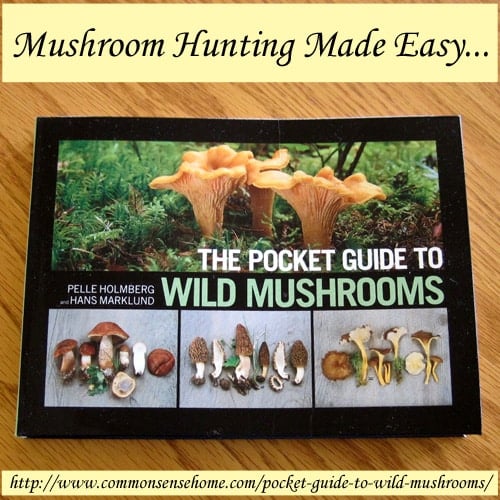
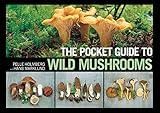
The Pocket Guide to Wild Mushrooms by Pella Holmberg and Hans Marklund is a great resource for any wild food forager.
While no book can take the place of an experienced guide, this pocket guide should provide you with the information you need to forage safely for mushroom varieties that are new to you.
Would you like to save this?
Fall is typically prime season for many mushroom varieties, so I am looking forward to taking this book out with me more later this year. I shared it with my neighbor last week, and if the weather cooperates this fall (you need rain for mushrooms, and it’s been a dry summer), we’re going to go investigating in their woods to see what we can find.
How The Pocket Guide to Wild Mushrooms is Organized
The book begins with an introduction and discussion of what exactly mushrooms are and where they are likely to be found. It then continues with a thorough explanation of proper picking, cleaning and preparation.
The authors also note that mushrooms contain fiber, important minerals, antioxidants and vitamins B and D in significant amounts. Not bad for a “free” food. This book focuses on varieties that are suitable for cooking (edible varieties), but also gives mention to potentially inedible look-alikes, if any.
Given that the authors hail from northern Europe, so too are the mushroom varieties featured in the book generally found in northern forests.
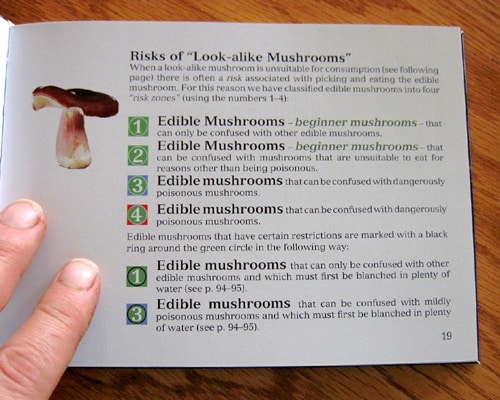
Each mushroom is categorized from 1 to 4, with 1 being the easiest to identify with only edible mushrooms that look similar, to 4 being those that are edible but could be confused with poisonous lookalikes.
You can stick with the #1 mushrooms (or beginner mushrooms) when you are just starting out and nervous about your identification skills.
In the interest of thoroughness, the authors also offer a detailed description of the potential symptoms of mushrooms poisoning. Stay safe, folks.
The bulk of the book is filled with two page spreads of52 edible mushrooms featuring detailed photos of the mushrooms in studio conditions, including cross sections, and photos of the mushroom in its natural habitat.
Each entry provides a description with distinguishing features, a guide to preparing and preserving, and a description and photo of look-alike mushrooms.
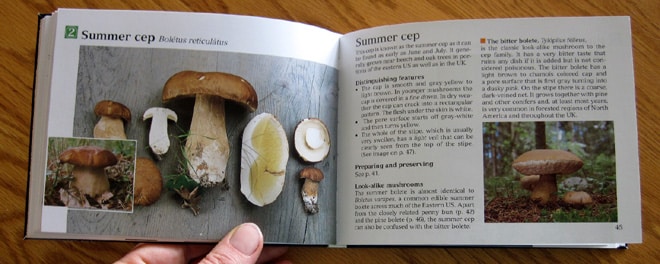
I particularly appreciate the extremely detailed photography with horizontal and vertical cross sections of the mushrooms. As anyone who has done any amount of foraging can tell you, good photos make or break a guide book. These qualify as good photos.
The Pocket Guide to Wild Mushrooms is a useful addition to the library of any northern wild food forager, and the photos are beautiful enough that it would make a good “coffee table book” as well.
This post originally included a giveaway, which has now ended.


Looks like it would be a beautiful addition ti a foragers library!
I was searching for a resource like this about a month ago but finally gave up. I’m trying to learn all the plants, trees and vegetation on our property. We have quite a few mushrooms that I’ve never seen. This looks like a good one! Hoping to win! 🙂
I haven’t tried the wild yet but with resources I sure will!
Lamb’s quarters is a very tasty iron rich wild plant, and I think it tastes better than spinach.
I grew up hunting Morels, we would do family outings in the woods with walkies-talkies, and everyone would have their favorite spot. I think this book would be a great way to add other mushrooms to my repertoire.
I grew up hunting for morels and now I’m trying to learn the other edibles, like the Chanterelles, black trumpets, chickens. So much to learn.
Looks like a very nice book. I love foraging for greens and berries but I haven’t put the time and effort into learning about mushrooms!
Looks like an awesome very detailed book……………..
look like an great book !!! hope i win 😉
Definitely and awesome thing to have. Although i do not forage for mushrooms yet I have been wanting to get into it since my husband is a mushroom lover. We definitely spend a lot of money buying them in a grocery store when they happen to be all around us.
This is what we did for foraging: http://wp.me/p3LdJc-9R Grape leaves, pine needles, and dandelion. I’ve wondered about mushrooms!
I’ve been wondering if there are any toxic lookalikes for lambsquarters?
I searched and came up with a reference to Nettleleaf goosefoot, which appears to potentially contain high levels of saponins, oxalic acid and nitrate compounds: http://www.ipm.ucdavis.edu/PMG/WEEDS/nettleleaf_goosefoot.html
Comments seemed to be mixed as to whether this would be dangerous or not.
http://www.pfaf.org/user/Plant.aspx?LatinName=Chenopodium+murale
This would come in handy. My BFF and myself love to forage, and she has aquired many books on mushrooms, but they are all so large and bulky.
I would love to try and identify some of the mushrooms that grow here. What a wonderful gift idea!
We are just starting out in foraging!!! We have a couple guides, but, this book would be awesome!!!
perfect addition to our go-bags!
I have never foraged for mushrooms for fear of picking the wrong ones. I’d hate to poison my entire family. This book would be enough to actually make me try it for once!!!
Really neat boom! Would love to win this!
Don’t have much experience with wild mushrooms. This guide would be super useful to help me get started.
I want to gather mushrooms but I need the info to do so