
The Nourished Kitchen Cookbook Review

This post may contain affiliate links. Read my full disclosure here.
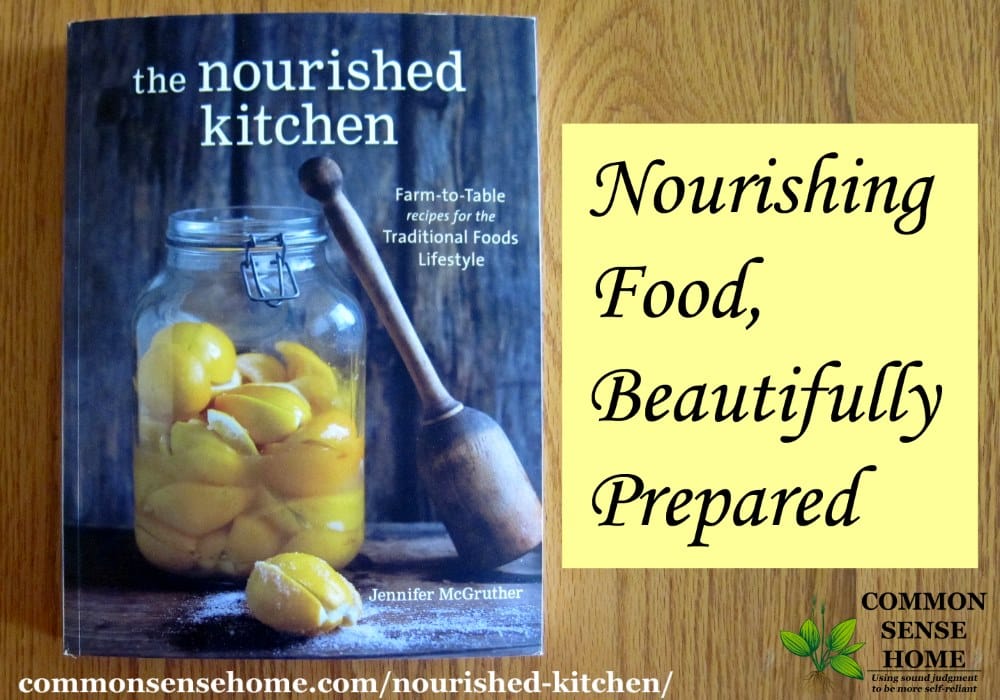
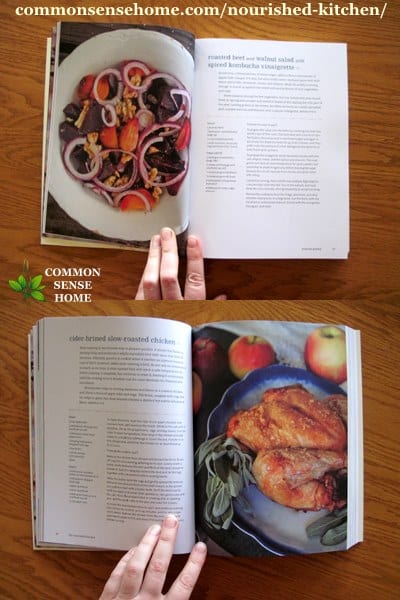
When we were running the family catering business, we often repeated the phrase, “The eyes eat first” – meaning that our food had to look good as well as taste good. “The Nourished Kitchen: Farm-to-Table recipes for the Traditional Foods Lifestyle” is a feast for the eyes as well as an inspiration to savor traditional recipes with a modern twist. I have the pleasure of receiving a review copy as we head into the perfect time to experiment with these farm to table options.
Would you like to save this?
The Nourished Kitchen cookbook is written by Jennifer McGruther of www.nourishedkitchen.com, an award winning traditional foods website. Her years of managing a farmers market and teaching traditional food preparation shine through in this beautiful new book.
What’s in the book?
The book is divided into eight chapters with 160 recipes, plus a glossary, resources, a listing of food advocacy groups and measurement conversion charts. The chapters include:
- From the garden, featuring salads and seasonal vegetables
- From the pasture, featuring milk, cream and eggs
- From the range, featuring pasture-raised chicken and poultry, grass-fed meats, pasture-raised pork, offal and bones
- From the water, featuring “finfish” – including roe, and shellfish
- From the fields, featuring flours, grains and beans
- From the wild, featuring wild fare from greens and mushrooms to pheasant and venison
- From the orchard, featuring fruit, nuts and honey
- From the larder, featuring fermentation and preserving in oil and vinegar
Recipes focus on seasonal cooking of locally available foods, and are based on the Weston A. Price traditional foods diet. You won’t find pre-packaged products assembled into “recipes”. This cooking starts with real food. Jenny offers detailed cooking instructions, and also provides insight into why and how the recipes were created. There are charts and gorgeous full colored photos sprinkled throughout the text.
At times “The Nourished Kitchen” reminds me of the work of Michael Pollan (The Omnivore’s Dilemma) and Barbara Kingsolver (Animal, Vegetable, Miracle: A Year of Food Life) in the way it examines the history and the ethics of food. It is more than just a recipe book – it tells a compelling story that makes you want to be a part of it. If you just want to cook great food from your garden or farm market finds, you can use it for that, too, but you’ll be missing out. 🙂
I have a large garden this year and am looking for recipes to make healthy and great tasting meals for my family. I would love to win this book!
I’ve had my eye on this! It is so beautiful and your review only makes me want it even more!
I would love this. I am hoping to work more seasonal meals into our menu this summer and I feel this would be a great start.
Seems like a very handy book to have on hand in the kitchen. Thanks.
would love to get this book
I don’t have any questions, but I would love to win this book!
I would really like to do more foraging but I’m a little nervous about actually eating the plants.
Your local cooperative extension office should have staff that can help you make a positive ID. There are also a growing number of foraging groups around the US.
Would love to have this book to help us get back.to the ways of the great generation my grandparents were a part of .
Would love to win the book. Can’t think of a question.
id love to find out how to use those preserved lemons!
Like a previous post I find it hard to find local food like meat and dairy that is affordable. I grow my own veggies and some fruit and we do raise some animals for meat.
This looks like a lovely book. I love the concept.
I’ve got the nourishing part down but i think my family would appreciate it if I got the beautiful part going to.
lol – I know what you mean!
We are trying to use more local produce both from our own yard and gardens and foraging and from others as we find more links and resources. I’d love to have a book like this!
Local eating is so hard in the mountains of Colorado. We can’t grow much in the garden. I’m a vegetarian, but I get farm fresh eggs as protein. How do you eat local and in season in such cold areas? We start our summer gardening at the beginning of June and we’ll lose everything by September due to very windy frosts. My cold weather crops were in the ground last fall and still aren’t ready for harvesting. The lettuce and spinach I can pick a few leaves from in a week or two, but produce is hard to grow here most of the year.
The book “Four Season Harvest” by Eliot Coleman is a great resource for keeping some sort of production coming from the garden even under very cold conditions.
Being Diabetic, one is always looking for recipes that are not involving processed foods, the more natural, the better. I would love to try some of these recipes. Virgina May 17th 10:40 pm
This would be a great book to have.
Should I be worried about purchasing wheat berries locally?
What do you mean by “worried”?
Also, how do I find and purchase good raw milk in a state where that is deemed illegal? I can occasionally obtain goat’s milk when I travel to a friend’s place a few towns away, but have never been able to find raw cow’s milk . . . and I really would like it for making raw kefir and cheeses.
Sometimes if you inquire in local real food circles, you can find someone who knows someone… “Incidental” sales are not typically prosecuted, it’s just when people make public what they are doing, the government hunts them down and punishes them. Sad, but true. Sometimes you can legally buy “milk for use by pets” or a cow share. The Real Mil Finder may be of help, but it didn’t do much for me – http://www.realmilk.com/real-milk-finder/
I want to know how to grow Cilantro so that I can continually harvest it daily for seasoning, salads etc.? The problem here in the desert is that it bolts (goes to seed) so quickly that we never have enough for our needs. Any ideas?
I know it doesn’t like the heat at all – wondering about shade cloth to block some sun, or creating a microclimate with other plants nearby to provide shade and extra water in the topsoil. I was just reading in “The Lost Language of Plants” about how various trees create whole ecosystems in the desert, creating oases of life where there was none. Maybe some of Geoff Lawton’s work would help? He has a site that discusses how he turned an area from desert to oasis in 4 years.